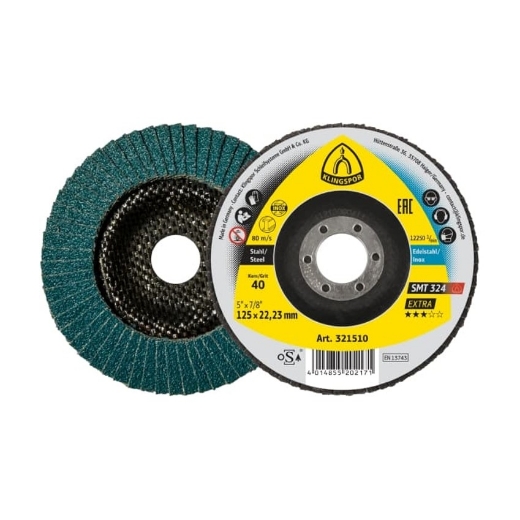
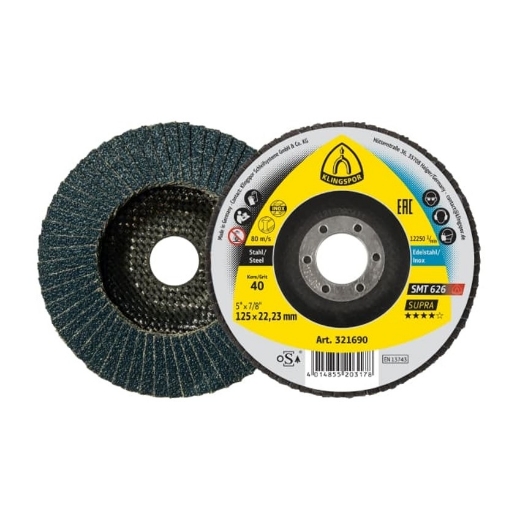
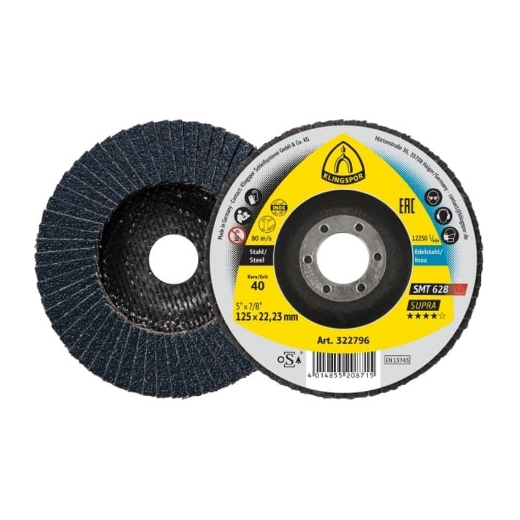
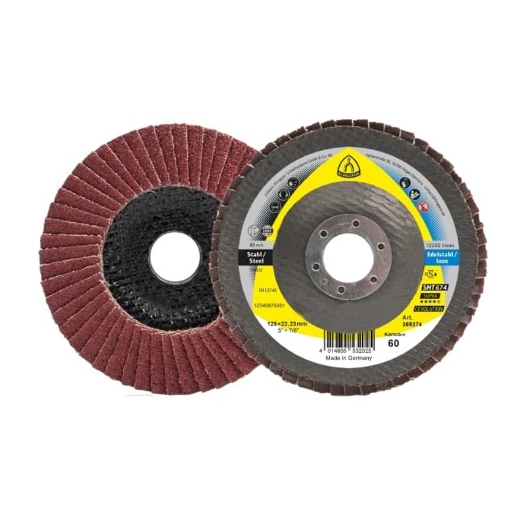
You choose a flap disc on three things: grit, shape and material match. For heavy stock removal and weld dressing you reach for a coarse disc, grit 24 or grit 40; for general deburring you move up to grit 60; for fine finishing on stainless you switch to grit 80 or a non-woven disc. A flat disc gives full-face contact on flat steel, while a convex (domed) disc follows contours and edges without digging in. Every disc in this guide fits a 22.23mm bore, in diameters from 125mm to 180mm.
Which flap disc do you actually need for your job? Browse the full range in our Klingspor flap disc collection, then follow the five steps below to land on the right one.
- Coarse grit (24-40) removes metal fast; fine grit (80 and up) finishes and blends without gouging.
- A flat disc suits flat, open surfaces; a convex disc suits edges, corners and contoured welds.
- Non-woven (schuurvlies) discs like the SMT 800 remove no material, they only produce a satin finish.
- Stainless steel needs a disc rated for stainless (or the dedicated SMT 850 combi) to avoid discolouration from overheating.
- Every disc here has a 22.23mm bore, so fit depends only on your angle grinder's diameter, 125mm or 180mm.
Quick overview: which flap disc for which job?
Match your task to the grit and shape in this table first, then read the steps below for the reasoning behind each choice. All discs listed come from the Klingspor flap disc range at DHZ-Proshop.
| Product | Grit | Shape | Material | Ideal for |
|---|---|---|---|---|
| SMT 925 Special, 180mm | 24 | Flat | Steel & stainless | Heaviest stock removal, weld dressing |
| SMT 626 Supra, 125mm | 40 | Convex | Steel & stainless | Fast grinding on edges and contours |
| SMT 628 Supra, 125mm | 40 | Flat | Steel & stainless | Heavy grinding on flat plate |
| SMT 674 Supra Cevolution, 180mm | 40 | Convex | Steel | Fast, long-life grinding on larger jobs |
| SMT 926 Special, 180mm | 40 | Convex | Steel & stainless | General-purpose grinding, larger surfaces |
| SMT 314 Extra, 180mm | 40 | Convex | Non-ferrous metal & steel | Aluminium, brass, copper |
| SMT 325 Extra, 125mm | 60 | Flat | Steel & stainless | General deburring and smoothing |
| SMT 324 Extra, 125mm | 80 | Convex | Steel & stainless | Fine finishing, blending welds |
| SMT 850 Plus Special combi, 125mm | 80 | Convex | Stainless steel | Fine finishing without discolouration |
| SMT 800 Special schuurvlies, 125mm | Very fine | Convex | Steel & stainless | Satin finish, no material removal |
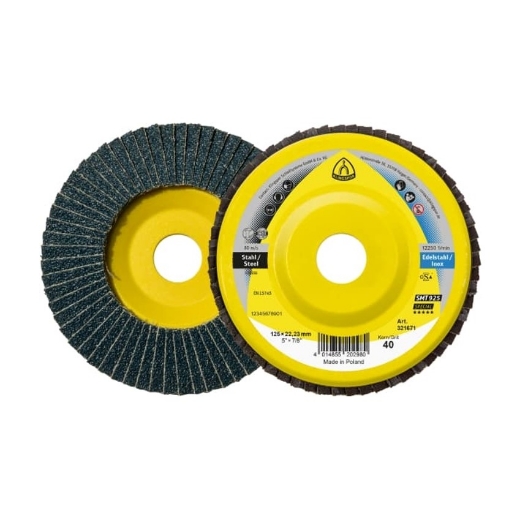
Heavy grinding & weld removal
Thick welds or heavy scale to remove fast? The grit 24 SMT 925 Special, flat and 180mm, clears material quicker than any finer disc.
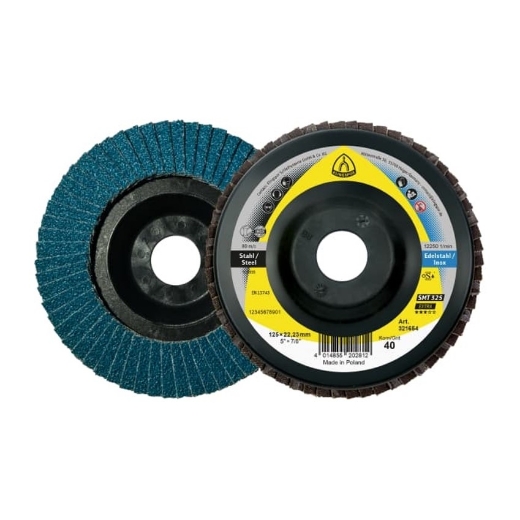
General deburring
Sharp edges and burrs after cutting? The grit 60 SMT 325 Extra is one of our most chosen discs for exactly this everyday job.
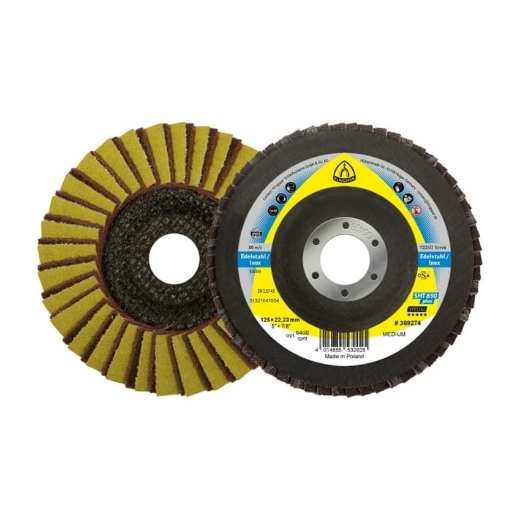
Fine finishing on stainless
Working stainless steel and want to avoid heat marks? The convex, grit 80 SMT 850 Plus Special combi is built specifically for that.
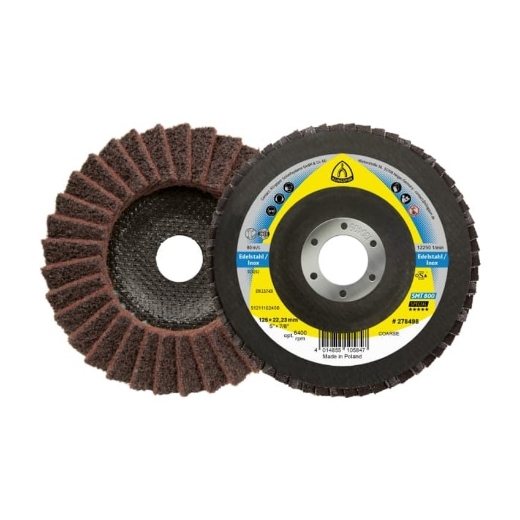
Satin finish, no removal
Need a decorative brushed look without taking off metal? The non-woven SMT 800 Special polishes rather than grinds.
Step 1: Define the job before you pick a disc
Ask yourself what you actually need to achieve: remove a lot of metal, smooth an edge, or produce a clean finish. These are three different jobs and each one uses a different flap disc. Grinding down a thick weld bead is not the same task as deburring a cut plate edge, and neither is the same as blending a weld into a stainless panel so it disappears.
Get this step wrong and everything downstream suffers. A coarse disc on a finishing job leaves deep scratches; a fine disc on heavy grinding wears out fast and barely touches the metal. Decide on the outcome first, then work through steps 2 to 4 to land on the exact product.
Step 2: Pick the grit size for your task
Grit size tells you how coarse or fine the abrasive flaps are, and it is the single biggest factor in how fast a disc cuts and how smooth the result looks. Lower numbers mean coarser abrasive and faster stock removal; higher numbers mean finer abrasive and a smoother finish. In this range that runs from grit 24 (the SMT 925 Special, our coarsest option) through grit 40 and grit 60 to grit 80 and a very fine non-woven disc for the SMT 800 Special.
Use grit 24 or grit 40 for heavy grinding: knocking down weld beads, removing rust or levelling uneven steel. Move to grit 60 once the bulk of the material is gone and you need to clean up edges and remove burrs, which is exactly where the SMT 325 Extra sits. Grit 80 is the finishing stage, useful for blending a weld into surrounding metal or prepping stainless before a brushed finish. The non-woven SMT 800 Special sits beyond that: it does not remove material at all, it only produces a satin surface.
Step 3: Choose flat or convex depending on the surface
A flat disc sits fully against a flat surface, giving even, controlled contact across the whole face. A convex (domed) disc is bent so the edge contacts the workpiece first, which makes it far better for edges, corners, tubes and contoured welds where a flat disc would only touch at one point.
Use flat discs like the SMT 325 Extra, SMT 628 Supra or SMT 925 Special on open, flat plate where you want a wide, even grinding path. Reach for convex discs such as the SMT 626 Supra, SMT 674 Supra Cevolution or SMT 926 Special when you are working a bevel, an inside corner, a round profile or any surface that is not perfectly flat. Most of the range leans convex because it handles a wider variety of real-world jobs.
In our Beerse showroom, tradesmen reach for a convex grit 40 disc whenever a weld seam needs to disappear fast, then switch to a grit 60 or grit 80 disc for the final pass.DHZ-Proshop vakteam, Beerse
Step 4: Match the disc to your material
Steel, stainless steel and non-ferrous metals do not behave the same way under a grinding disc, so material match matters as much as grit. Most discs in this range, including the SMT 325 Extra, SMT 626 Supra, SMT 628 Supra and SMT 926 Special, are rated for both steel and stainless steel. That covers the bulk of everyday grinding and deburring work.
Stainless steel deserves extra care because heat build-up causes discolouration and weakens corrosion resistance. The SMT 850 Plus Special combi is built specifically for stainless finishing work, giving a cooler cut at grit 80. If you are grinding aluminium, brass or copper, pick the SMT 314 Extra, which is rated for non-ferrous metal and steel rather than stainless. Using a disc outside its rated materials wastes flaps fast and can leave contamination on the metal.
Step 5: Mount the disc and run it at the right angle
Fit the disc onto a 22.23mm bore backing pad and check it spins freely before you start the grinder. Hold the disc at roughly 15 to 25 degrees to the surface for grinding and closer to 5 to 10 degrees for light deburring or finishing passes; a flatter angle spreads the load across more flaps and extends the life of the disc.
Let the disc do the work instead of pressing hard. Heavy pressure overheats the flaps, glazes the abrasive and slows down cutting rather than speeding it up. Move the disc steadily across the surface in overlapping passes, and switch to a finer grit as soon as the coarse marks are gone rather than trying to finish the job with the same disc you started with.
Common mistakes
- Starting too fine: a grit 80 disc on a thick weld bead removes almost nothing and burns out quickly. Start coarse, then step up in grit.
- Using a flat disc on a contour: a flat disc only contacts a curved surface at one point, which grinds unevenly. Switch to a convex disc for edges, tubes and bevels.
- Grinding stainless like mild steel: too much pressure or the wrong grit overheats stainless and leaves it discoloured. Use a stainless-rated disc such as the SMT 850 combi and keep pressure light.
- Pressing hard instead of letting the disc cut: excess pressure glazes the flaps and shortens the working life of the disc rather than speeding up the job.
Browse the complete selection in our flap disc collection at DHZ-Proshop.
Frequently asked questions about flap discs
Which flap disc should I use for metal?
What does flap disc grit mean?
What is the highest grit flap disc available, and what is it used for?
Which grit flap disc is used for sharpening mower blades?
How long does a flap disc last?
What is the difference between a grit 80 flap disc and a coarser grit 40 disc?
Compiled by the trade team of DHZ-Proshop, your DIY and trade supplier with a shop and pickup point in Beerse. What we advise most often in the shop is to start one grit coarser than you think you need, then work your way finer rather than the other way around. Questions about matching a flap disc to your job? Contact our team or browse the full Klingspor flap disc collection.