Pick the blade by what you are cutting, not by the brand. For clean cuts in wood and OSB use an HCS plunge blade; for wood with hidden nails or screws use a bi-metal (BiM 8% Co) blade; for metal the same bi-metal teeth cut steel and sheet; for drywall and plasterboard a fine HCS or bi-metal blade works; and for tile, grout and stone you need a carbide-grit or diamond blade with no teeth. Cut width matters: a 44 mm bi-metal blade clears a wider slot fast, while a 28 mm blade reaches tight corners. The wrong blade overheats, dulls in seconds or shatters your tile.
Which blade fits your job and your tool? Browse the multi-tool blade range at DHZ-Proshop, with Starlock and universal fittings for wood, metal, drywall, tile and more.
- HCS blades cut wood, OSB and plastic; bi-metal (BiM 8% Co) blades cut wood with nails and metal.
- Tile, grout and stone need a toothless carbide-grit or diamond blade, never a saw-tooth blade.
- Cut width decides reach: 28 mm for tight spots, 44 mm for fast straight slots.
- Match the fitting: Starlock is the standard here; universal type 1 fits older spindles.
- For drywall and plasterboard a fine wood or wood-and-metal blade gives the cleanest opening.
Which multi-tool blade for which material?
Match the material to the blade type and its cut width. The table below is built from our real CMT Starlock and universal blades, so you can pick straight from stock in the multi-tool range.
| Blade | Type / fitting | Cut width | Best for |
|---|---|---|---|
| OMF160 wood + nails & fibreglass | BiM 8% Co / Starlock | 35 mm (31–40) | Wood with hidden fasteners |
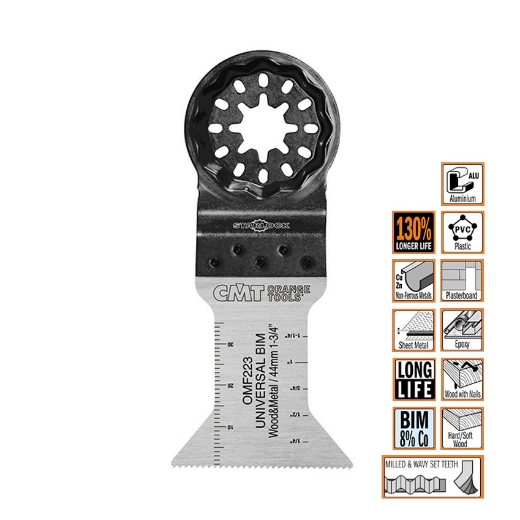
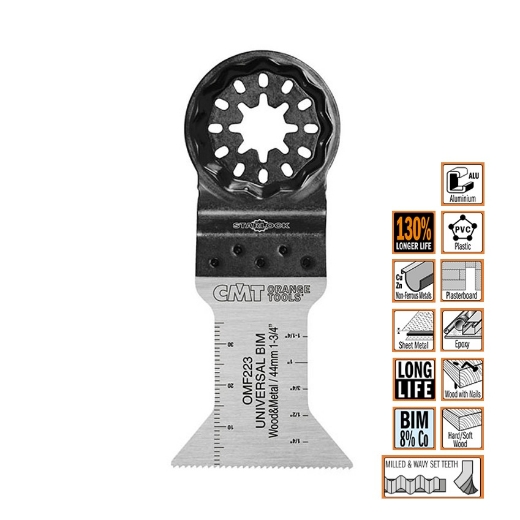
| OMF223 wood & metal | BiM 8% Co / Starlock | 44 mm (41–50) | Mixed wood and metal, wide slots |
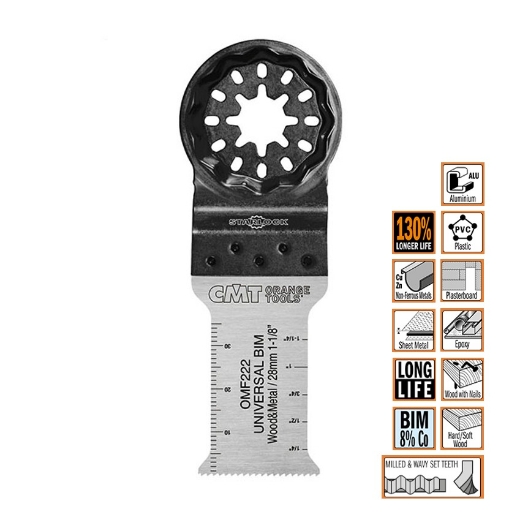
| OMF222 wood & metal | BiM 8% Co / Starlock | 28 mm (21–30) | Tight corners, narrow cuts |
| OMF133 wood & OSB | HCS / Starlock | 35 mm (31–40) | Clean fast cuts in nail-free wood |
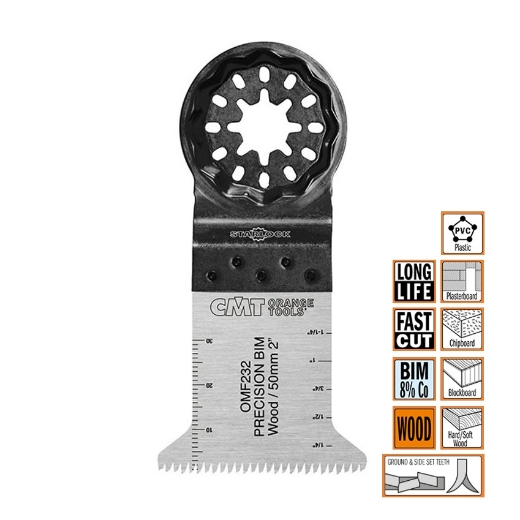
| OMF232 Japanese tooth | BiM 8% Co / Starlock | 45 mm (41–50) | Hardwood and plastic, smooth finish |
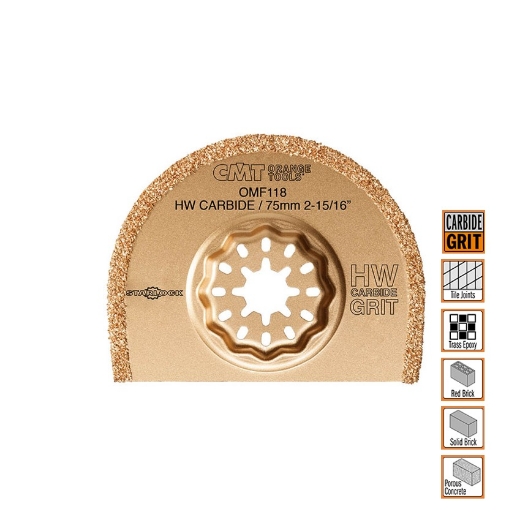
| OMF118 carbide-grit disc | HW-grit / Starlock | 75 mm (71–100) | Tile, grout and stone |
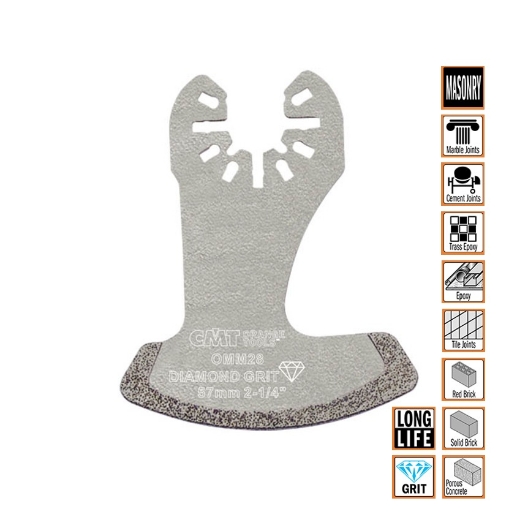
| OMM28 diamond-coated | DP-grit / Universal type 1 | 57 mm (51–70) | Hard tile, ceramics, grout joints |
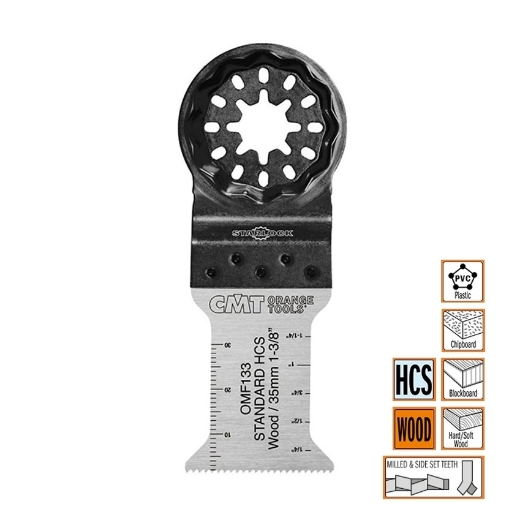
Clean wood & OSB
Skirting, plywood or OSB with no fasteners? The HCS plunge blade cuts fast and clean at a 35 mm width.
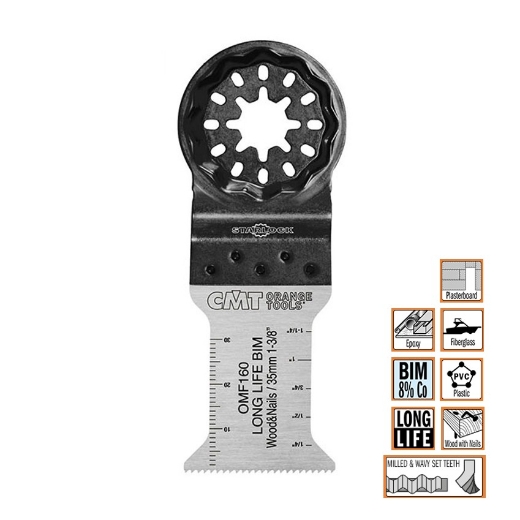
Wood with nails & metal
Old frames, embedded screws or sheet metal? A bi-metal blade powers through wood and fasteners alike.
Tile, grout & stone
Removing grout or cutting tile? Use a toothless carbide-grit or diamond blade, never saw teeth.
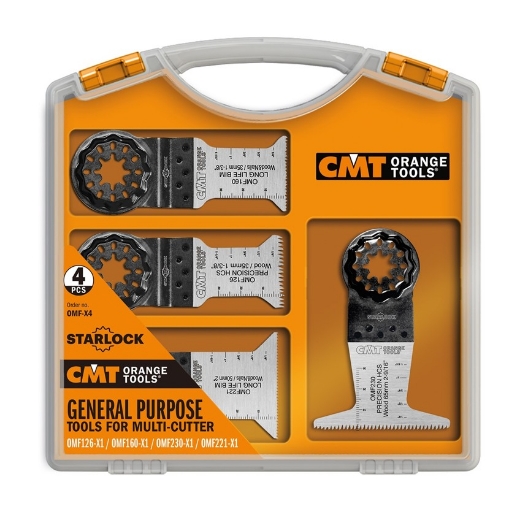
Starter set
Not sure where to start? A mixed Starlock set covers wood, metal and more in one box.
Start with the fitting and the material
Check the fitting before the material, because a blade that does not clamp is useless. Most modern oscillating tools use the Starlock system, which clamps the blade three-dimensionally and lets you change without tools. Our CMT wood, metal and grit blades are nearly all Starlock; a few, like the OMM28 diamond blade, use the Universal type 1 fitting for older spindles.
Once the fitting matches, choose by material. Wood and OSB want HCS teeth, wood with nails and metal want bi-metal (BiM) teeth, and tile or stone wants a toothless grit edge. Get this wrong and you feel it instantly: an HCS wood blade hitting a screw loses its teeth, while a saw blade pressed into tile just smokes and shatters the glaze.
Wood and OSB: the HCS plunge blade
For nail-free wood, plywood, MDF and OSB use an HCS plunge blade such as the OMF133 at a 35 mm cut width. HCS (high carbon steel) teeth stay sharp in soft and engineered wood and give a fast, clean plunge cut, ideal for cutting out a section of floorboard or trimming a door jamb. The 35 mm width balances speed against control in tight spaces.
Keep the tool moving and let the teeth clear the chips; forcing the blade only generates heat and slows the cut. For hardwood or a smoother finish, step up to the OMF232 Japanese-tooth blade at 45 mm, whose finer geometry leaves a cleaner edge in hardwood and plastic.
Wood with nails and metal: the bi-metal blade
For wood that hides nails or screws, and for cutting metal itself, use a bi-metal (BiM 8% Co) blade. The OMF160 (35 mm) is built for wood with nails and even fibreglass, while the OMF223 (44 mm) and the narrow OMF222 (28 mm) handle mixed wood and metal. The 8% cobalt content lets the teeth survive contact with steel that would strip an HCS blade in seconds.
Choose the width by the job. The 44 mm OMF223 clears a wide, fast slot for cutting through a doorframe with embedded screws, while the 28 mm OMF222 reaches into corners and pipe recesses where a wide blade will not fit. For sheet metal, light bar or nails, the bi-metal teeth are the safe choice across the board.
In our Beerse shop we tell renovators the same thing every week: if there is any chance of a hidden nail, fit the bi-metal OMF160 and stop guessing.DHZ-Proshop vakteam, Beerse
Drywall, plasterboard and plaster: a fine blade
For drywall, plasterboard and soft plaster, use a fine-tooth wood or wood-and-metal plunge blade. A bi-metal blade like the OMF223 (44 mm) cuts plasterboard cleanly and tolerates the occasional screw or corner bead, while an HCS wood blade handles plaster alone. The key is a controlled plunge, since plasterboard is soft and easy to overcut.
Plasterboard contains screws, corner protectors and sometimes fixings, so a bi-metal edge is the safer pick when you are cutting an opening for a socket or pipe. Work in short controlled passes and let the blade do the cutting; pushing hard tears the paper face and leaves a ragged edge that is harder to fill.
Tile, grout and stone: carbide-grit or diamond
For tile, grout joints and stone, never use a toothed blade: you need a toothless carbide-grit or diamond edge. The OMF118 carbide-grit disc (75 mm) grinds through stone and ceramic, the OMM28 diamond-coated blade (57 mm) handles hard tile and porcelain, and the OMF002 carbide-grit rasp (33 mm) is shaped for raking out grout. These abrade rather than saw, so they survive material that would destroy a saw blade.
For raking out old grout before re-pointing, the narrow OMF002 rasp follows the joint precisely. For cutting a notch in a fitted tile, the diamond OMM28 or the larger OMF118 disc gives a controlled line. Keep moving and avoid heavy pressure: grit and diamond edges work by abrasion, and forcing them only generates heat and chips the glaze.
Carpet, leather, sealant and tight detail work
For soft materials there are dedicated knife-style attachments rather than saw blades. The OMF251 multi-knife (41 mm) has three cutting edges for leather and carpet, while the OMF201 bevelled blade (16 mm cut width) slices through sealant, foam and other soft materials in tight spots. Both use the Starlock fitting and rely on a slicing action, not teeth.
Need a round blade for mixed soft materials? The OMF113 round HCS blade (85 mm) covers wood and plastic over a wide arc. For a ready selection across materials, the OMF-X4 Starlock set or the OMM-X4 universal set gives you several blade types to start with.
Common mistakes
- HCS blade into a hidden nail: high carbon steel teeth strip the instant they meet a screw. If there is any metal risk, fit a bi-metal blade.
- Saw blade on tile or grout: toothed blades shatter glaze and overheat. Tile, stone and grout need a carbide-grit or diamond edge only.
- Wrong fitting: a Starlock blade will not clamp safely on a universal-type spindle and vice versa. Check the fitting before you buy.
- Forcing the cut: heavy pressure overheats the blade and slows the cut. Let the oscillation do the work and keep the blade moving.
See the full selection in our multi-tool blade range or find all your tools and building materials in Belgium at the DHZ-Proshop webshop.
Frequently asked questions about multi-tool blades
Which multi-tool blade for wood?
Which multi-tool blade for metal?
Which multi-tool blade for drywall or plasterboard?
Which oscillating blade for tile or grout?
Which blade for plastic?
What is the difference between Starlock and universal type 1 blades?
Compiled by the DHZ-Proshop vakteam, your DIY and trade supplier with a shop and pickup point in Beerse. What we recommend most in the shop is simple: if there is any chance of a hidden nail, choose a bi-metal blade like the OMF160, and for tile or grout always reach for a carbide-grit or diamond edge. Questions about the right blade for your material? Contact our team or browse the full multi-tool blade range.