Choose a jigsaw blade by material first, then tooth pitch (TPI), length and tooth set. For fast cuts in wood use a coarse HCS blade with 8 TPI (cutting depth up to 60 mm); for clean finishes use a fine 10 TPI HCS blade. For metal pick a short HSS blade with 21 TPI (1-3 mm material). For laminate a bi-metal blade with reverse-friendly geometry stops chipping. Nearly all modern jigsaws take a T-shank, which clicks in without tools and is the standard at DHZ-Proshop.
Which jigsaw blade do you actually need? The jigsaw and reciprocating blade range at DHZ-Proshop covers wood, metal, plastic, laminate and even cement board. This step-by-step guide gets you to the right one fast.
- T-shank is the universal fit; almost every cordless and corded jigsaw accepts it tool-free.
- Fewer teeth (lower TPI) = faster, rougher; more teeth (higher TPI) = slower, cleaner.
- For wood, an 8 TPI coarse HCS blade cuts up to 60 mm deep; a 10 TPI HCS blade gives a clean edge.
- For metal, use a short HSS blade with 21 TPI rated for 1-3 mm sheet.
- For laminate and chip-free work, choose a bi-metal blade with fine 10-15 TPI variable teeth.
Which jigsaw blade for which material?
Match the material to the blade first, then check TPI and length. The table below pairs each common job with a real CMT blade from our jigsaw blade range.
| Blade | Material | Key spec | Best for |
|---|---|---|---|
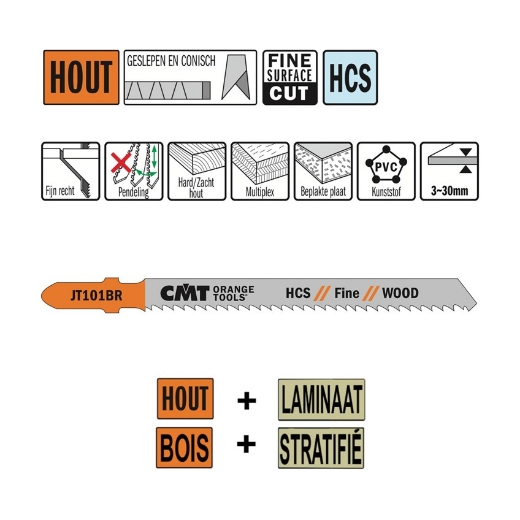
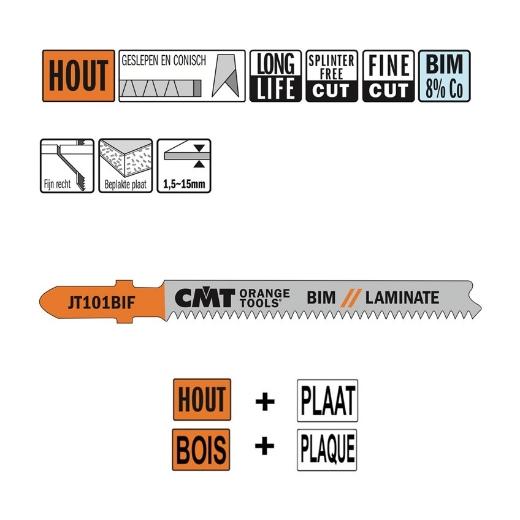
| CMT JT101BR fine straight (HCS) | Wood | L=100 mm, 10 TPI, cut 3-30 mm | Clean straight cuts in board and plank |
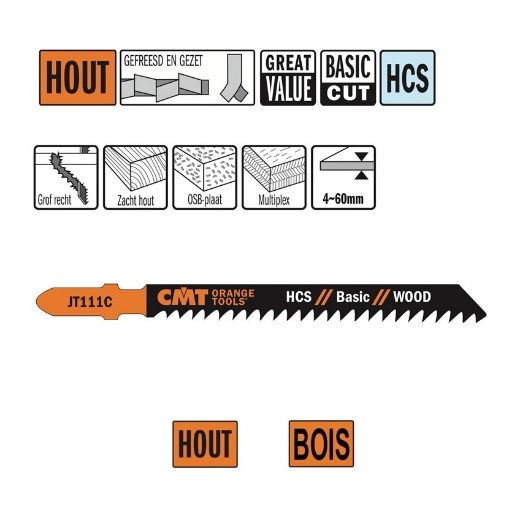
| CMT JT111C coarse straight (HCS) | Wood | L=100 mm, 8 TPI, cut 4-60 mm | Fast cuts in thick timber |
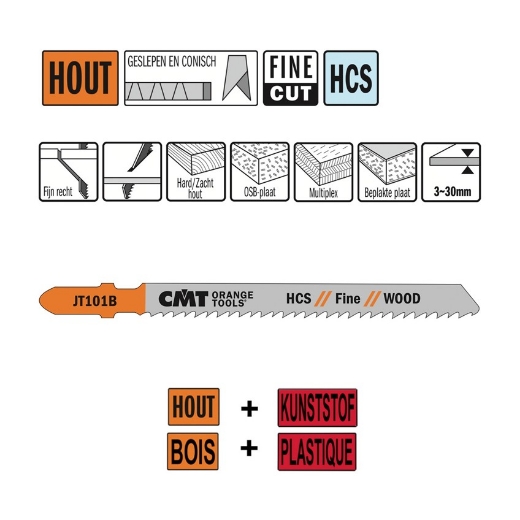
| CMT JT101B fine straight (HCS) | Wood & plastic | L=100 mm, 10 TPI, cut 3-30 mm | uPVC, plywood, soft plastics |
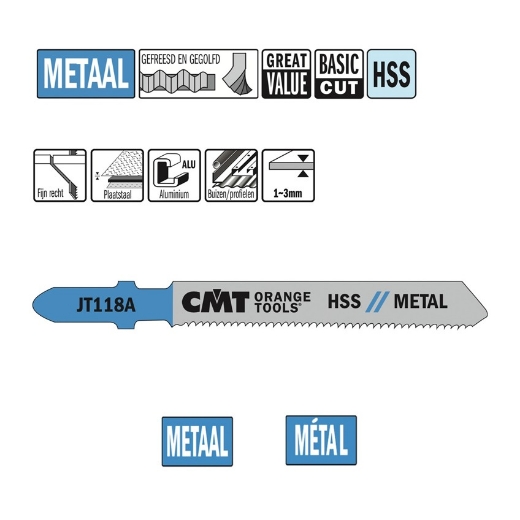
| CMT JT118A fine straight (HSS) | Metal | L=76 mm, 21 TPI, 1-3 mm | Sheet metal, profiles, tube |
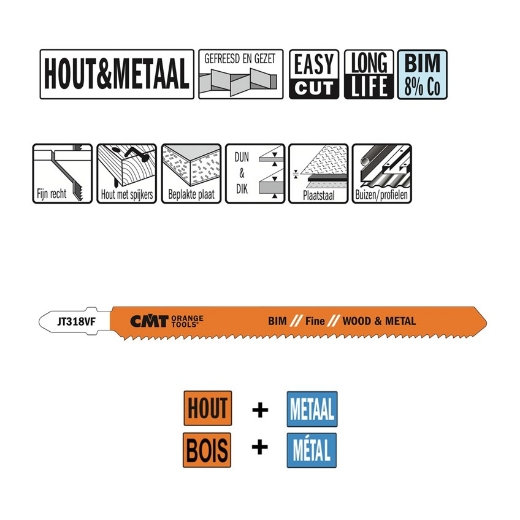
| CMT JT318VF fine straight (Bi-metal) | Laminate / wood & metal | L=132 mm, 10-15 TPI, Bim 8% Co | Chip-free laminate, mixed material |
| CMT JT341HM coarse straight (HM) | Cement board, plasterboard | L=132 mm, 6 TPI, carbide tipped | Fibre cement, concrete, gypsum |
Wood & board
Plank, plywood or MDF? An HCS blade with 8-10 TPI gives the right balance of speed and a clean edge, with cuts up to 60 mm deep.
Metal
Sheet steel, tube or profile? A short HSS blade with 21 TPI keeps several teeth in the cut at once, so it bites without snagging.
Laminate
Worktop or laminate floor? A bi-metal blade with 10-15 variable TPI cuts both faces clean and resists chipping on the visible side.

Cement board
Fibre cement, plasterboard or thin concrete? A carbide-tipped (HM) blade with 6 TPI handles abrasive material that destroys steel teeth.
Step 1: Check the shank (T-shank is standard)
First confirm your jigsaw takes a T-shank blade, because that is the fit nearly every modern jigsaw uses. The T-shaped tang clicks into a tool-free quick-release clamp and locks securely, which is why every CMT blade in our range is a T-shank. Older or hobby machines sometimes use a U-shank with a screw clamp; check your manual before buying.
If your saw is a Stanley with the dedicated U-shank fitting, use the matching Stanley jigsaw blades. Get the shank wrong and the blade simply will not seat. With the shank settled, the rest of the choice is purely about the material.
Step 2: Start from the material, not the blade name
The material decides everything: tooth shape, tooth set, blade steel and TPI. HCS (high-carbon steel) blades are flexible and ideal for wood and soft plastics. HSS (high-speed steel) is harder and made for metal. Bi-metal blades combine an HSS edge on a springy HCS body, so they cut wood, metal and laminate without snapping. HM (carbide) is for abrasive board like fibre cement.
Match the wrong blade to the material and you feel it instantly: an HCS wood blade goes blunt in seconds on steel, while a 21 TPI metal blade clogs and burns when forced through thick timber. For uPVC doors and soft plastics, the wood-and-plastic JT101B with 10 TPI cuts clean without melting the edge, provided you keep the speed moderate.
In our Beerse shop, the CMT JT101BR fine wood blade is one of the first things we hand over: it suits the everyday plywood, MDF and plank work that most DIYers and fitters bring in.DHZ-Proshop vakteam, Beerse
Step 3: Set the TPI to the job
TPI (teeth per inch) controls speed versus finish: fewer teeth cut faster but rougher, more teeth cut slower but cleaner. For thick timber, the coarse CMT JT111C with 8 TPI rips through stock up to 60 mm deep. For tidy edges in board, the fine JT101BR with 10 TPI leaves much less tear-out.
Thin materials need high TPI. Metal demands at least three teeth in the cut at all times, so the metal blade JT118A runs 21 TPI and is rated for 1-3 mm sheet. Laminate sits in between: the bi-metal JT318VF uses a variable 10-15 TPI tooth pitch that stays smooth across hard surface layers.
Step 4: Match the blade length to the thickness
Pick a blade long enough that the teeth pass fully through the workpiece on each downstroke. The usable cutting length matters more than the total length: the JT101BR runs L=100 mm with a 75 mm cutting section (I=75 mm), so it clears stock comfortably up to that depth. For deeper cuts in beams, the coarse JT111C handles material up to 60 mm.
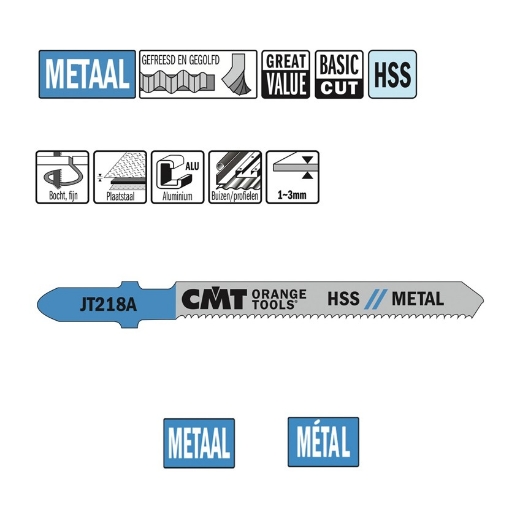
For thin work, shorter is better. The metal blade JT118A is only L=76 mm with a 50 mm cutting length, which keeps it rigid and accurate in sheet. For curved cuts in metal, the JT218A curved blade (also 21 TPI, 1-3 mm) flexes through tight radii without wandering. A blade that is too long whips and bevels the cut; too short and it bottoms out before clearing the material.
Step 5: Choose the tooth set for the finish you want
Tooth set and geometry decide how clean the visible face stays. Standard side-set teeth clear sawdust fast but leave a rougher edge, so use them where the cut is hidden. For visible work and chip-sensitive surfaces, a ground or bi-metal blade with finer teeth gives a crisp line. The bi-metal JT318VF (Bim 8% Co) is built exactly for that on laminate and worktops.
For a near-perfect top face on laminate flooring, keep the speed moderate, cut from the back where you can, and let the fine teeth do the work without forcing. When you need a curve rather than a straight line in board, swap to a narrower blade so it tracks the radius. For abrasive fibre cement or plasterboard, the carbide JT341HM at 6 TPI lasts where steel teeth would round off in a single sheet.
Common mistakes
- Using a wood blade on metal: HCS teeth blunt within seconds on steel. Switch to an HSS blade like the JT118A with 21 TPI for any metal.
- Too few teeth on thin material: a coarse blade hooks and chips thin sheet or plastic. Keep at least three teeth in the cut at all times.
- Forcing the blade: pushing too hard overheats the teeth and bends the blade, giving a bevelled cut. Let the blade set the pace.
- Wrong shank for the saw: a U-shank blade will not seat in a T-shank clamp. Confirm your machine's fitting before buying.
Browse the full selection in our jigsaw blade range or find all your tools and building materials in Belgium at DHZ-Proshop.
Frequently asked questions about jigsaw blades
How do I know which jigsaw blade to use?
Which jigsaw blade for plywood and MDF?
Which jigsaw blade for laminate or laminate flooring?
Which jigsaw blade for metal or a uPVC door?
What is the difference between HCS, HSS and bi-metal blades?
Do all jigsaws use the same blade fitting?
Compiled by the DHZ-Proshop vakteam, your do-it-yourself and trade supplier with a shop and collection point in Beerse. What we most often advise across the counter: confirm the T-shank, match the blade steel to the material, then set TPI to thickness, and a CMT JT101BR or JT118A covers most everyday wood and metal work. Questions about the right blade for your job? Contact our team or browse the full jigsaw blade range.