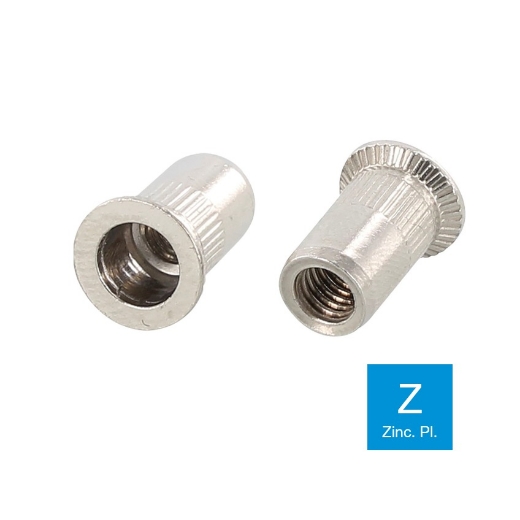
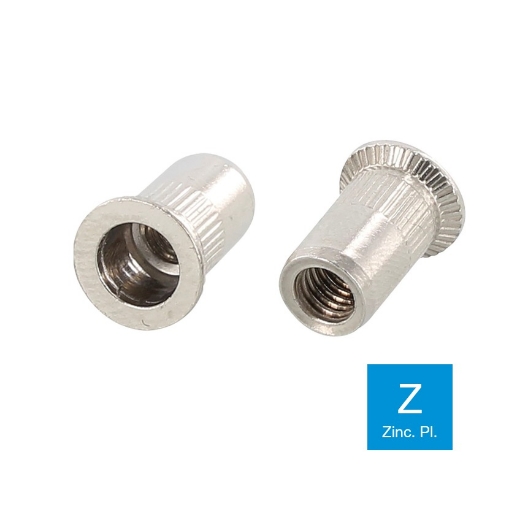
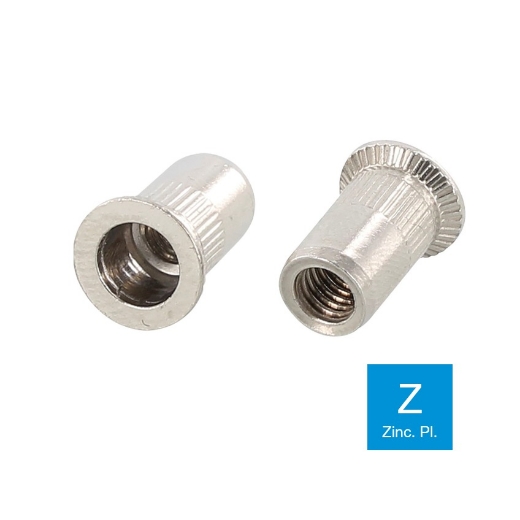
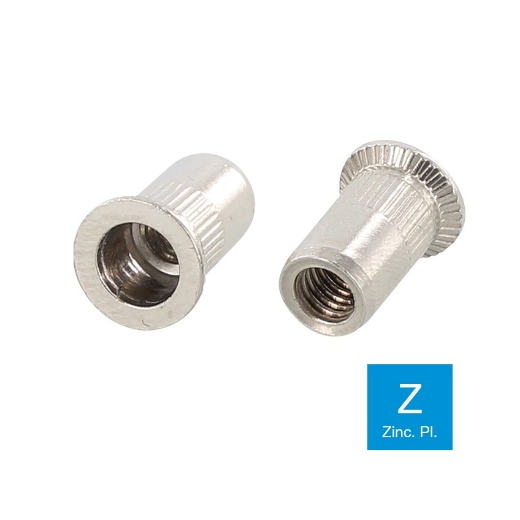
A rivet nut (rivnut) puts a full metric thread into thin sheet metal you can only reach from one side: drill, insert the nut, set it with the tool and the bolt screws straight in. Pick the size from the bolt you want to fit (M4 to M10 are the common sizes) and check the grip range: a standard nut clamps sheet from 0.5 to 3.0 mm thick, with versions up to 6.0 mm for heavier work. Zinc-plated steel is the standard, aluminium is the pick on aluminium sheet and stainless A2 for outdoors. The knurling on the body locks the nut against spinning.
Which rivet nut suits your sheet metal? Browse the full range in our rivet nuts category.
- A rivet nut creates metric thread in sheet metal that is too thin to tap a thread into.
- Pick the size from the bolt (M4-M10) and check the grip range: 0.5-3.0 mm sheet thickness as standard.
- Zinc-plated steel indoors, stainless A2 outdoors, aluminium on aluminium sheet (prevents galvanic corrosion).
- The drill hole equals the body diameter of the nut; the exact drill size is on every product page.
- Set the nut square in one smooth stroke; a crooked nut will spin later.
Which rivet nut for which job?
The table puts the most chosen rivet nuts from our range side by side, from the universal zinc-plated nut to stainless and aluminium versions.
| Product | Material | Key spec | Ideal for |
|---|---|---|---|
| Rivet nut M6 zinc-plated | Zinc-plated steel | M6, knurled body | The all-round size for indoor work |
| Rivet nut M8 zinc-plated | Zinc-plated steel | M8, knurled body | Heavier connections in profiles |
| Rivet nut M4 zinc-plated | Zinc-plated steel | M4, knurled body | Fine sheet metal and enclosures |
| Qonnect Q-Nut steel M8 (grip 3.0-6.0 mm) | Steel | M8, grip range 3.0-6.0 mm | Thicker sheet and tubular profiles |
| Qonnect Q-Nut stainless A2 M5 | Stainless A2 | M5, grip range 0.5-3.0 mm | Outdoor use and damp rooms |
| Qonnect Q-Nut alu M5 | Aluminium | M5, grip range 0.5-3.0 mm | Aluminium sheet (no galvanic corrosion) |
The zinc-plated M6 is the nut that leaves our shelves the most: strong, universal and a match for every standard bolt.
Stainless A2 does not rust and keeps the joint tight outside, from gate hinge to solar panel frame.
An aluminium nut on aluminium sheet prevents galvanic corrosion between two different metals.
A hand tool sets M3 to M6; for larger sizes or series work you step up to a pneumatic tool.
How do you install a rivet nut in 5 steps?
Setting takes under a minute per nut once the preparation is right. Work through the steps in order.
- Pick the size and material. The size follows from the bolt you want to fit; the material from the environment. Check on the product page that your sheet thickness falls inside the grip range; for a standard M5 that is 0.5 to 3.0 mm.
- Drill the hole and deburr. The hole equals the body diameter of the nut; you find the exact drill size on every product page. Deburr so the flange sits flat on the sheet.
- Thread the nut onto the mandrel of the tool. Take the mandrel and nosepiece of the same size as the nut and wind the nut on fully, up against the nosepiece.
- Insert the nut square into the hole and set it. Hold the tool perpendicular to the sheet and squeeze in one smooth stroke. The body collapses and clamps the sheet between flange and bulge.
- Wind out the mandrel and check. Unscrew the mandrel, check that the nut is tight (it does not spin) and fit the bolt.
Which size and which material do you pick?
The size picks itself: it equals the bolt that goes in. M4 and M5 are for enclosures and fine sheet metal, the M6 is the all-rounder for furniture, racking and machine covers, and the M8 and M10 carry the heavier connections in profiles and frames.
The material follows the environment. Zinc-plated steel is the standard for dry indoor work. For outdoors, damp rooms and trailers you take stainless A2, such as the PGB rivet nut M6 stainless A2. On aluminium sheet an aluminium nut belongs, such as the PGB M4 in aluminium: two equal metals rule out galvanic corrosion.
Check the grip range last. If your sheet thickness falls outside it, the nut either does not clamp or deforms the sheet. For thicker work there is an adapted range, such as the Qonnect Q-Nut M8 with a grip range of 3.0 to 6.0 mm.
In our shop in Beerse the zinc-plated M6 is one of our most chosen rivet nuts; anyone coming in for a trailer or outdoor job leaves with the stainless A2 version, every time.DHZ-Proshop expert team, Beerse
Which tool do you need?
For the small sizes a hand tool is enough: the one-hand tool from PGB sets M3 to M6 and fits in any toolbox. If you set nuts regularly or work in M8 to M12, the pneumatic rivet nut tool M3-M12 works faster and with constant setting force: every nut gets exactly the same collapse.
Always work with the mandrel and nosepiece of the correct size. A mandrel that is too small pulls crooked and damages the thread before the first bolt ever goes in.
Common mistakes with rivet nuts
- Sheet thickness outside the grip range: too thick and the nut does not clamp, too thin and the bulge squeezes the sheet out of shape. Check the range on the product page.
- Drilled too big: in an oversized hole the nut spins as soon as you tighten the bolt. Drill exactly to the body diameter.
- Set crooked: a nut that is not square sits with a lifted flange and starts working loose. Hold the tool perpendicular to the sheet.
- Steel on aluminium: a steel nut in aluminium sheet causes galvanic corrosion over time. Take the aluminium version.
Frequently asked questions about rivet nuts
Can I install a rivet nut without a tool?
How big do I drill the hole?
What does the grip range mean?
Which material do I pick: steel, stainless or aluminium?
Why does my rivet nut spin?
Which version do I use for thicker sheet in M8?
Need advice on your choice?
Compiled by the expert team of DHZ-Proshop, your DIY and trade supplier with a shop and pickup point in Beerse. What we advise most in the shop: take the nut, the matching drill and the tool in one go, then the sizing is right first time. Unsure about size or material? Get in touch or browse the full range of rivet nuts.