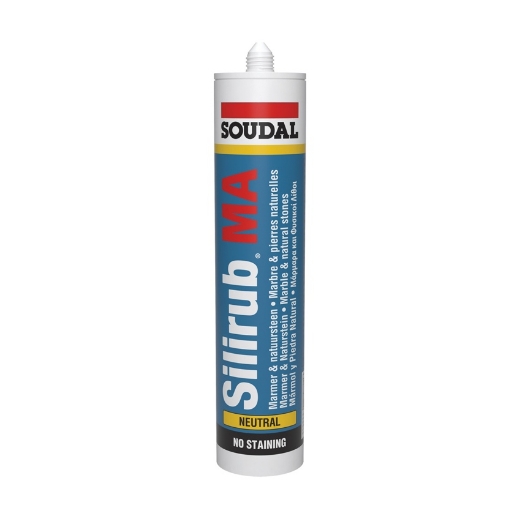
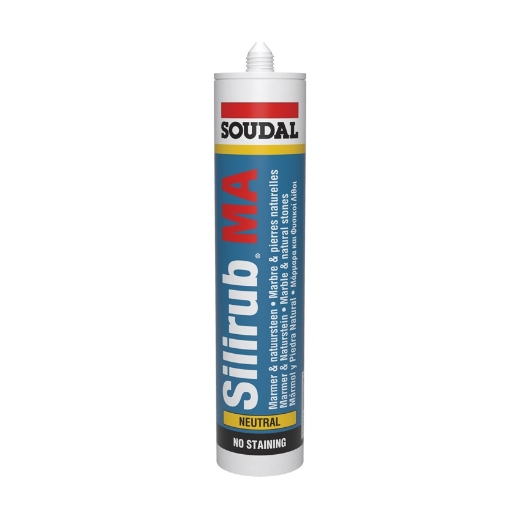
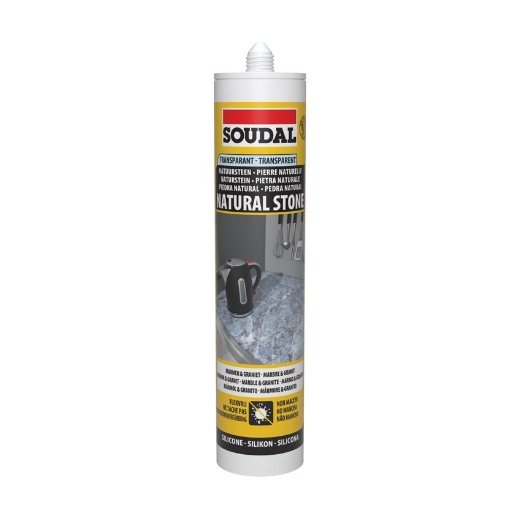
Sealing on natural stone, marble or composite? Use the wrong sealant and the joint will bleed into the stone, causing that permanent edge-zone staining that can no longer be removed. Below you will quickly find the right Soudal sealant per application, followed by everything you need to know about the why.
Which sealant do you use on natural stone?, quick selection per application
View the full Soudal joint sealant range in our webshop, filter on "natural stone" for all suitable products.
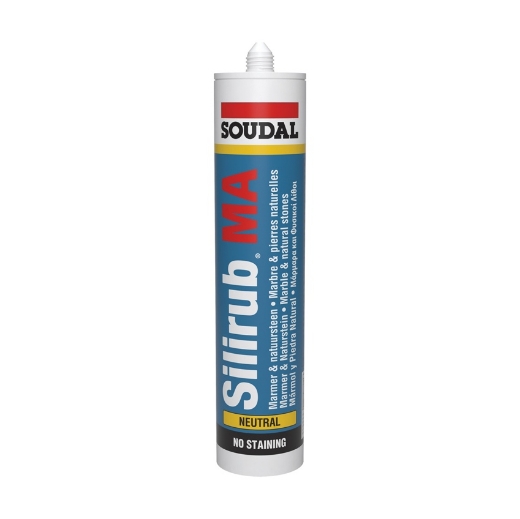
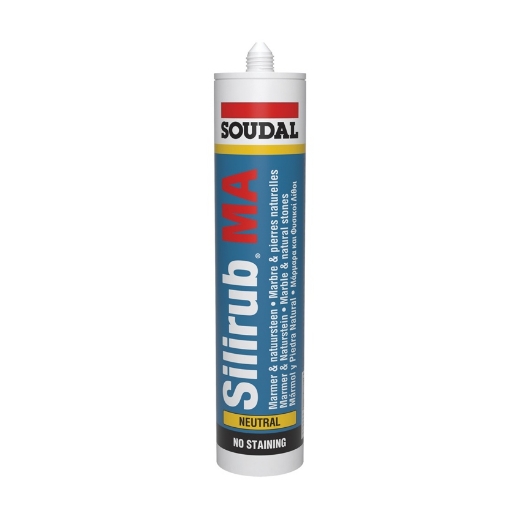
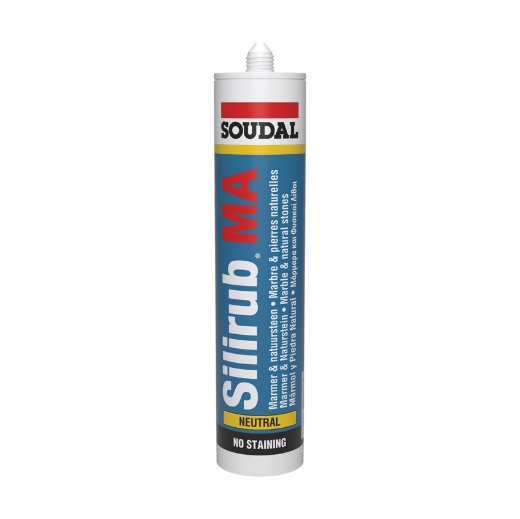
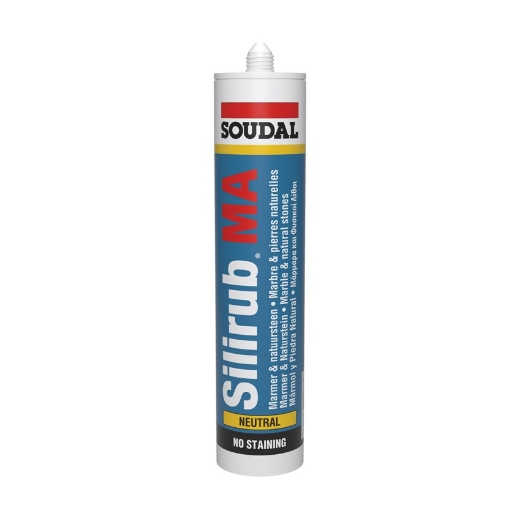
Bathroom & shower on natural stone → Silirub MA or S8800
For joints in showers, baths or bathroom floors on marble, granite or slate. Both sealants are neutral silicone sealants without migrating plasticisers, they cause no edge-zone staining. Silirub MA for standard sanitary applications, Silirub+ S8800 for higher demands on mould resistance and durability.
Worktop & kitchen on composite → Soudaseal 215 LM+
For connection joints around worktops, sinks and kitchen splashbacks of composite or natural stone. Soudaseal 215 LM+ is a hybrid polymer sealant without hydrophobic migration effects: it leaves no stains, stays elastic and is overpaintable with water-based paint. Fix All Flexi (colour variant) is also suitable for jointing where elasticity and colour fastness matter.
Outdoors: window sills & façades → Soudaseal 222 LM
For exterior joints along blue-stone window sills, façade cladding or natural stone façade panels. Soudaseal 222 LM is an elastic SMX polymer sealant with broad adhesion to building materials including natural stone. UV-resistant, weather-resistant and durably elastic without edge-zone staining.
This is what you do NOT use on natural stone
Standard silicone sealants (such as Silirub 2, Silirub 2S without an MA/S8800 marking) contain plasticisers that bleed into porous stone and cause edge-zone staining. Acrylic sealant is equally unsuitable: water absorption and the additives present discolour the stone surface. Once it has bled in, the discolouration is usually permanent, repair is rarely possible. In doubt? Always do a test joint in an inconspicuous spot first.
Why does natural stone require a different sealant?, edge-zone staining explained
Natural stone, marble and composite are more sensitive than ceramic tiles. Anyone who is unaware of this makes a mistake that can no longer be repaired.
- Porosity of the stone: Marble, granite, slate, blue stone and many composites are porous to a greater or lesser extent. Substances from the sealant, plasticisers, solvents or pigments, are absorbed into the stone surface along the joint by capillary action. This causes a dark, greasy or discoloured edge: so-called edge-zone staining.
- Plasticisers in standard silicones: Conventional silicone sealants contain organic plasticisers that, after application, migrate out of the sealant into the adjacent material. On ceramic this is no problem, but on porous stone they bleed deep into the surface and cause a permanent stain. Neutral sealants such as Silirub MA and S8800 are specially formulated without these migrating plasticisers.
- Acrylic sealant and moisture absorption: Acrylic sealant is water-based and contains additives that are absorbed by porous substrates. Moreover, acrylic sealant is not water-resistant enough for bathrooms and kitchens, a double reason not to use it on natural stone.
- Once it has bled in, it is there to stay: Edge-zone staining is in most cases irreversible. A specialised stone cleaner can sometimes reduce the effect, but complete removal is rarely possible, certainly not with marble. Choosing the right sealant before you start is the only real protection.
- Masking is mandatory: Even with the right sealant: always mask the edges of the stone with painter's tape before applying. Excess sealant that ends up on the stone surface and stays there for a while can still leave a slight stain, even with suitable sealants. Remove the tape immediately after smoothing, while the sealant is still wet. Read our guide on sealing a bathroom for the full step-by-step plan.
- Respect the drying time: Only use the room or worktop after the sealant has fully cured. With silicone sealants the surface film is skinned over after 30–60 minutes, but full curing takes 24–48 hours depending on temperature and humidity. Find out more about drying times in our guide how long does sealant need to dry.
Frequently asked questions about sealing on natural stone
Why can't I use ordinary silicone sealant on marble or granite?
What is the difference between Silirub MA and Silirub+ S8800?
Is composite as sensitive to edge-zone staining as natural stone?
Does a primer help against edge-zone staining on natural stone?
Can I still repair existing edge-zone staining?
How long does it take before edge-zone staining becomes visible?
Posted by the Soudal sealant expert of DHZ-Proshop, your specialist in fixings, adhesives & silicones. Webshop available 24/7 & collection point in Beerse (province of Antwerp). Questions about the right sealant for your natural stone or composite? Contact our team.