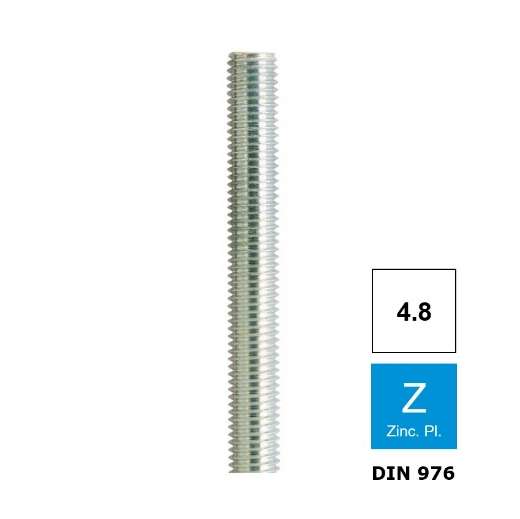
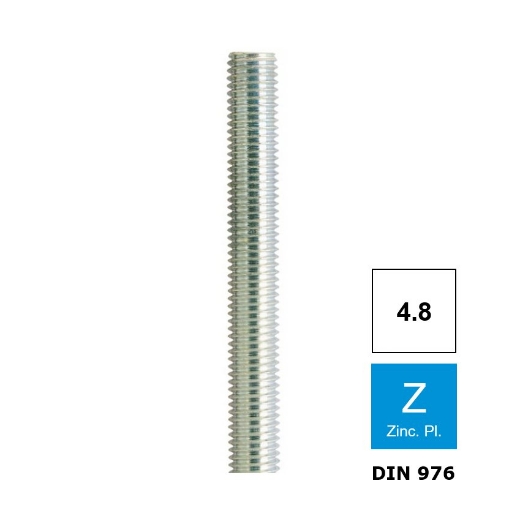
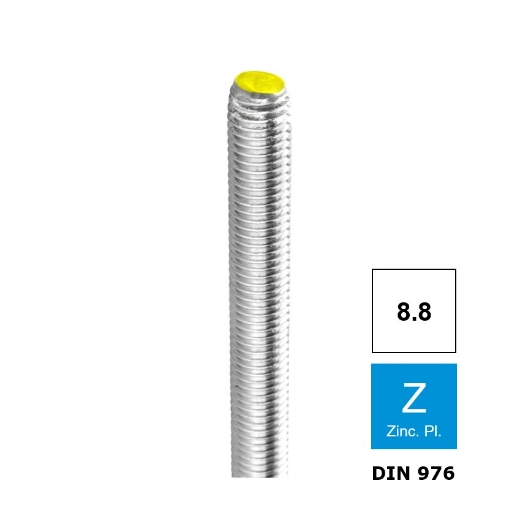
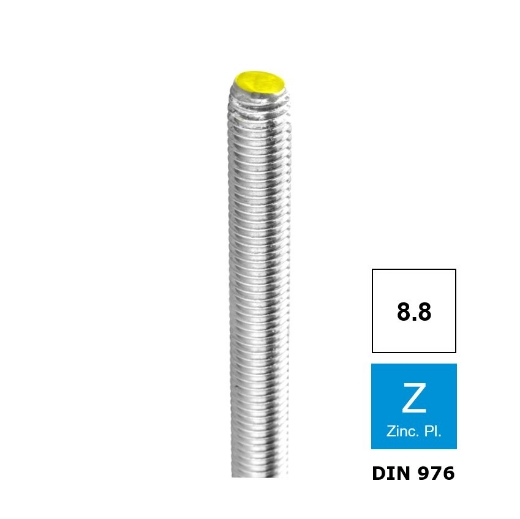
You choose threaded rod on three factors at once: diameter, strength class and material. The diameter (M6 up to M20 in our range) must match your nut, washer or anchor and determines how much load the connection can carry. The strength class tells you the steel's tensile strength: class 4.8 reaches 400 N/mm², class 8.8 reaches 800 N/mm², exactly double. The material decides how the rod copes with moisture: galvanized steel for dry to slightly damp indoor work, stainless steel A2 for humid interiors, and stainless steel A4 for outdoor, coastal or chemical exposure. Pick any of these three wrong and the fixing either fails under load or corrodes within a few years.
Which threaded rod suits your project? Browse the full range in our threaded rod category, and use this guide to match diameter, class and material to the job at hand.
- Diameter must match the nut, washer or anchor sleeve exactly; never round up "just to be safe".
- Strength class 8.8 carries twice the tensile load of class 4.8 (800 N/mm² versus 400 N/mm²).
- Galvanized steel handles dry to slightly damp indoor work; stainless A2 suits humid interiors.
- Stainless A4 is the only choice for coastal air, chemical exposure or permanent outdoor use.
- For chemical anchoring in masonry, a sieve sleeve keeps the resin exactly where the rod needs grip.
Which threaded rod for which job? Overview
Match your diameter first, then decide between class 4.8 and 8.8, and finally pick the material for your environment. The table below lists our threaded rods with their real specifications, all from our threaded rod assortment.
| Product | Material / class | Diameter | Ideal for |
|---|---|---|---|
| Threaded rod DIN 976 M6x1000mm galvanized 4.8 | Galvanized steel, 4.8 | M6 | Light indoor brackets, cable trays |
| Threaded rod DIN 976 M8x1000mm galvanized 4.8 | Galvanized steel, 4.8 | M8 | General indoor mounting, shelving |
| Threaded rod DIN 976 M10x1000mm galvanized 4.8 | Galvanized steel, 4.8 | M10 | All-round DIY and building work, one of our most chosen |
| Threaded rod DIN 976 M12x1000mm galvanized 4.8 | Galvanized steel, 4.8 | M12 | Heavier brackets, light structural framing |
| Threaded rod DIN 976 M20x1000mm galvanized 4.8 | Galvanized steel, 4.8 | M20 | Heavy-duty anchoring, large structures |
| Threaded rod DIN 976 M8x1000mm galvanized 8.8 | Galvanized steel, 8.8 | M8 | High-load fixings, machinery mounts |
| Threaded rod DIN 976 M12x1000mm galvanized 8.8 | Galvanized steel, 8.8 | M12 | Structural steelwork, chemical anchors |
| Threaded rod DIN 976 M16x1000mm galvanized 8.8 | Galvanized steel, 8.8 | M16 | Heavy structural load-bearing |
| Threaded rod DIN 976 M8x1000mm stainless A2-70 | Stainless steel A2 | M8 | Damp interiors: bathrooms, kitchens |
| Threaded rod DIN 976 M10x1000mm stainless A2-70 | Stainless steel A2 | M10 | Sheltered outdoor use, humid rooms |
| Threaded rod DIN 976 M16x50mm stainless A4-70 | Stainless steel A4 | M16 | Coastal air, chemical exposure, short fixings |
| Threaded rod DIN 976 1m M4 brass CU2/CU3 | Brass CU2/CU3 | M4 | Decorative work, electrical panels, non-magnetic use |
| Threaded rod DIN 976 1m M8 bright steel 4.8 | Bright steel, 4.8 | M8 | Dry indoor use, further machining or painting |
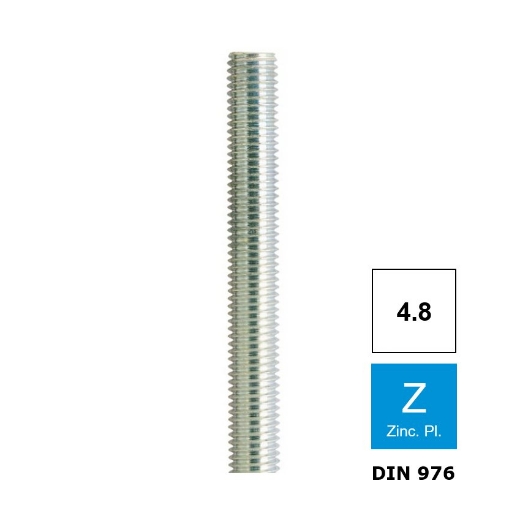
General DIY and building work
For most indoor jobs, an M10 galvanized rod in class 4.8 offers plenty of margin. It is one of our most chosen sizes for shelving, brackets and general assembly.
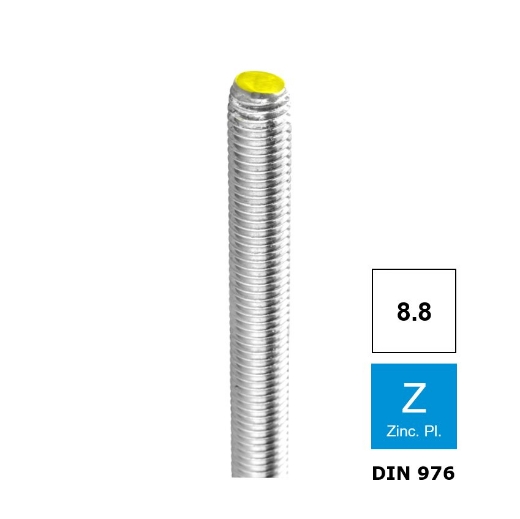
Heavy structural loads
Steel framing, suspended ductwork and chemical anchors in concrete need the extra reserve of class 8.8. An M16 rod handles serious tensile forces.
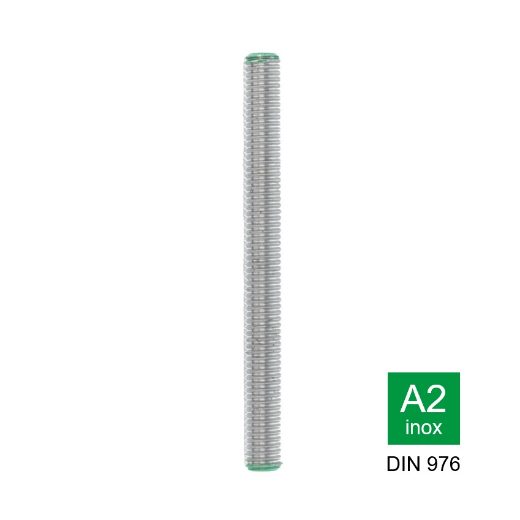
Damp interiors
Bathrooms, kitchens and utility rooms expose fixings to condensation. Stainless A2 resists surface rust where galvanized coating would eventually fail.
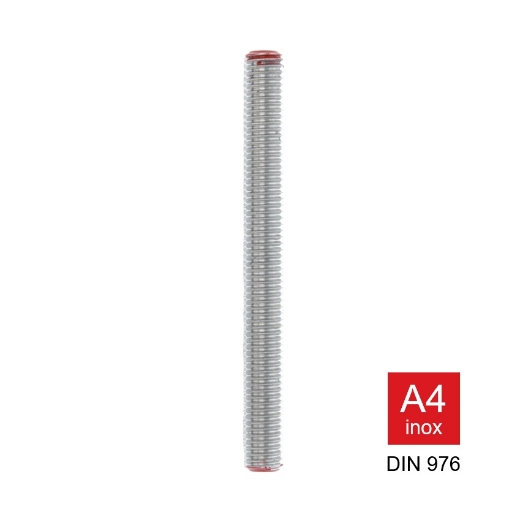
Coastal or chemical exposure
Salt air, pool chemicals and industrial fumes attack A2 over time. Stainless A4 adds molybdenum for a far tougher resistance to pitting corrosion.
Which diameter of threaded rod do you need?
The diameter is set by the load and by the nut, washer or anchor you already have, not by guesswork. M6 and M8 suit light indoor brackets and cable supports. M10 and M12 cover most general construction and DIY work, from mounting boilers to fixing timber frames. M16 and M20 are reserved for structural steelwork, heavy machinery bases and large suspended loads.
Always check the drilled hole, anchor sleeve or nut you plan to use before ordering. A rod that is even half a millimetre too thick will not thread through a fixed nut, and one too thin leaves the connection loose and unsafe under vibration.
What is the difference between strength class 4.8 and 8.8?
Strength class tells you how much tensile force the steel withstands before it deforms or snaps. Class 4.8 reaches a tensile strength of 400 N/mm², suitable for general fixings, brackets and light structural work. Class 8.8 doubles that to 800 N/mm², and is the standard for heavy structural connections, machinery anchoring and any load where safety margins matter.
The numbers themselves explain the code: the first digit is roughly a tenth of the tensile strength in N/mm², the second gives the yield-to-tensile ratio. So 8.8 means 800 N/mm² tensile strength with a yield point at about 80% of that value. Choosing 8.8 "just in case" rarely hurts, but choosing 4.8 for a genuinely heavy load is a real risk.
Galvanized, stainless or brass: which material do you choose?
The material determines how long your threaded rod lasts in its environment, not how strong it is on day one. Galvanized steel carries a zinc coating that protects against surface rust indoors and in sheltered, dry-to-slightly-damp conditions. Stainless steel A2 resists corrosion from humidity and light cleaning chemicals, making it the right pick for bathrooms, kitchens and food-processing areas. Stainless steel A4 adds molybdenum to the alloy, giving it real resistance to chloride, salt spray and industrial chemicals, so it is the only sensible choice outdoors near the coast or in a chemical plant.
Brass (CU2/CU3) and bright steel serve narrower needs. Brass rod is non-magnetic and does not corrode, which suits decorative fittings, electrical cabinets and instrumentation work where steel would interfere. Bright steel has no protective coating at all, so it belongs indoors in dry conditions, typically where the rod still needs to be cut, threaded further or painted after installation.
In our shop in Beerse, customers fixing anything in a bathroom or utility room reach for stainless A2 without hesitation once they hear it will never show rust streaks the way a galvanized rod eventually can.DHZ-Proshop trade team, Beerse
How do you anchor threaded rod in masonry or concrete?
For load-bearing fixings in brick or concrete, threaded rod is set with chemical resin rather than a mechanical plug. A sieve sleeve is inserted into the drilled hole first, so the resin stays contained around the rod instead of disappearing into hollow or porous material. Our Soudal Zeefhuls PRO sieve sleeve is sized for M6 and M8 rod at a 12x80mm hole, giving a clean, full-strength bond in one step.
Match the sleeve diameter to your drilled hole and rod size exactly, and always let the resin cure for the time stated on the cartridge before loading the fixing. Skipping the cure time is one of the most common causes of a chemical anchor failing under load.
Common mistakes
- Ignoring the strength class: using 4.8 rod for a heavy structural or suspended load leaves no safety margin; check the stamped class before you buy.
- Mixing galvanized and stainless in one connection: two dissimilar metals in contact, especially in damp conditions, can trigger galvanic corrosion on the weaker part.
- Skipping the sieve sleeve in hollow or porous masonry: without it, resin escapes into the material and the anchor never reaches its rated pull-out strength.
- Choosing A2 for coastal or chemical environments: salt air and industrial fumes will pit A2 over time; A4 is the correct grade for those conditions.
Browse the complete range in our threaded rod category to compare diameters, classes and materials side by side.
Frequently asked questions about threaded rod
What diameter threaded rod do I need?
What's the difference between strength class 4.8 and 8.8?
Is galvanized or stainless steel threaded rod better?
What's the difference between A2 and A4 stainless steel?
Can I cut threaded rod to length myself?
What length threaded rod should I buy?
Compiled by the trade team of DHZ-Proshop, your DIY and professional supplier with a shop and pickup point in Beerse. What we advise most often in the shop is to check the strength class stamp and match the material to the environment before cutting a single rod. Questions about the right threaded rod for your project? Contact our team or browse the full threaded rod range.