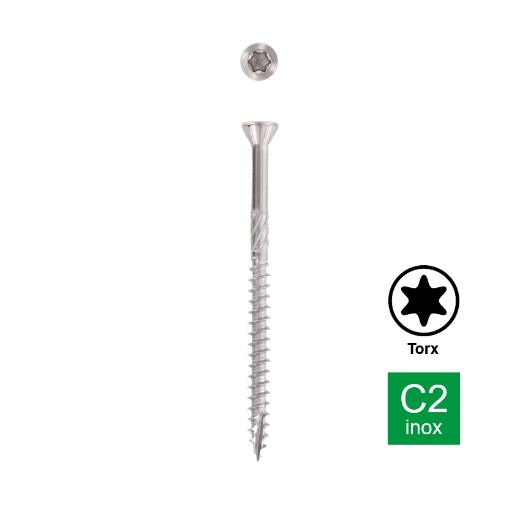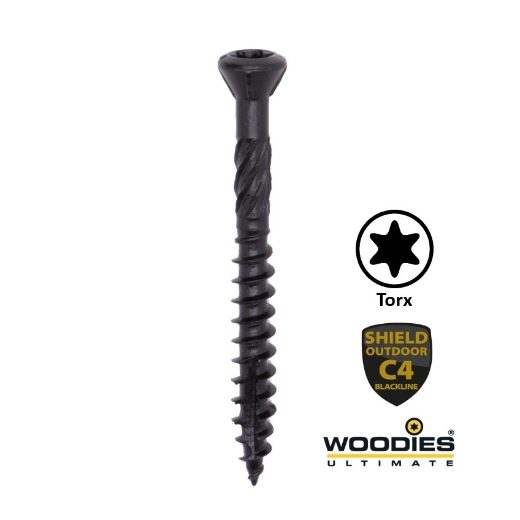
Which screw for your hardwood decking? For long-lasting decking you should always choose a corrosion-resistant screw. In our range you'll find C2 hardwood screws: corrosion-resistant martensitic steel (AISI 410) with high pull-out strength, ideal for inland decking in non-tannin-rich hardwood. Below you'll read how to choose the right length, why pre-drilling matters with hardwood, and when you're better off with A4 stainless steel.
Corrosion resistance is a must: our C2 hardwood screws
Decking is exposed to rain, moisture and temperature fluctuations all year round. Ordinary galvanised screws rust and leave unsightly black streaks on your boards. That's why you should always choose corrosion-resistant screws.
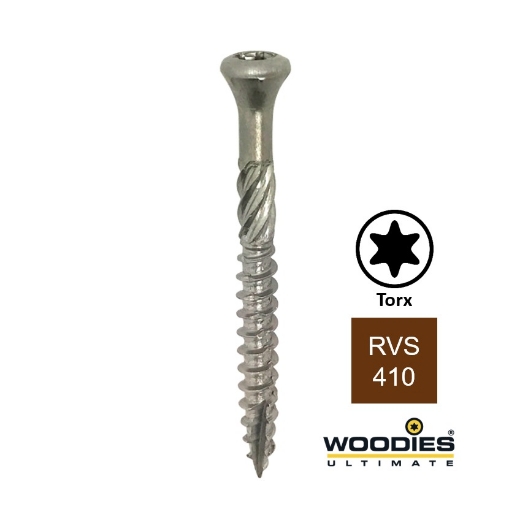
- C2 (AISI 410): our C2 decking screws are made of hardened martensitic stainless steel. They combine high pull-out and breaking strength with corrosion resistance, which makes them strong enough for the hard, dense wood of decking.
- For which wood? C2 is the right choice for inland decking in non-tannin-rich hardwood. For most gardens in inland Belgium this screw is a perfect fit.
- Torx drive: our decking screws have a torx head. This gives more grip than a Phillips head, so the bit won't slip when driving into hard wood.
- Countersunk head with milling ribs: the head sits neatly flush in the board and the milling ribs under the head clear the wood, so the screw finishes flush without breaking out.
Correct installation: length, pre-drilling and spacing
- Choose the right length: as a rule of thumb, count roughly 2.5 times the thickness of your decking board. A thicker board therefore requires a longer screw, so that it grips sufficiently into the underlying joist.
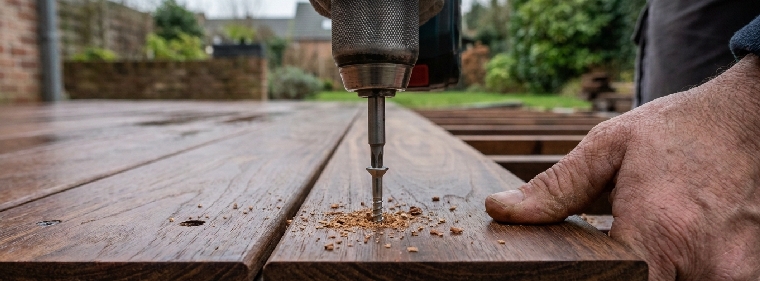
- Pre-drilling with hardwood: hardwood is dense and hard. Always pre-drill to prevent splitting, especially near the ends of a board. Use a drill diameter slightly smaller than the screw core.
- Keep distance from the edge: don't screw too close to the end or side of a board, otherwise the wood may crack. Pre-drilling helps here too.
- Let the wood work: hardwood expands and contracts with the seasons. Maintain a ventilation gap between the boards, so that water can drain away and the wood can move.
Azobé, bangkirai or close to the coast? Choose A4 stainless steel
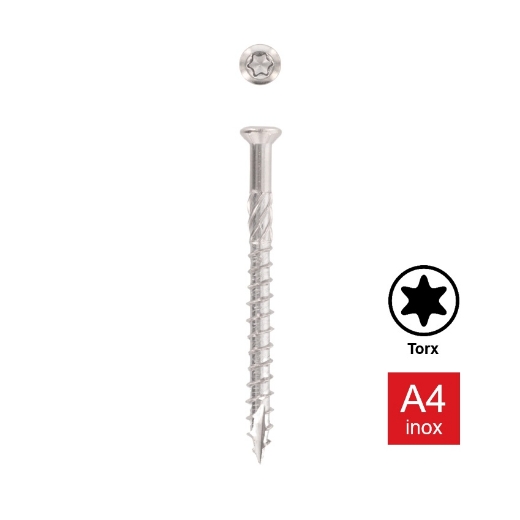
In two cases C2 isn't the best choice. These involve heavier exposure where you're better off reaching for A4 stainless steel (AISI 316).
- Tannin-rich hardwood (azobé, bangkirai, cumaru): these wood species contain a lot of tannic acid (tannin). That acid attacks martensitic steel and accelerates corrosion. For this wood, therefore, choose A4 stainless steel.
- Coastal areas and chlorine: do you live within roughly 5 km of the sea, or is your decking next to a chlorinated swimming pool? Then the salt and chlorine exposure is higher. A4 stainless steel contains molybdenum and is considerably more resistant to it.
We don't carry these A4 decking screws as standard in our range. Unsure about the right choice for your wood species or location? Ask our team, we're happy to help you find the right fastening material.
Frequently asked questions about decking screws
Which screw do I use for hardwood decking?
How long should my decking screw be?
Do I need to pre-drill in hardwood?
Why no galvanised screws on decking?
What do I use for azobé or decking by the coast?
Posted by the expert team at DHZ-Proshop, your specialist in fastening, hardwood screws and decking construction materials. Webshop available 24/7 and collection point in Beerse (province of Antwerp). Questions about the right screw for your decking? Contact our team.