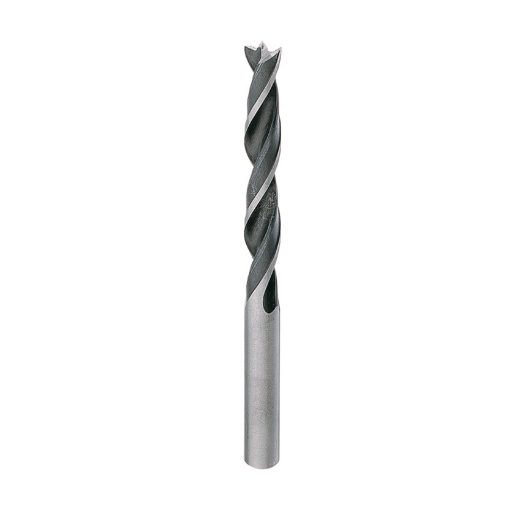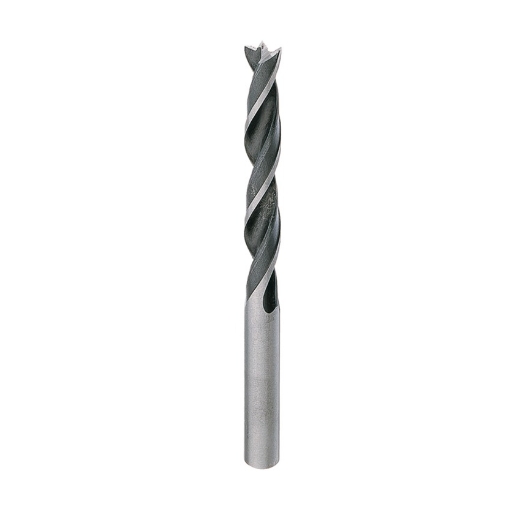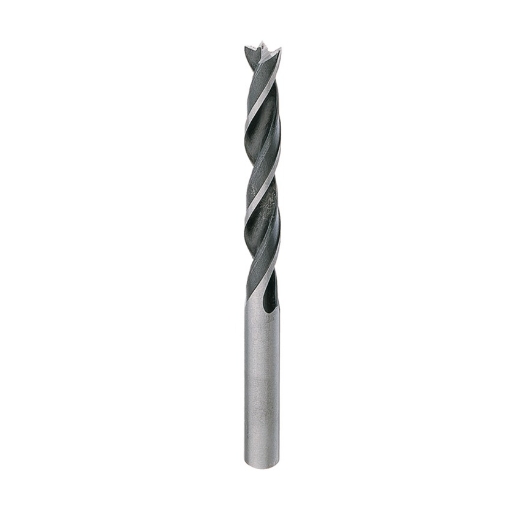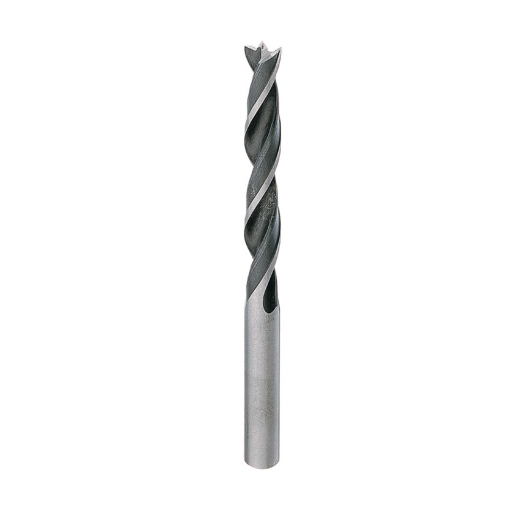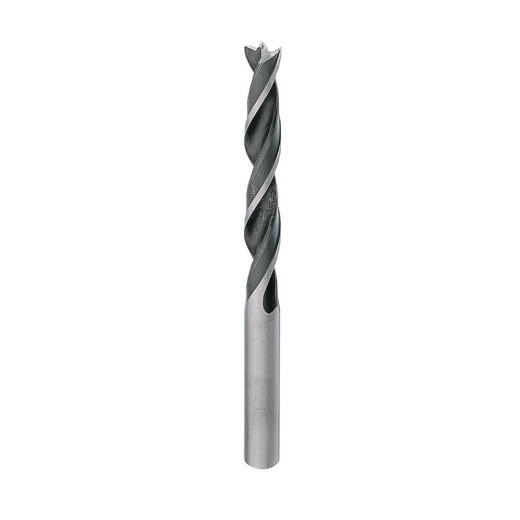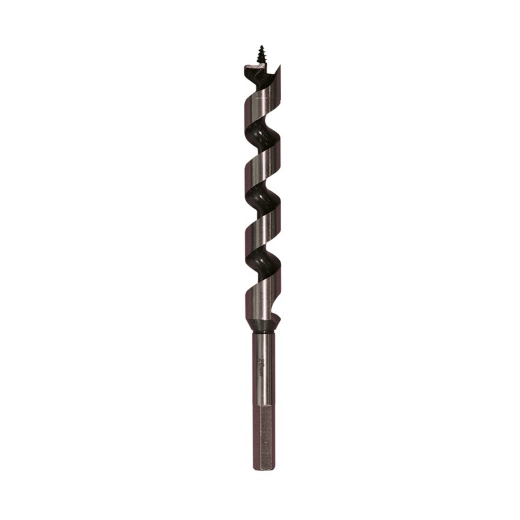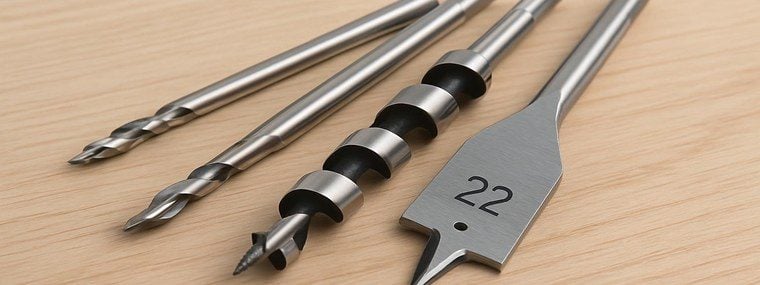
Match the wood drill bit to the hole, not just the diameter. For small, shallow holes up to 8 mm in planks, boards and MDF you reach for a twist bit (chrome vanadium); for deep, clean holes of larger diameter you use an auger bit with a screw point that pulls itself through and clears chips over its full 155 mm flute; for fast, rough through-holes in soft timber a spade bit does the job. A twist bit centres neatly, an auger bit drills deep and straight, and hardwood like azobé asks for a reinforced auger. Get the pairing wrong and you burn the wood, wander off centre, or the bit jams halfway.
Which wood drill bit does your job need? The full wood drill bit range at DHZ-Proshop holds twist bits and auger bits from 3 mm up to 20 mm. This guide walks you through it step by step.
- Twist bits (chrome vanadium) suit small, precise holes; the 5 mm Labor bit has a 50 mm useful length.
- Auger bits with a screw point pull themselves in and clear chips over a 155 mm flute, ideal for deep holes.
- For azobé and other dense hardwoods, use a reinforced Labor Azobé auger bit.
- Spade and larger bits go up to 20 mm; drill wood without the hammer function.
- The hex shank on Labor augers stops the bit slipping in the chuck under load.
Which wood drill bit for which hole?
Choose the bit by the hole you need: diameter, depth and how clean the edge must be. The table below matches real DHZ-Proshop bits to their job. Browse the complete wood drill bit range to see every size.
| Bit | Brand | Key spec | Ideal for |
|---|---|---|---|
| Labor twist bit 4x75mm | Labor | Ø 4 mm, 45 mm useful length, chrome vanadium | Small pilot holes, screws in trim |
| Labor twist bit 5x86mm | Labor | Ø 5 mm, 50 mm useful length, point tip | Everyday holes in board and plank |
| Labor twist bit 12x150mm | Labor | Ø 12 mm, 95 mm useful length | Wider clean holes in solid wood |
| Labor auger bit 12x155/230mm | Labor | Ø 12 mm, screw point, hex shank, 155 mm flute | Deep holes in beams and construction timber |
| Labor Azobé auger 10.5x155/230mm | Labor | Ø 10.5 mm, tool steel, hardwood ground | Azobé and dense hardwood |
| Irwin wood twist bit 13x114mm | Irwin | Ø 13 mm, 114 mm total length | Larger holes at shorter reach |

Small precise holes
Pilot holes, hinges, screws in trim? A slim chrome vanadium twist bit centres cleanly and drills a tight, accurate hole.

Deep holes in beams
Cabling, dowels or bolts through thick timber? An auger bit with a screw point pulls itself through and stays straight.
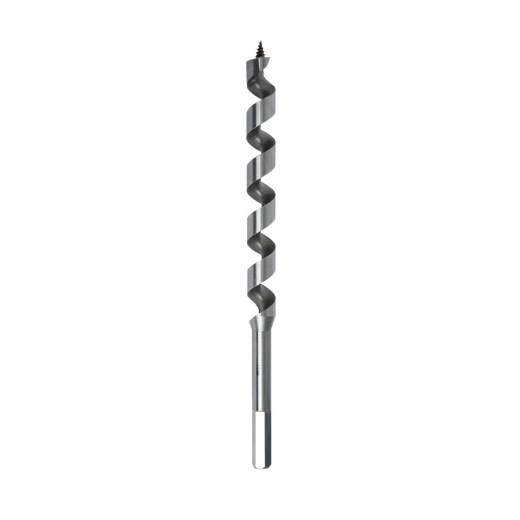
Hardwood like azobé
Decking, hardwood joints, tropical timber? The Labor Azobé auger is ground for dense wood without burning or jamming.

Extra-long reach
Drilling right through a thick post or double beam? A 460 mm auger reaches where a standard bit runs out.
Step 1: define the hole before you pick the bit
Start with three questions: how wide, how deep, and how clean must the hole be? Diameter and depth decide the bit type; edge quality decides your technique. A shallow 5 mm hole in a shelf calls for a different tool than a 20 mm hole straight through a roof beam.
Write down the diameter you actually need. For a screw you want a pilot hole slightly under the thread; for a dowel or bolt you want an exact fit. Then look at depth: anything past roughly 80 mm asks for a long bit that can clear its own chips, which rules out a short twist bit. Wood also drills only in the plain rotary setting, never with the hammer function.
Step 2: small and precise? Use a twist bit
For holes from 3 mm to around 12 mm in planks, boards, plywood and MDF, a chrome vanadium twist bit is the right choice. The point tip centres the bit so it does not wander, and the ground flutes shear a clean edge. The Labor 5x86mm gives 50 mm of useful drilling depth, enough for most furniture and trim work.
Step up the diameter as the job grows. The 3x61mm and 4x75mm cover pilot holes and thin screws; the 8x117mm handles dowels and medium fixings; the 12x150mm opens wider clean holes with 95 mm of useful length. For a 13 mm hole at a shorter working length, the Irwin 13x114mm twist bit is a compact option.
Step 3: deep or large? Reach for an auger bit
For deep holes and diameters from 6 mm to 20 mm, an auger bit beats a twist bit every time. The threaded screw point bites in and pulls the bit through under its own power, while the wide single flute lifts chips out of the hole. The Labor no-axis auger bits carry a 155 mm useful length and a hex shank that grips firmly in the chuck.
Match the diameter to the job: the 6 mm and 8 mm augers suit cabling and small dowels, the 10 mm and 12 mm handle bolts and heavier fixings. When a standard 230 mm bit runs short, the 20x385/460mm auger drills right through thick posts and double beams. Keep the drill at moderate speed and let the screw point set the feed rate.
In our Beerse shop, anyone drilling deeper than a hand's width in a beam walks out with a hex-shank auger bit, not a twist bit. The screw point does the pulling so your wrist doesn't.DHZ-Proshop vakteam, Beerse
Step 4: hardwood or azobé? Choose a reinforced auger
Dense tropical hardwoods such as azobé need an auger bit ground specifically for them. A standard auger overheats and dulls fast in azobé, while the Labor Azobé tool steel augers are shaped to cut cleanly through the hard fibres without burning. They come in Ø 8.5 mm and Ø 10.5 mm for standard depth and a Ø 12 mm in a 460 mm length for through-drilling thick sections.
Drill hardwood slower than softwood and back the bit out regularly to clear chips and let it cool. The screw point still pulls the bit in, but let it work at its own pace rather than forcing extra pressure. For garden decking, hardwood fencing and outdoor joints, this reinforced auger is the tool that lasts.
Step 5: drill a clean, splinter-free hole
A clean hole comes from the right technique, not just the right bit. Mark the centre, set the drill to rotary only, and start slowly so the point bites before you speed up. On a through-hole, the back face is where splintering happens, so plan for it.
Clamp a piece of scrap timber tightly behind the workpiece: the bit exits into the offcut and leaves the back edge clean. On visible surfaces, drill from the show side until the point just breaks through, then finish the hole from the reverse. Keep the auger flute clear of packed chips, because a clogged flute burns the wood and stalls the drill.
Common mistakes
- Using the hammer function in wood: the hammer setting is only for stone and concrete. In wood it tears the edge and gives a ragged hole. Drill wood in plain rotary mode.
- Forcing a short twist bit deep: once the flutes fill, chips can't escape and the bit burns and jams. Past 80 mm, switch to an auger bit that clears its own hole.
- Ignoring the back face: drilling straight through without backing scrap behind the workpiece splinters the exit edge. Clamp an offcut behind it or finish from both sides.
- A standard auger in azobé: ordinary augers overheat and blunt in dense hardwood. Use a Labor Azobé auger ground for tropical timber.
See the full selection in our wood drill bit range or find all your tools and building materials in Belgium at the DHZ-Proshop webshop.
Frequently asked questions about wood drill bits
Which are wood drill bits and how do I recognise one?
Which colour are wood drill bits?
What is the best wood drill bit for deep holes?
What is the largest wood drill bit you stock?
Can I use a wood drill bit in hardwood like azobé?
Do I drill wood with the hammer function on?
Compiled by the vakteam of DHZ-Proshop, your do-it-yourself and trade supplier with a shop and pickup point in Beerse. What we advise most often in the shop: a twist bit for small precise holes and a hex-shank auger for anything deep or wide, with an Azobé auger kept aside for hardwood. Questions about the right bit for your timber? Contact our team or browse the full wood drill bit range.