Why do screws break in hardwood? (causes and how to prevent it)
Screws break in hardwood mainly due to excessive torque, no or incorrect pre-drilling, unsuitable screws and the extreme density of hardwood. Prevent this by always pre-drilling with the correct drill diameter (70-80% of the screw diameter, meaning the outer diameter), using torx screws, setting your screwdriver to a lower torque (guide value 6-8 Nm) and choosing quality screws suited to hardwood.
Why do screws break in hardwood? In this technical guide you will discover the main causes of broken screws in hardwood and concrete solutions to prevent this. From azobé to bangkirai: this is how you work flawlessly with the densest types of wood.
Main causes of broken screws in hardwood
| Cause | Why does this happen? | Solution |
|---|---|---|
| No pre-drilling | Hardwood is very dense (900-1100 kg/m³), the screw cannot penetrate without breaking | Always pre-drill with the correct drill diameter |
| Excessive torque | The screw head or shaft breaks due to excessive turning force | Limit the torque (guide value 6-8 Nm for hardwood) |
| Wrong drill diameter | Too narrow: screw breaks, too wide: no grip | Drill 70-80% of the screw diameter (outer diameter) |
| Poor screw quality | Brittle material or overly hard heat treatment | Choose quality screws for hardwood |
| Wrong screw type | Cross head cams out, a screw that is too weak breaks | Use torx screws for hardwood |
Why do screws break in hardwood?
Hardwood such as azobé, bangkirai, cumaru and massaranduba has an exceptionally high density. This makes the material very strong, but also challenging for fixing.
1. The density of hardwood
Most types of tropical hardwood have a density between 900 and 1100 kg/m³. By comparison: spruce is around 500 kg/m³. This high density causes:
- High resistance: The screw has to cut through very compact wood fibres
- Friction heat: Friction heats up the screw while driving it
- Stress build-up: Without a pilot hole the wood has to be pushed aside, breaking the screw under pressure
2. Excessive torque
This is the most common cause of broken screws. When you screw with too much force:
- The screw head breaks off at the transition to the shaft
- The screw shaft bends or breaks halfway
- The head cams out (with cross head or Phillips)
With hardwood you quickly build up a lot of resistance. Without torque limiting on your drill, breaking is almost inevitable.
3. Wrong or no pilot hole
Many users think they can drive screws without pre-drilling. With hardwood this is almost always wrong:
- No pilot hole: The screw has to displace all the wood → extreme resistance → breakage
- Pre-drilled too narrow: Still too much resistance, the screw breaks
- Pre-drilled too wide: The screw has no grip, but does not break (poor connection though)
4. Incorrect screw choice
Not every screw is suitable for hardwood:
- Cross head (Phillips/Pozidriv): Cams out quickly in hardwood, especially at higher resistance
- Standard wood screws: Often too brittle or insufficiently strong for hardwood
- Overly hardened screws: Cheap screws with an overly aggressive heat treatment become brittle and snap under torque
How do you prevent broken screws in hardwood?
With the right technique and materials you prevent virtually all screw breakages. Follow these steps:
Always pre-drill
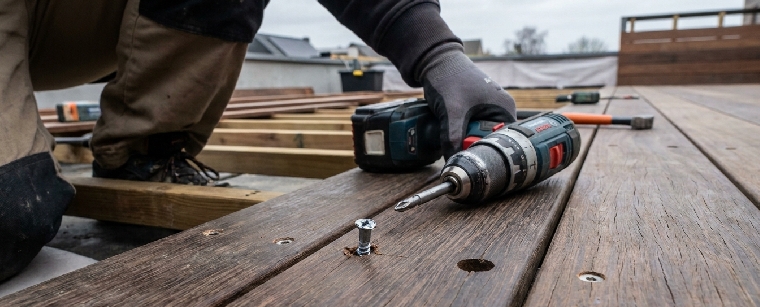
Always drill a pilot hole in hardwood. Use a drill diameter of around 70-80% of the screw diameter (the outer diameter). For a 5mm screw this is around 3.5-4mm. Drill at least as deep as the screw reaches into the substructure. Still breaking screws? Then make the pilot hole a fraction larger.
Limit the torque
Set your cordless screwdriver to a lower torque (guide value 6-8 Nm, depending on screw size). Start lower and increase if necessary. Use the torque setting, not the drill mode. This prevents you from applying too much force.
Choose torx screws
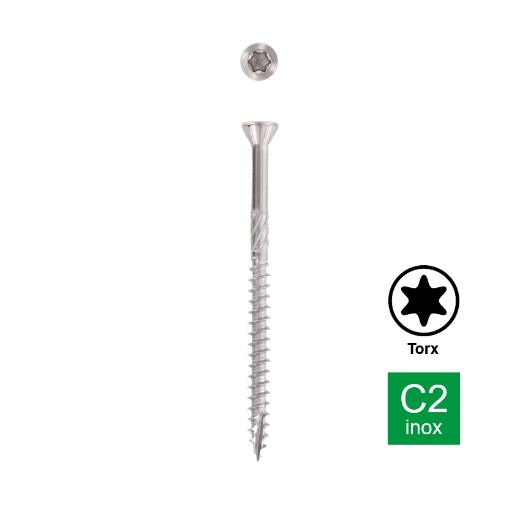
Torx (TX) screws transfer considerably more torque than cross head without camming out. The star-shaped head grips better and distributes the force more evenly. Choose TX25 or TX30 for hardwood.
The right screw for the job
For outdoor use (decking, façade) choose stainless steel A2, or A4 near the coast and pools, for corrosion resistance. Note: stainless steel is tough but softer than hardened steel and shears more easily, so pre-drilling and torque control matter even more. For indoor use, quality hardened hardwood screws are fine. Avoid cheap, brittle screws.
Countersink and pre-drill
Use a countersink bit for a neat finish and to give the screw head room. This reduces the resistance when tightening and prevents the head from breaking due to lateral pressure.
Use screw wax or soap
With very hard wood such as azobé it helps to lubricate the screw with screw wax or soap. This considerably reduces friction and friction heat, so the screw is less likely to break.
Technical specifications per type of hardwood
Not all hardwood is equally hard. Adjust your technique to the specific type of wood. The torque values are guide values for a screw of around 5mm; adjust them to your screw size.
| Type of wood | Density | Drill diameter (5mm screw) | Guide torque | Extra tips |
|---|---|---|---|---|
| Azobé | 1000-1100 kg/m³ | 3.5-4mm | 6-7 Nm | Always lubricate, pre-drill in two steps if needed |
| Bangkirai | 900-1000 kg/m³ | 3.5-4mm | 7-8 Nm | Torx advised, tighten carefully |
| Cumaru | 1000-1050 kg/m³ | 3.5-4mm | 6-7 Nm | Lubrication recommended, stainless steel A4 for outdoors |
| Massaranduba | 1050-1100 kg/m³ | 3.5-4mm | 6-7 Nm | Very hard, always lubricate |
| Iroko | 650-700 kg/m³ | 4mm | 8-9 Nm | Lighter tropical hardwood, pre-drilling still recommended |
At 650-700 kg/m³, Iroko is clearly lighter than the other types in this table and falls outside the typical 900-1100 kg/m³ class. It remains a durable tropical hardwood, but you have more margin: pre-drilling is still recommended, but the chance of screw breakage is smaller than with azobé or massaranduba.
What to do if a screw breaks?
Despite all precautions, it can still go wrong. This is how you remove a broken screw:
Method 1: Screw extractor
- Drill a small hole (2-3mm) in the middle of the broken screw
- Turn a left-hand screw extractor into the hole
- Turn anti-clockwise to remove the screw
- Work carefully so as not to damage the wood
Method 2: Left-hand drill bit
- Use a left-hand (anti-clockwise) metal drill bit
- Drill slowly into the middle of the screw
- The direction of rotation may already loosen the screw
- Start with a small diameter and work up
Method 3: Saw or multitool
- If the screw protrudes: saw a slot in the head
- Use a flat screwdriver to unscrew it
- For countersunk screws: mill off the head and drill out the rest
Checklist: how to prevent screw breakage
- Use torx screws (TX25 or TX30)
- Pre-drill with 70-80% of the screw diameter (outer diameter)
- Limit the torque (guide value 6-8 Nm)
- Choose quality screws; stainless steel A2/A4 for outdoor use
- Use a countersink bit for a neat finish
- Lubricate screws with very hard wood (azobé, massaranduba)
- Work with sharp drill bits (blunt bits create more resistance)
- Drill straight holes (angled holes cause lateral loading)
- Keep enough distance from the edge (at least 2x the screw diameter)
- Do not drive too deep (stop when the head sits flush)
Frequently asked questions about screws breaking in hardwood
Why do screws break in hardwood?
Do I always have to pre-drill in hardwood?
Which drill diameter for a 5mm screw?
Torx or cross head for hardwood?
How do I set the torque?
How do I remove a broken screw?
Does lubrication help with hardwood?
Which screws for azobé?
Posted by the fixing expert at DHZ-Proshop, Your specialist in hardwood screws, torx fixings, stainless steel screws and professional fitting techniques. Webshop available 24/7 and collection point in Beerse. Questions about screws in hardwood? Contact our team or view our complete range of fixings.