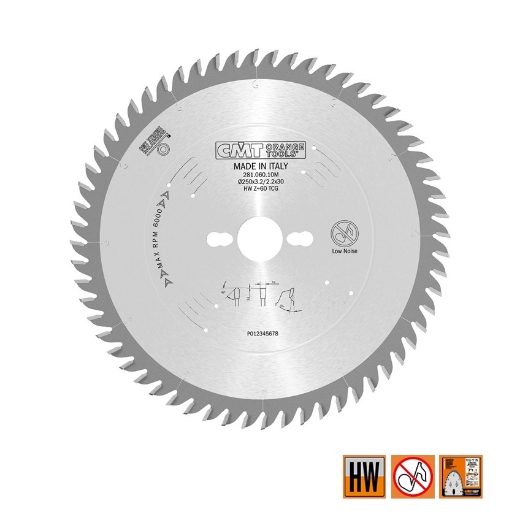
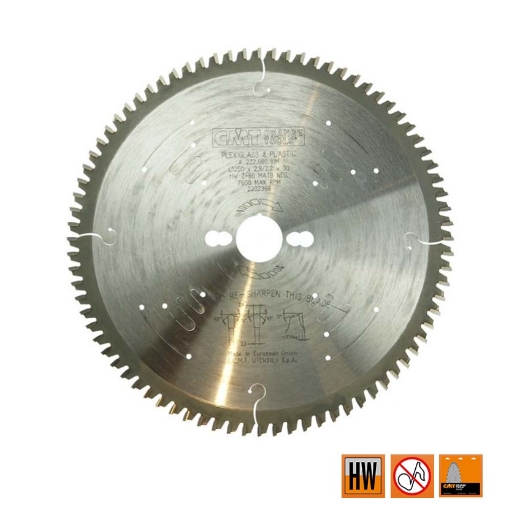
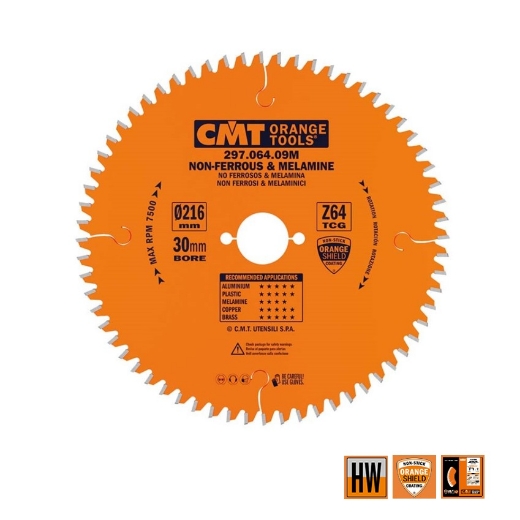
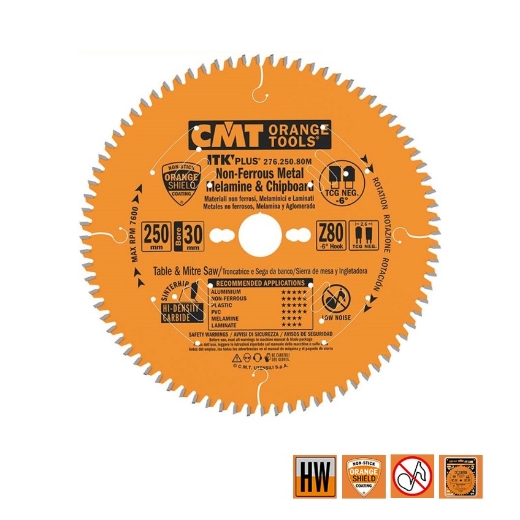
Which circular saw blade for which material? (Quick guide: wood, fine cross-cuts, laminate and aluminium)
You choose a circular saw blade by tooth count and tooth shape, not by diameter alone. As a rule: few teeth (16–24, ATB) for fast ripping of solid wood, many teeth (40–60, ATB) for clean cross-cuts and fine work, a high tooth count (60–80, TCG) with a negative hook angle for laminate, melamine, plastic and non-ferrous metal like aluminium. Fewer teeth cut faster but rougher; more teeth cut cleaner but slower. On top of that, the diameter and the bore (arbor) size must match your machine exactly.
Which blade fits your job and your saw? In the circular saw range at DHZ-Proshop you will find CMT blades for ripping, fine cross-cutting, laminate and aluminium, each tuned to a different material and machine. This guide lines them up quickly.
Overview: which circular saw blade for which material?
Browse the complete circular saw range in our webshop. The table links the material to the right blade, tooth count and tooth shape.
| Material | Tooth count (Ø 160–190 mm) | Tooth shape |
|---|---|---|
| Solid wood, ripping / fast cuts | 16–24 teeth | ATB, positive hook angle |
| Plywood, MDF, chipboard, fine cross-cuts | 40–60 teeth | ATB, fine and clean |
| Laminate, melamine, coated panels | 60–80 teeth | TCG or Hi-ATB, neutral/negative hook |
| Aluminium, plastic, non-ferrous metal | 60–96 teeth | TCG, negative hook angle |
Wood and ripping
Ripping planks and beams or rough construction cuts? A low tooth count (16–24, ATB) clears chips fast and powers through solid wood.
Fine cross-cuts
Clean edges in plywood, MDF or chipboard? A 40–60 tooth ATB blade leaves a smooth, tear-free cut for finish work.
Laminate and melamine
Coated panels, melamine or laminate flooring? A 60–80 tooth TCG blade with a neutral hook prevents chipping of the surface.
Aluminium and plastic
Aluminium profiles, PVC or solid plastic? A high tooth count (60–96, TCG) with a negative hook angle cuts cleanly without grabbing.
Start with the material and the machine
The first question is not "which diameter", but "which material, how fine, and which machine". Solid wood, sheet material, laminate and aluminium each need a different tooth count, a different tooth shape and a different hook angle. As a guideline: the more teeth, the cleaner but slower the cut; the fewer teeth, the faster but rougher. Hard, brittle or coated materials need many teeth and a neutral or negative hook angle so the blade does not lift or chip the surface.
The machine matters too. A hand-held circular saw, a plunge saw on a guide rail and a table or mitre saw all use blades of a specific diameter and bore. Use the wrong blade and you notice it instantly: too few teeth in melamine chips the edge, a positive hook angle in aluminium makes the blade grab, and a diameter that exceeds your saw's capacity simply will not fit the guard.
Solid wood and ripping: few teeth, ATB
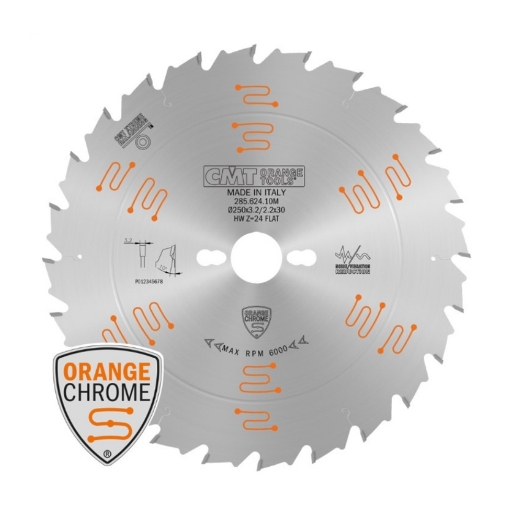
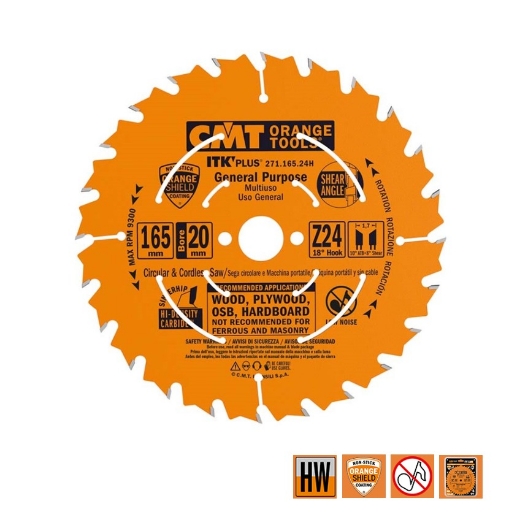
For ripping along the grain and for fast construction cuts in solid wood you use a blade with a low tooth count, roughly 16 to 24 teeth on a 160–190 mm blade. The large gullets between the teeth clear sawdust quickly, so the blade does not clog and the saw cuts with less effort. The tooth shape is ATB (Alternate Top Bevel) with a clear positive hook angle that pulls the blade into the wood.
This blade is built for speed, not for a furniture-grade finish: across the grain it will leave some tear-out. For a coarse but quick job, framing, decking, rough boards, that is exactly what you want. If you need both ripping and the occasional clean cut, a versatile combination blade around 24–40 teeth is a good compromise.
Fine cross-cuts, plywood, MDF and chipboard: more teeth, ATB
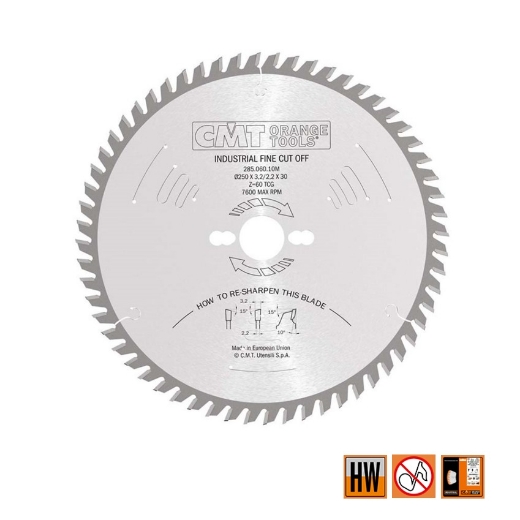
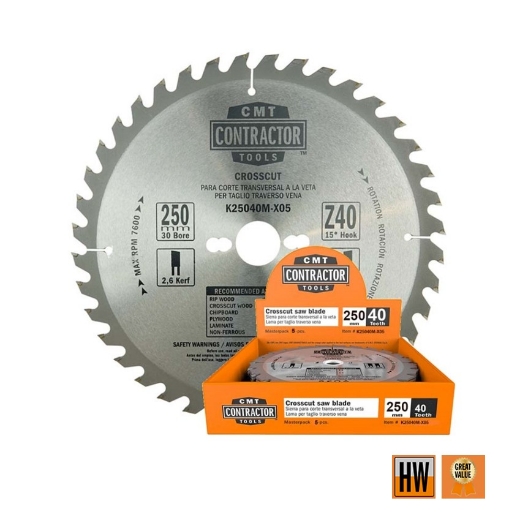
For clean cross-cuts and for sheet materials such as plywood, MDF and chipboard you step up to a higher tooth count, typically 40 to 60 teeth. With more teeth, each tooth removes less material, so the cut is smoother and edges are tear-free. The tooth shape stays ATB, often with a finer grind for a crisp finish on veneered and unfaced panels.
MDF and chipboard are abrasive and dull blades faster than solid wood, so a quality carbide-tipped (TCT) blade pays off. Support the panel well, set the cutting depth so only a few millimetres of tooth project below the workpiece, and back the cut with scrap to keep the underside clean. For unfaced MDF a 48-tooth ATB blade is a sound all-rounder.
Laminate, melamine and coated panels: high tooth count, neutral hook
Laminate flooring, melamine-faced board and coated panels chip easily because of their hard, brittle surface. Here you want a high tooth count of 60 to 80 teeth and a tooth shape that shears rather than tears: a TCG (Triple Chip Grind) or a Hi-ATB grind, combined with a neutral or slightly negative hook angle so the blade does not lift and flake the coating.
The negative or neutral hook also keeps the cut controlled, which is important on a mitre saw or when crosscutting at the very edge of a coated board. Feed the material steadily and let the high tooth count do the work; pushing too hard generates heat and can melt the resin coating. A dedicated laminate/melamine blade gives a glass-smooth edge with no visible chipping on either face.
Aluminium and plastic: TCG with a negative hook angle
For aluminium profiles, non-ferrous metals and solid plastics you need a specific blade: a very high tooth count (60 to 96 teeth), a TCG tooth shape and a clearly negative hook angle. The negative hook prevents the blade from grabbing and climbing through the thin walls of an aluminium profile, while the triple-chip teeth shear the metal cleanly and resist wear.
Never use a standard wood blade with a positive hook on aluminium: it digs in, throws chips and can be dangerous. Cut aluminium dry or with a dedicated cutting lubricant/wax, clamp the workpiece firmly and feed slowly. For PVC, acrylic and other plastics the same principle applies, a high tooth count and a neutral or negative hook give a melt-free, splinter-free edge. Match the blade speed (RPM) to what your saw and the material allow.
Diameter and bore: match the blade to your saw
Beyond teeth and tooth shape, two figures must match your machine exactly: the outer diameter and the bore (arbor) hole. The diameter determines the maximum cutting depth and must equal what your saw is rated for, fit a larger blade and it will not clear the guard; fit a smaller one and you lose depth. The bore must fit the saw's spindle precisely so the blade runs true.
| Machine type | Common diameter | Common bore |
|---|---|---|
| Cordless / compact hand-held saw | 160–165 mm | 20 mm |
| Hand-held / plunge saw | 184–190 mm | 20 / 30 mm |
| Mitre / chop saw | 216–254 mm | 30 mm |
| Table saw | 250–315 mm | 30 mm |
Always read the diameter and bore printed on your old blade or on the machine's nameplate before ordering. Reduction rings can adapt a 30 mm bore to a smaller spindle, but never the other way round. Browse the full range of circular saws and blades or find all your tools and building materials in Belgium on the DHZ-Proshop webshop.
Common mistakes
- Too few teeth in coated panels: a ripping blade chips melamine and laminate badly. Coated and brittle materials need 60+ teeth and a neutral or negative hook angle.
- A positive hook wood blade on aluminium: it grabs, climbs and is unsafe. Aluminium and plastic need a TCG blade with a negative hook angle.
- Ignoring the bore size: the right diameter is useless if the bore does not fit the spindle. Always check both before ordering.
- Pushing a fine blade too hard: high tooth-count blades cut slowly. Forcing the feed burns the wood, melts coatings and overheats the teeth.
Need help matching a blade to your saw and material? Browse the complete circular saw range in our webshop.
Frequently asked questions about circular saw blades
Which circular saw blade for wood?
Which circular saw blade for plywood and MDF?
Which circular saw blade for chipboard?
Which circular saw blade for laminate and melamine?
Which circular saw blade for aluminium and plastic?
Which diameter and bore circular saw blade do I need?
Posted by the cutting-tools expert at DHZ-Proshop, your specialist in circular saw blades: ripping blades, fine cross-cut blades, laminate and melamine blades and TCG blades for aluminium and plastic, including CMT. Webshop available 24/7 and a pick-up point in Beerse. Questions about the right blade for your material and saw? Contact our team or browse the full circular saw range.