Which Fischer plug for your wall type? (Concrete, brick, aerated concrete or hollow wall)
The easiest way to choose the right Fischer plug is to start with the wall and then match the load. In practice: the S and SX expansion plugs suit solid masonry, the DuoPower is the best all-rounder, aerated concrete requires a special aerated-concrete plug, and hollow walls require cavity anchors or Fischer systems designed for cavities. A plug that grips beautifully in concrete may fail in a hollow wall, and a cavity anchor is superfluous or too complex for a solid wall. That is why Fischer offers several plug families instead of one universal answer.
Which Fischer plug do you use for your wall type? The choice depends on where the load goes and what the wall is made of. Concrete and solid brick can carry classic expansion plugs well, while hollow walls and aerated concrete require a special design because their internal structure is far less forgiving. In this visual guide you start from the wall structure and arrive at the right plug.
Overview: which plug for which wall?
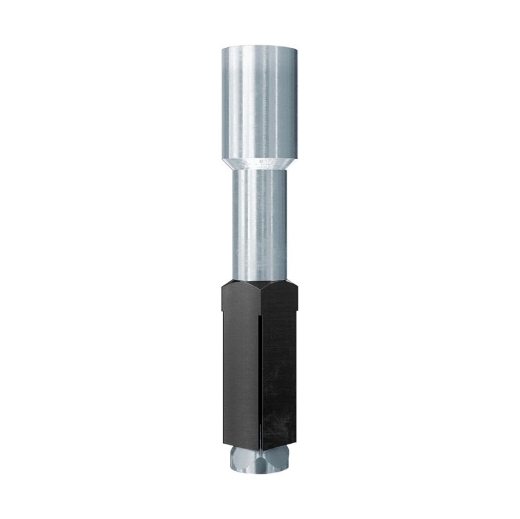
Take a look at the full Fischer general fixings range in our webshop: DuoPower, SX and S plugs, aerated-concrete plugs and brass plugs. The table below links the wall type to the right plug.
| Wall type | Best plug | How it works | Load |
|---|---|---|---|
| Solid concrete | S, SX (SX Plus) or DuoPower | Expanding in solid material | Light to medium-heavy |
| Solid brick | S, SX or DuoPower | Expanding, drill carefully | Light to medium-heavy |
| Aerated concrete | Aerated-concrete plug GB with safety screw | Form fit via spiral ribs | High in soft material |
| Hollow wall / board | Cavity anchor or system | Expanding or locking behind the board | Light to medium-heavy |
Concrete or solid brick
Dense, solid substrate? The S plug (2-way expansion) or the more powerful SX (4-way expansion) grips reliably for everyday mounting.
Uncertain or mixed wall
Not sure what the wall contains? The DuoPower adapts to the material and is the best all-rounder for most normal wall types.
Aerated concrete
Soft, porous aerated concrete? The Aerated-concrete plug GB cuts a form fit with spiral ribs and carries high loads, provided the safety screw is used.
Always use the matching safety screw
Hollow wall or board
Cavity or board material behind the surface? A cavity anchor expands or locks behind the board, where an expansion plug would spin freely.
Do not use an ordinary expansion plug
Always start with the wall structure
The first question is whether the wall is solid, porous or hollow. Solid concrete and solid brick give the plug something dense to expand into, while hollow walls depend on mechanical expansion, tilting or special anchor behaviour.
If the wall is uncertain, the safest strategy is to choose a plug that adapts better to different substrates. That is precisely why the Fischer DuoPower is on the market as a universal solution for many building materials. The more uncertain the substrate, the more value a versatile plug provides.
But when the wall is clearly special, such as aerated concrete or a hollow board wall, the specialised plug is usually the better choice. A simple check beforehand: drill a small test hole. If the drill suddenly breaks through into a cavity, the wall is hollow; if fine, light-grey, granular dust comes out that crumbles away easily, that points to aerated concrete; hard stone or concrete dust indicates solid material.
Concrete: S and SX are strong standard choices
For concrete, the classic nylon plugs from Fischer, such as the S and the SX, are the standard starting point. They are designed for solid, dense building materials where expansion provides excellent grip.
The difference between S and SX
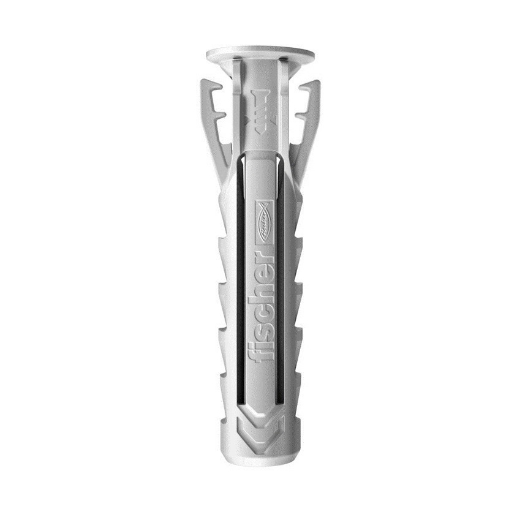
The S plug is the classic, easy-to-fit nylon plug with 2-way expansion, widely used in solid building materials such as concrete and solid brick. The SX plug is the more powerful expansion plug with 4-way expansion in all directions, with an anti-rotation feature on the neck and a pronounced collar to prevent slipping through. For sturdy everyday mounting the SX is therefore the stronger of the two. Note: Fischer is gradually replacing the SX with its successor, the SX Plus, which uses the same principle; in practice you now choose an SX or SX Plus.
For light to medium-heavy loads in concrete, these plugs are reliable and easy to place. If the load becomes heavier, or the fixing is safety-critical, it is better to switch to a stronger anchoring method than to rely on a small nylon plug.
Solid brick: like concrete, but more delicate
Solid brick can often use the same plug families as concrete, but with more care. Brick is more variable, and edges, joint zones and porous spots can affect the holding power.
This means S and SX plugs are still good choices, certainly for general mounting in solid brick. The DuoPower is particularly useful when the wall may vary from spot to spot, because it adapts to the substrate. With perforated brick this counts even more: there the plug must not cause break-out and must transfer the force behind the webs.
If the brick is old, brittle or crumbly, be more cautious with drill-hole quality and load. In those cases a stronger or more forgiving solution may be better than letting a classic expansion plug do everything.
DuoPower: the best all-rounder
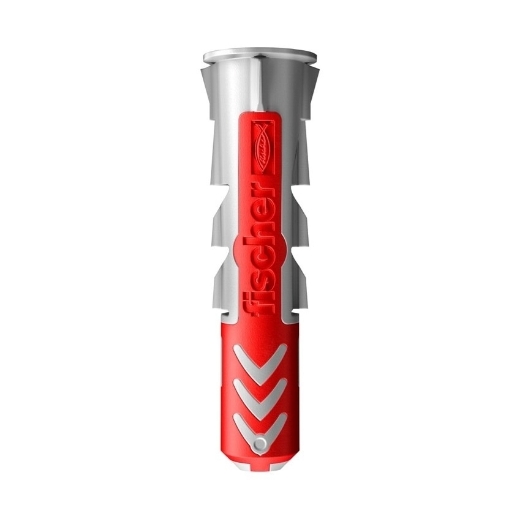
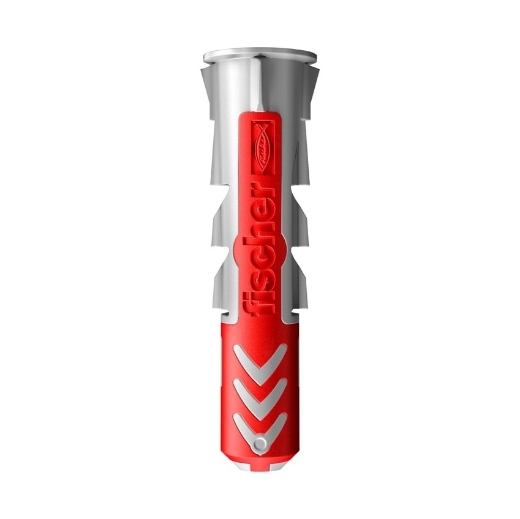
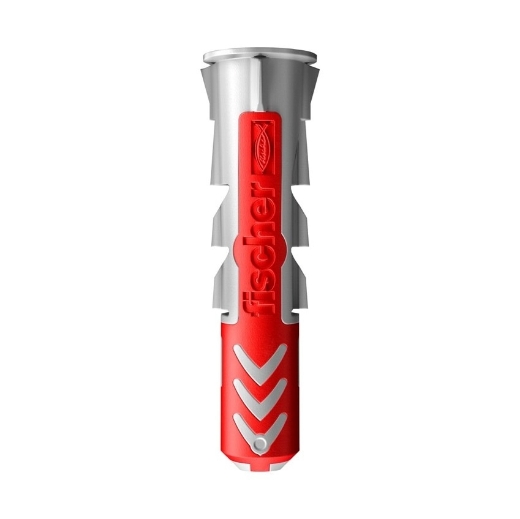
The Fischer DuoPower is the most versatile plug in this category because it automatically adapts to different materials. That makes it a smart choice if you don't know exactly what the wall contains, or if the wall changes from spot to spot.
This plug is usable in concrete, solid brick, perforated materials and some hollow substrates, because its design responds to the wall condition instead of assuming one fixed behaviour: it expands in solid material, folds in perforated brick and knots behind board material. That saves time when the substrate is mixed or uncertain.
For many DIY and professional jobs, the DuoPower is the best first choice when you want one plug that covers most normal wall types. Even so, it is no substitute for a special plug in aerated concrete or a genuine hollow-wall application. In softer materials such as aerated concrete, the long version of the DuoPower gives better load distribution, but for high or safety-critical loads in aerated concrete the special aerated-concrete plug remains the right choice.
Aerated concrete: use a special aerated-concrete plug
Aerated concrete, also called autoclaved aerated concrete, is a category of its own. It is much softer and more porous than normal concrete, so standard expansion plugs do not hold in the same way.
The Fischer Aerated-concrete plug GB is specifically made for high loads in aerated concrete. After pre-drilling, the plug is tapped into the aerated concrete with a hammer, whereby the spiral outer ribs cut a form fit into the material. This distributes the pressure more effectively and gives high load values. Important: the GB must be used together with the Fischer safety screw to achieve the certification and the maximum load capacity; the GB 10 combined with that screw is even certified for safety-relevant applications such as facade and roof constructions and railings.
This matters because aerated concrete can crumble or lose grip if the wrong plug is used. If you are fixing facade elements, railings or other important objects in aerated concrete, use the special plug instead of an ordinary nylon plug.
Hollow walls: special anchors needed
Hollow walls are not suitable for ordinary solid-wall plugs, unless the plug is specifically designed to work in a cavity. In a hollow wall, a standard plug may simply spin freely or collapse, because there is no solid mass behind the surface.
Fischer offers hollow-wall solutions in its wider range, and cavity anchors are the right family for board walls, cavity walls and similar constructions. These anchors expand behind the board or lock mechanically in the cavity.
If the object is light, some universal plugs may still work in limited hollow-wall situations. But for a reliable fixing, certainly with repeated or varying load, use a genuine cavity anchor system. Choose the anchor based on the thickness of the board material, so that it can expand correctly behind the board.
Brass plugs and load level
Brass plugs for specific applications
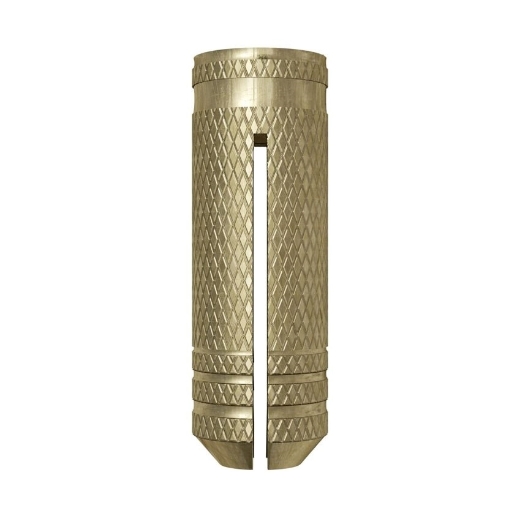
Brass plugs are used for specific mounting situations in solid substrates. The Fischer brass plug MS is a brass expansion plug for metric bolts and threaded rods, suitable for anchoring non-safety-relevant attachments in concrete and solid masonry, for example appliances, control cabinets and shelves. When the bolt is screwed in, the wings expand and clamp the plug against the drill-hole wall.
The compact design saves drilling work and mounting time, and brass is more corrosion-resistant and durable than an ordinary nylon plug. Important to remember: the brass plug is not a replacement for a certified heavy-duty anchor. If it concerns a safety-critical or heavy structural load, choose an anchor system designed for that instead of a brass plug.
Load still counts
You don't choose a plug on wall type alone. The weight of the object and whether the load is static or moving also count. A light shelf in solid brick can do fine with a simple nylon plug; a heavier bracket or a safety-critical fixing may require a stronger system or even a different anchor class. If the fixing is critical, don't assume that the most common plug suffices: choose the plug for both the wall and the load.
Solid versus perforated masonry
Some masonry behaves like solid material, while others behave more like a hollow or perforated structure. That distinction matters, because the plug must match how much actual material there is to grip into.
S and SX plugs are good when there is enough solid material to bite into. The DuoPower gives extra flexibility when the wall is not perfectly predictable. For perforated or weak masonry, the plug must manage the force without causing break-out, and that is why a wrong assumption about the wall type is one of the quickest ways to get a poor fixing.
Common mistakes in plug choice
🧊 Wrong plug in aerated concrete
- A concrete plug in aerated concrete: aerated concrete is too soft and porous for many standard plugs, so the fixing does not reach the intended holding power. Use the Aerated-concrete plug GB.
- Leaving out the safety screw with the GB: without the matching screw you don't achieve the certification and the maximum load capacity.
🕳️ Solid plug in a hollow wall
- A solid-wall plug in a hollow wall: the plug never reaches good expansion because there isn't enough solid material behind the surface. Use a cavity anchor.
🏷️ Choosing on brand name instead of substrate
- Choosing on brand name alone: even a premium plug performs poorly in the wrong wall type. The substrate determines the choice, not the logo.
- Seeing brass as a heavy-duty solution: the brass plug is for non-safety-relevant applications, not for heavy structural loads.
Quick decision logic
If you want the shortest possible answer, use this logic before you drill:
- Concrete: S or SX plug, or DuoPower if you want a universal option.
- Solid brick: S, SX or DuoPower, depending on load and wall condition.
- Aerated concrete: Aerated-concrete plug GB with safety screw.
- Hollow walls: cavity anchors or Fischer cavity systems.
- Heavy or safety-critical loads: consider a stronger or specialised anchor system.
The rule of thumb: solid walls like expansion plugs, aerated concrete requires a special plug, and hollow walls require a genuine cavity system. View the full selection via our Fischer general fixings category or find all your fixings in Belgium on the DHZ-Proshop webshop.
Frequently asked questions about Fischer plugs
Which Fischer plug do I use in concrete?
What is the difference between the S and the SX plug?
Which plug do I use in aerated concrete?
Is the DuoPower suitable for all wall types?
Why can't an ordinary plug go in a hollow wall?
What is a brass plug for?
Can I use an SX plug in aerated concrete?
How do I know if my wall is solid, hollow or aerated concrete?
Posted by the fixing expert of DHZ-Proshop, premium dealer of Fischer and your
Une question sur cet article ?
Notre chat expert connaît tout notre assortiment et répond immédiatement — ou contactez notre équipe.