Which Nut Will Not Rust on Your Outdoor Project? (A2 stainless, A4 stainless and hot-dip galvanized steel)
The nut that is least likely to rust on your outdoor project is made from A4 stainless steel for aggressive environments, A2 stainless steel for standard outdoor use, or hot-dip galvanized steel for a budget-friendly solution in moderate exposure. The right choice depends on how wet, salty, or chemically aggressive the environment is, not just on the fact that it is outside.
Which nut will not rust on your outdoor project? In this guide, you will learn everything about corrosion resistance, the differences between A2 and A4 stainless steel, and why the combination of your nut, bolt, and substrate is crucial. View our assortment of nuts for outdoor constructions at DHZ-Proshop.
The right materials for every outdoor environment
The first step in choosing the right nut is assessing the environment. A covered garden frame and a coastal railing are two completely different challenges, even though both are technically located outdoors.
A2 stainless: the reliable standard
A2 stainless steel is the most commonly used stainless steel option for fasteners. It is extremely suitable for general indoor and outdoor use where moisture is present, but there is no severe chloride or salt exposure. This makes it the perfect choice for garden furniture, pergolas, sheds, brackets, and countless construction or DIY projects exposed to normal weather. It offers a strong balance between corrosion resistance, availability, and price. The limitation of A2 is that it is not the best choice when salt, fertilizer, pool chlorine, or persistent wetness are part of the environment; in those conditions, it can still corrode sooner than you would like.
A4 stainless: the heavy-duty choice for aggressive environments
A4 stainless steel is the stronger choice for harsh outdoor conditions. It is widely used in marine and chemical environments because, in addition to chromium and nickel, it also contains the addition of molybdenum. This specific element significantly improves resistance to chloride-related corrosion and pitting. Use A4 when rust would be expensive, dangerous, or extremely difficult to repair: coastal structures, docks, seaside railings, outdoor lighting that gets constantly wet, and installations that must remain maintenance-free for years. A4 is more expensive to purchase than A2, but it gives you a much larger safety margin in aggressive environments.
Hot-dip galvanized: the budget-friendly workhorse
Hot-dip galvanized nuts are a strong alternative when you want decent corrosion protection for outdoors without paying the high price of stainless steel. The zinc layer is much thicker and more durable than simply electroplated nuts, which is why hot-dip galvanized fasteners are often used in heavy structures and outdoor applications. They are highly usable in moderate outdoor conditions where exposure is real but not of marine severity, and a practical choice for structural frames, outdoor support work, and general construction projects where the coating will hold up for many years. The disadvantage is that it is still a coating: once it is damaged or worn, the underlying steel becomes vulnerable to corrosion.
Electroplated zinc and bright steel: avoid outdoors
Electroplated zinc nuts or bright steel nuts are absolutely not suitable for permanent outdoor projects. The zinc layer is too thin, and the steel is unprotected. As soon as these nuts are exposed to rain, dew, or humid air, they will start to rust within a short time. Use these exclusively for dry indoor applications or temporary structures that will later be coated anyway.
The differences between A2 and A4 stainless steel in practice
Choosing between A2 and A4 is often the biggest dilemma when purchasing fasteners. Both materials look identical and feel the same, but their chemical composition determines their fate in the outdoors.
| Property | A2 Stainless (AISI 304) | A4 Stainless (AISI 316) |
|---|---|---|
| Composition | Chromium and Nickel | Chromium, Nickel, and Molybdenum |
| Salt resistance | Moderate, sensitive to pitting | Excellent, very high resistance |
| Ideal application | Sheds, fences, facades, standard outdoor work | Coastal areas, swimming pools, chemical industry, docks |
| Price indication | Affordable and widely available | Slightly higher, but cheaper than replacement |
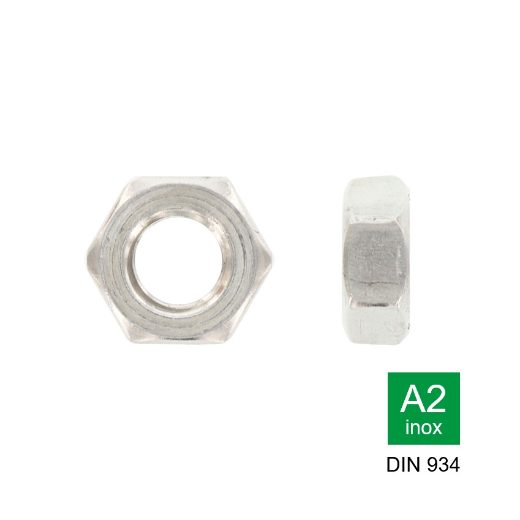
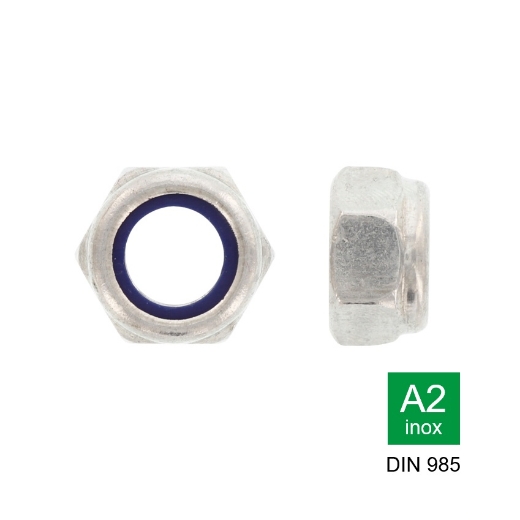
For most DIYers and professional construction projects inland, A2 stainless steel is the absolute standard. You will find this in our assortment of hex nuts and lock nuts in stainless steel for the best price-quality ratio. However, as soon as you work within a few kilometres of the coastline, or realise a project around a chlorinated swimming pool, the switch to A4 is not a luxury, but a strict requirement.
The pitfall of mixed metals and galvanic corrosion
Outdoor rust problems are not always the fault of the nut itself. Sometimes the real problem is galvanic corrosion between dissimilar metals in the presence of moisture. When you combine a stainless steel nut with a bolt of a different metal, or when the fastener passes through an aluminium profile, a chemical reaction can occur. Water acts as an electrolyte here, and the metals have a different nobility in the galvanic series, so the less noble metal starts to dissolve. The nut itself technically remains intact, but the surrounding material is slowly eaten away. This leads to structural weakening and ugly white or brown deposits.
The safest approach is to keep the entire connection in a compatible corrosion class: preferably use a stainless nut on a stainless bolt. If you must combine different metals, isolation is the key. Use plastic washers, EPDM washers, or special insulating pastes to break the direct metal-on-metal contact. The substrate is just as important as the nut itself: a good outdoor nut must always be chosen with the complete assembly in mind.
The right nut for your specific project
A garden building, a carport, and a coastal deck all require a different approach. The right choice depends on both the environment and the accessibility of the connection.
Standard outdoor work and garden timber
For fences, pergolas, garden sheds, and standard wood constructions, A2 stainless steel is the simplest and safest standard choice, offering excellent protection against rain and normal weather. Be careful with hardwood species such as oak or chestnut: these contain a lot of tannic acid that can attack the passive layer of stainless steel, so consider A4 stainless steel or specially coated fasteners there.
Heavy structures and steelwork
When assembling heavy steel structures, such as carports, halls, or bridge railings, the tensile strength of the fastener is crucial. Stainless steel bolts and nuts generally have a lower tensile strength than high-grade steel equivalents, so for these applications hot-dip galvanized is the best choice: it combines the enormous strength of steel with the heavy corrosion protection of a thick zinc layer. You will find these when you look for galvanized nuts for heavy structures.
Coastal areas, swimming pools, and chemical environments
If you are building a deck, fence, or structure in a coastal area, or directly around a chlorinated swimming pool, there is only one right choice: A4 stainless steel. The addition of molybdenum is the only way to keep the aggressive chlorides and salts at bay. Any other nut will show signs of pitting corrosion within a few seasons and eventually seize up.
The accessibility rule
There is an important rule of thumb for outdoor projects: the harder the nut is to reach or replace later, the higher the corrosion class must be. If the nut is hidden in a closed box, high up in a roof structure, or embedded in concrete, always upgrade to the best possible corrosion-resistant option. Fasteners that are difficult to access should be chosen with more margin, not less.
Frequently asked questions about nuts and corrosion
Can I use a galvanized nut outdoors?
What is the exact difference between A2 and A4 stainless steel?
Can I use a stainless steel nut on a steel bolt?
Why is my nut seized tight after a few years?
Is a stainless steel nut strong enough for structural work?
How do I prevent white deposits on my aluminum structure?
Posted by the fastening expert at DHZ-Proshop, your partner for bolts, nuts, threaded rods, and specialized fasteners for every environment. Webshop available 24/7 and pickup point in Beerse. Questions about corrosion resistance or the right nut for your project? Contact our team or view our complete assortment of nuts and fasteners for your next project.