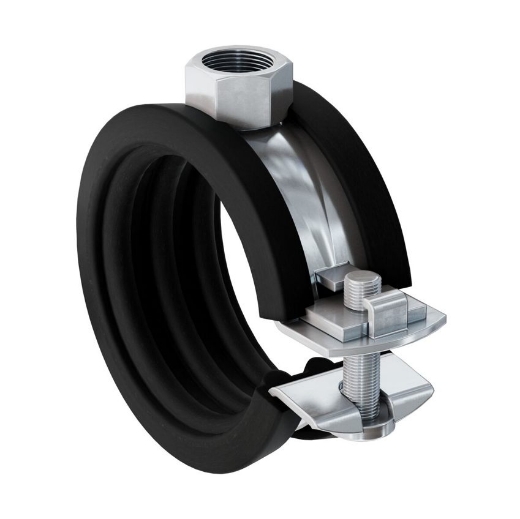
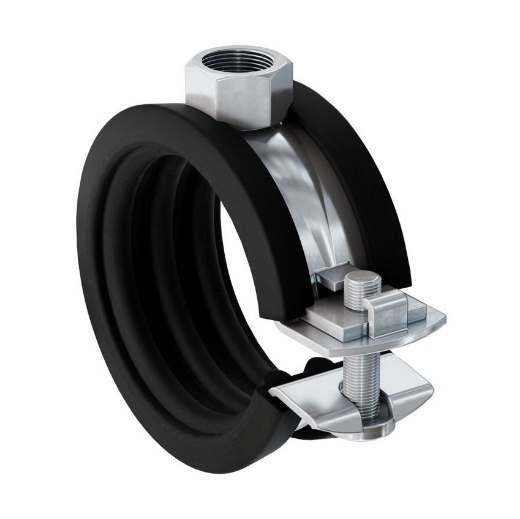
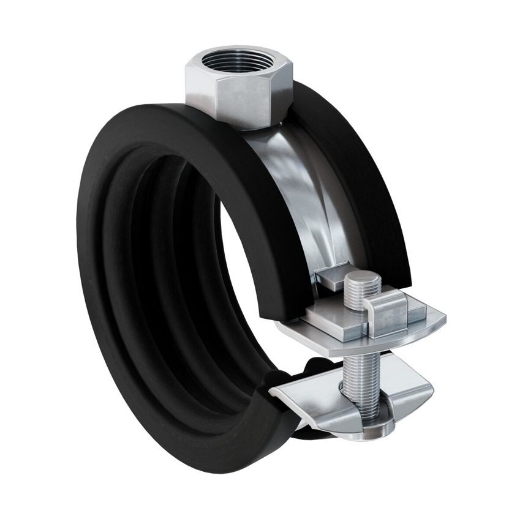
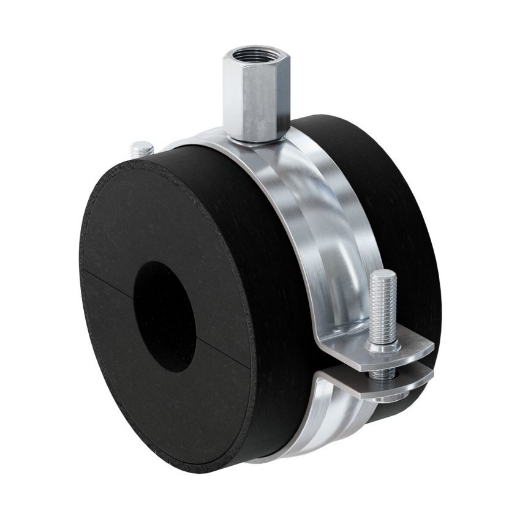
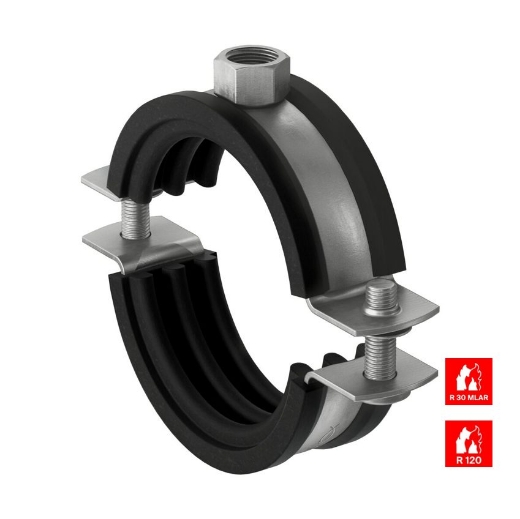
You choose a pipe clamp in three steps: measure the outer pipe diameter, decide whether you need a rubber or silicone lining for noise damping, and pick the fixing type that matches your wall or ceiling. Fischer's Samontec range covers clamping widths from 0-20mm up to 101-150mm, in galvanized steel or inox A2, with single-screw, hinged or double-screw designs. Get the diameter wrong and the pipe rattles or the clamp cracks; get the lining wrong and a heating pipe ticks against the wall for years.
Which pipe clamp fits your pipe? Browse the full pipe clamp range at DHZ-Proshop and follow the five steps below to pick the right one in minutes.
- Measure the outer diameter of the pipe first; clamping ranges run from 0-20mm to 101-150mm across the Samontec line.
- A rubber-lined clamp (FGRS) dampens vibration and noise; an unlined "koudebeugel" (FRSK) suits hidden cold water pipes.
- Hinged clamps with M8/M10 thread install around a pipe that's already in place, without sliding it through.
- Inox A2 clamps resist corrosion in bathrooms, kitchens and outdoor runs; galvanized steel is fine for dry indoor heating lines.
- A silicone-lined clamp handles the heat of central heating pipes better than a standard rubber insert.
Which pipe clamp for which diameter and job?
The table below lists the real Samontec and Fischer clamps sold by DHZ-Proshop, sorted by clamping range so you can match your pipe in one glance.
| Product | Clamping range | Lining / material | Ideal for |
|---|---|---|---|
| Samontec FGRS 15-19 | 0-20mm | Rubber-lined, galvanized | Small branch lines, thin copper or PVC |
| Samontec slangklem SGS 9 W2 10-16 | 0-20mm | Worm-drive, galvanized | Flexible hoses, garden hose connections |
| Samontec FGRS 25-30 | 21-40mm | Rubber-lined, galvanized | Standard water and heating pipes |
| Fischer koudebeugel FRSK 32-35 | 21-40mm | No lining, galvanized | Cold water pipes in cellars, technical rooms |
| Samontec FRS 1/2" inox A2 | 21-40mm | No lining, stainless A2 | Bathrooms, outdoor runs, drinking water |
| Samontec FRSH 32-37, silicone inleg | 21-40mm | Silicone lining, heat-resistant | Central heating and hot supply pipes |
| Samontec FGRS 40-44 | 41-60mm | Rubber-lined, galvanized | Larger supply and return pipes |
| Samontec FGRS 50-55 | 41-60mm | Rubber-lined, galvanized | Soil, waste and wide supply pipes |
| Fischer koudebeugel FRSK 42-45 | 41-60mm | No lining, galvanized | Cold water lines, larger diameter |
| Samontec FRS 1 1/4" inox A2 | 41-60mm | No lining, stainless A2 | Outdoor or corrosive environments, larger pipes |
| Samontec FGRS 46-52 M8/M10, hinged | 41-60mm | Hinged, galvanized, M8/M10 thread | Threaded rod or angled mounting |
| Samontec rondstaalbeugel ETR 90-102 | 81-100mm | Two-piece bracket, galvanized | Wide pipes, suspended ceiling mounting |
| Samontec FRS 102-116 M8/M10 | 101-150mm | Galvanized, M8/M10 thread | Large diameter drainage or supply pipes |
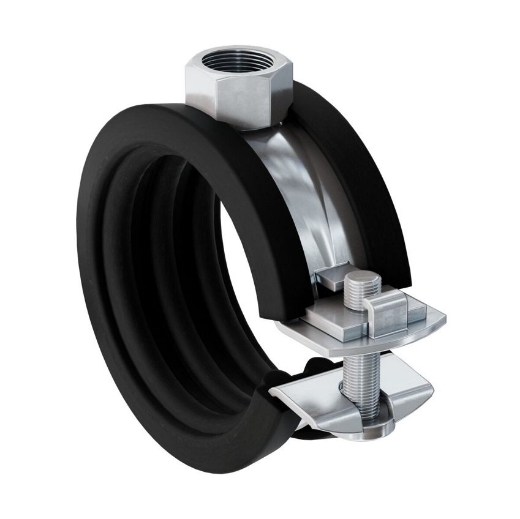
Standard pipe, needs damping
For a 21-40mm supply or heating pipe running along a visible wall, the rubber-lined FGRS 25-30 is one of our most chosen clamps for exactly this job.
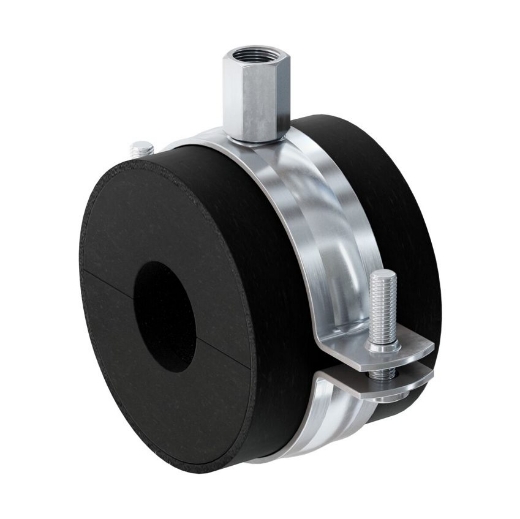
Cold water, hidden pipe
In a cellar or technical room, noise from a cold water line rarely matters. The unlined koudebeugel FRSK 32-35 does the job without extra cost.
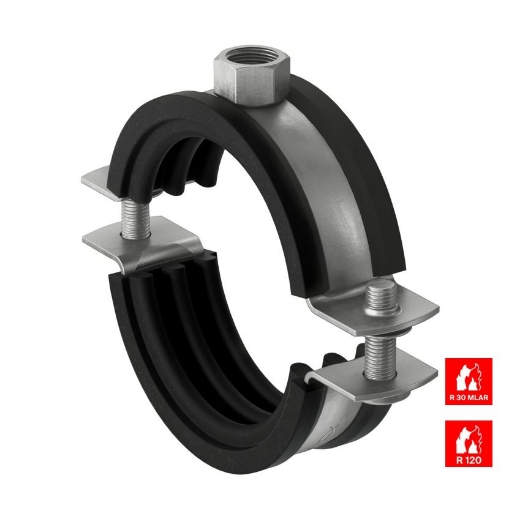
Damp or outdoor pipework
Bathrooms, kitchens and outdoor runs corrode plain steel fast. The inox A2 FRS 1/2" resists rust where galvanized clamps eventually fail.
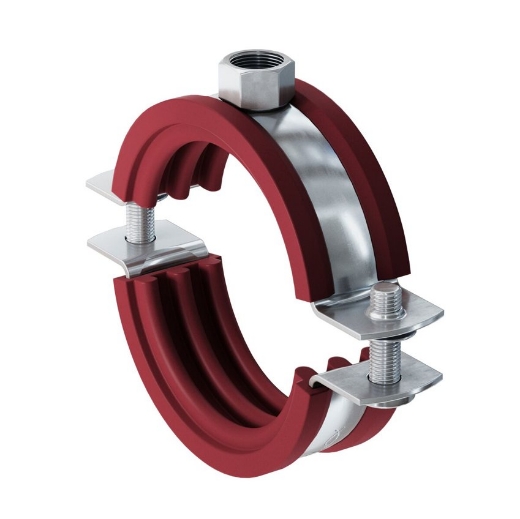
Hot heating pipe
A standard rubber insert softens under sustained heat. The FRSH 32-37 with silicone lining is built to handle central heating temperatures.
Step 1: Measure the outer pipe diameter
Wrap a tape measure around the pipe, read the circumference, then divide by 3.14 to get the outer diameter, or simply hold a caliper across the pipe. Write that number down before you shop; it is the only figure that matters for sizing. The Samontec range covers this from 0-20mm (FGRS 15-19, slangklem SGS 9) right through to 101-150mm (FRS 102-116), with steps at 21-40mm, 41-60mm and 81-100mm in between.
Always measure the pipe itself, not the insulation around it. A clamp that grips insulation instead of metal or PVC will loosen within weeks once the foam compresses. If your pipe sits right between two ranges, size up rather than down; a slightly wider clamp still seats correctly, a too-narrow one will not close.
Step 2: Decide if you need a rubber or silicone lining
A lined clamp absorbs vibration and expansion noise; an unlined clamp is simpler and works fine where sound never becomes an issue. Choose a rubber-lined FGRS clamp for heating pipes, hot water lines, or any pipe running through or near a living space, since metal-on-metal contact ticks loudly as the pipe heats and cools. Choose the unlined koudebeugel (FRSK) for cold water supply pipes hidden in a cellar, garage or crawl space, where that same noise is never heard anyway.
For pipes that run genuinely hot, such as central heating flow lines, a standard rubber liner degrades faster than it should. The FRSH 32-37 uses a silicone insert instead, built specifically to keep clamping tight after years of thermal cycling.
Step 3: Pick single-screw, hinged or double-screw fixing
Most of the clamps in this range close with a single screw, which is fast to tighten and easy to reposition during rough plumbing. The FGRS and FRSK series both use this quick omega-style closure across every diameter from 0-20mm to 60mm.
When a pipe is already fixed at both ends, sliding a closed clamp over it is not an option. The hinged FGRS 46-52 M8/M10 opens on a pivot, wraps around the pipe from the side, and locks with its integrated M8/M10 threaded stud, so you never need to disconnect the pipe run. For genuinely large pipes, the two-piece rondstaalbeugel ETR 90-102 works the same way but is built for 81-100mm diameters and suspended mounting. Flexible hose, by contrast, calls for a true worm-drive double-screw clamp such as the slangklem SGS 9 W2 10-16, which tightens gradually around a soft-walled hose rather than clicking shut like the rigid pipe clamps.
Step 4: Choose galvanized steel or stainless A2
Galvanized steel handles dry, indoor conditions well and is the standard choice for heating installations behind walls or in utility rooms. For anywhere damp, humid or outdoors, switch to inox A2: bathrooms, kitchens, outdoor rainwater pipes and drinking water lines all benefit from its corrosion resistance.
The FRS 1/2" and FRS 1 1/4" inox A2 clamps cover 21-40mm and 41-60mm respectively and skip the rubber lining, since stainless steel does not need the same protective barrier that galvanized steel does against condensation. Choosing galvanized purely to save a step in a wet room is a false economy; rust stains on tile grout are hard to remove.
In our shop in Beerse, customers fitting a visible heating pipe reach for the rubber-lined FGRS 25-30 far more often than any unlined alternative in that size.DHZ-Proshop vakteam, Beerse
Step 5: Mount the clamp correctly
Screw a standard clamp straight into a wall or joist through its mounting hole using an appropriate wall plug, and tighten until the pipe sits firm but can still be nudged by hand; over-tightening a lined clamp squeezes the rubber flat and cancels its damping effect. For pipes running below a ceiling, thread an M8 or M10 rod into the hinged FGRS 46-52 or the FRS 102-116 and suspend the clamp from an overhead fixing instead of the wall.
On a long hot water run, leave the clamp screw at a moderate torque rather than fully rigid, since copper and PVC both expand slightly with heat; a clamp locked bone-tight can bow the pipe over a long straight section. Space clamps close enough that the pipe cannot sag between them, and always place one within a short distance of every fitting, elbow or valve.
Common mistakes
- Sizing the clamp to the insulation, not the pipe: measure the bare pipe diameter, then add insulation clearance separately if needed.
- Fitting an unlined clamp on a hot pipe: the metal edge ticks with every heating cycle and eventually marks the pipe.
- Using galvanized steel in a bathroom or outdoors: switch to inox A2 wherever moisture is a constant factor.
- Forcing a closed clamp onto a pipe already fixed at both ends: use a hinged model instead of disconnecting the pipe run.
Browse the complete range in our pipe clamp category to find the exact diameter and lining you need.
Frequently asked questions about pipe clamps
Which pipe clamps are the best?
What pipe clamp size do I need for my pipe diameter?
What are pipe clamps used for?
What type of pipe works with a pipe clamp?
Is there a standard pipe clamp size chart?
Where can I buy pipe clamps in Belgium?
Compiled by the trade team of DHZ-Proshop, your DIY and professional supplier with a shop and pickup point in Beerse. What we advise most often in the shop is to measure the pipe first and only then pick lining and material, never the other way round. Questions about which clamp fits your installation? Contact our team or browse the full pipe clamp range.