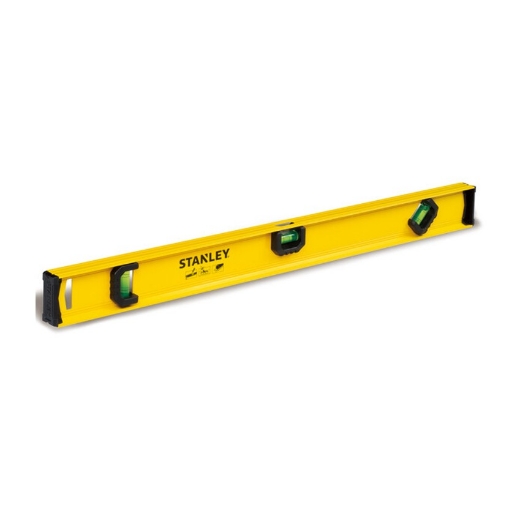
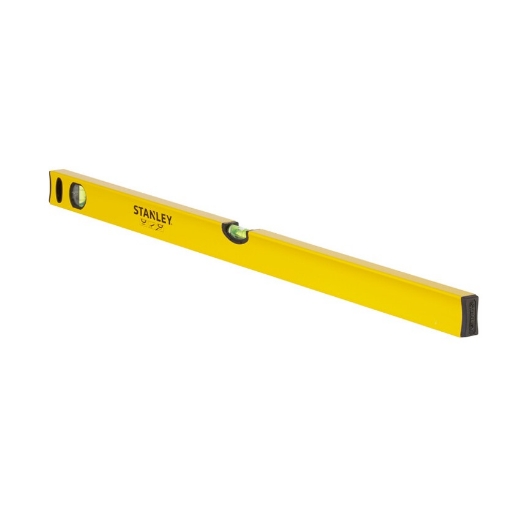
Pick your measuring tool by the job, not by habit. Use a folding rule for quick marks up to 2m, a tape measure for anything longer on site, a spirit level to check that something is truly horizontal or vertical, and an angle level for mitres, staircases and corners. Stanley's I-Beam spirit level, for example, comes in an 800mm length with a 180° vial, so you can read it from either side without turning it around. The wrong tool for the job costs you time and, worse, a wall unit that isn't level.
Not sure which measuring tool suits your project? Browse the full Stanley measuring instruments range at DHZ-Proshop. This guide walks you through the choice step by step.
- A folding rule is fastest for marks up to 2m; a tape measure takes over beyond that.
- Spirit level length should roughly match your longest surface: 200mm for fittings, 800-1000mm for shelves and worktops.
- A 180° vial lets you read a spirit level from both sides without repositioning it.
- An angle level, not a standard spirit level, is the right tool for mitres and staircases.
- A laser level adds value on long runs and multiple points; for a single quick check a spirit level is faster.
Which measuring tool suits which job? Quick overview
The table below lines up real Stanley tools by task, so you can match your job to the right measuring instrument in one glance. Full details and specifications are on each product page in our measuring instruments range.
| Tool | Model | Key spec | Ideal for |
|---|---|---|---|
| Folding rule | Stanley Vouwmeter 2m x 15mm | 2m reach, wooden sections | Marking cuts and quick checks at the bench |
| Tape measure | Stanley Tylon 5m x 19mm | 5m range, 19mm blade | Everyday DIY measuring around the house |
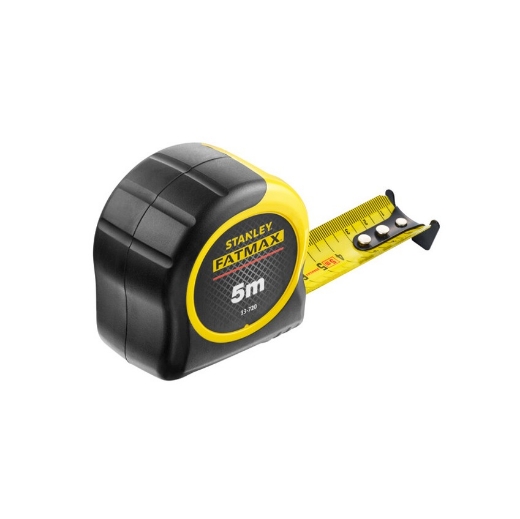
| Heavy-duty tape measure | Stanley FatMax Blade Armor 5m x 32mm | 5m range, 32mm blade | Long unsupported reach when working solo |
| Long tape measure | Stanley Tylon 8m x 25mm | 8m range, 25mm blade | Bigger rooms, longer walls and runs |
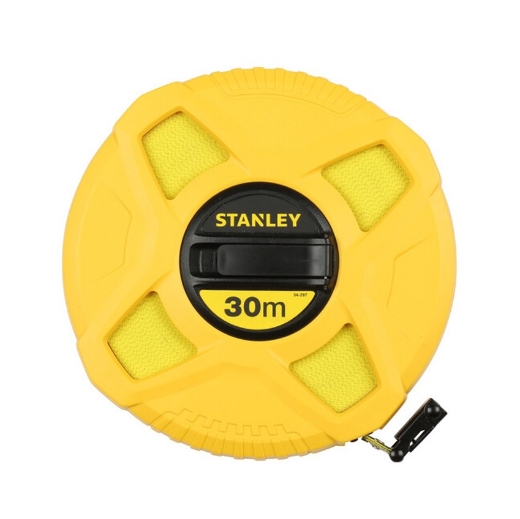
| Land measuring tape | Stanley Landmeter Fiberglas 30m | 30m fiberglass, closed case | Garden, plots and outdoor distances |
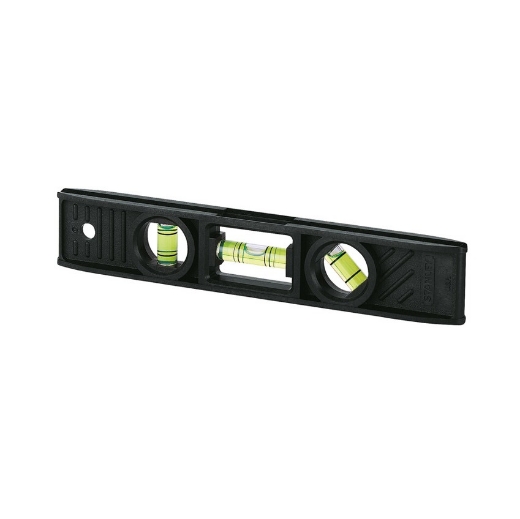
| Compact spirit level | Stanley Torpedo 200mm 3L | 200mm, 3 vials | Sockets, fittings and tight spaces |
| General-purpose spirit level | Stanley I-Beam 800mm 3L, 180° vial | 800mm, readable from both sides | Shelves, doors and cabinets |
| Angle level | Stanley Hoekwaterpas | Compact corner design | Mitres, corners and staircases |
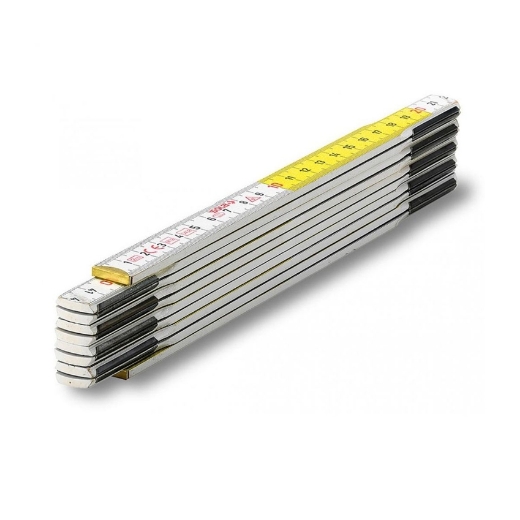
Folding rule
One of our most chosen tools for quick marking at the bench. Rigid, self-standing and ideal for cut lists up to 2m.
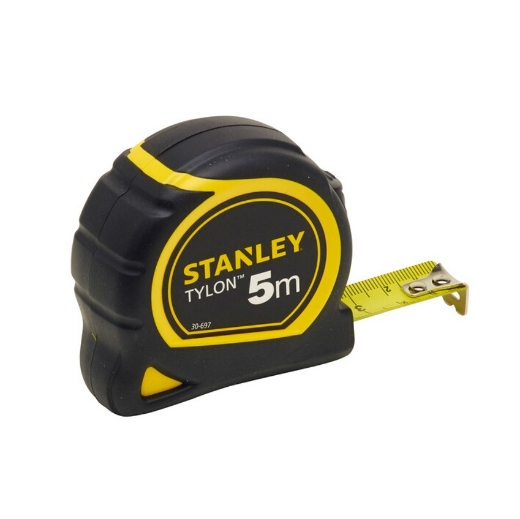
Tape measure
The everyday choice for anything longer than a folding rule can handle, from room widths to furniture placement.
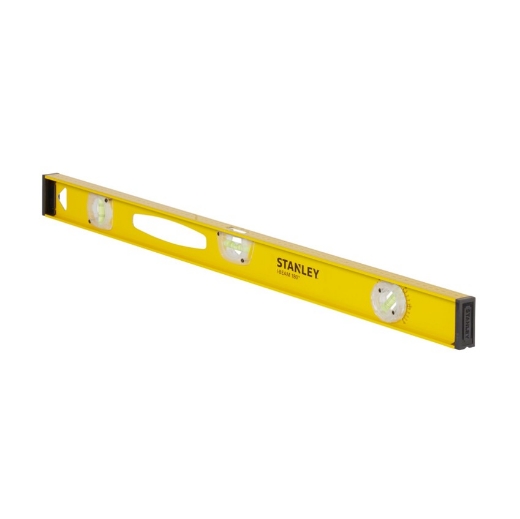
Spirit level
Confirms that shelves, cabinets and worktops sit truly horizontal or vertical before you drill a single hole.
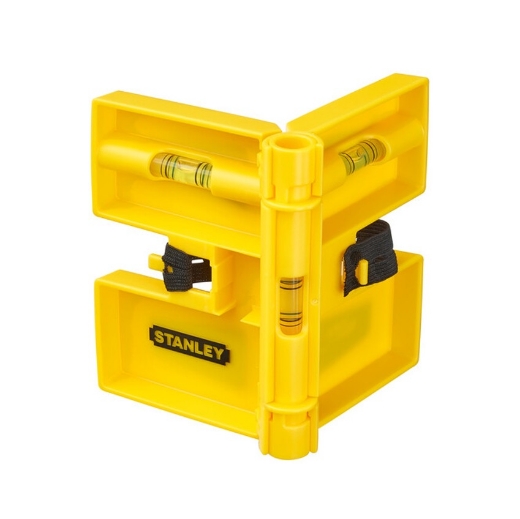
Angle level
Reads slopes and corners in degrees, which a standard spirit level cannot do accurately on its own.
Which measuring tool do you need for a typical DIY job?
Match the tool to the type of measurement, not the other way round. Need a straight length? Reach for a folding rule or tape measure. Need to confirm level or plumb? That's a spirit level's job. Working with a slope, a mitre or a staircase? An angle level reads the actual degree, which a standard level cannot.
Most home workshops need at least three of these tools side by side. A cabinet installation, for instance, starts with a tape measure to check the opening, continues with a spirit level to set the unit true, and finishes with an angle level if the wall itself isn't perfectly square.
Folding rule or tape measure: which measuring tape is best?
Choose a folding rule for short, repeated measurements at the workbench, and a tape measure for anything on site or longer than its reach. The Stanley Vouwmeter unfolds to a rigid 2m, stays straight without support, and won't retract mid-measurement the way a tape sometimes does when reaching across a wide panel.
For site work, blade width matters as much as length. The Stanley FatMax Blade Armor 5m x 32mm stands out further unsupported than a narrower blade, which is exactly what you want when measuring a ceiling height alone. Working in a smaller space or a toolbox with limited room? The Stanley Tylon Duallock 3m x 13mm is compact enough to carry everywhere. For plots, gardens and long outdoor distances, a fiberglass land tape such as the Stanley Landmeter Fiberglas 20m or the 30m version does a job neither a folding rule nor a standard tape can handle.
Which spirit level do you need for the job?
Match the spirit level's length to the surface you're checking, not the other way round. A short level on a long surface amplifies small errors over distance; a long level in a tight spot simply won't fit.
For sockets, brackets and other small fittings, the Stanley Torpedo 200mm 3L slips into places a full-size level never reaches. Carrying tools from job to job? The Stanley FatMax Pro Box Torpedo 228mm is built to survive life in a tool bag. For general jobs like hanging shelves or setting a door frame, step up to an I-Beam level: the 600mm version covers most cabinets, while the 800mm model with a 180° vial lets you read the bubble from either side without walking around the workpiece. For worktops, decking and other long runs, the Stanley Classic 1000mm gives you the longest reference edge in this range.
In our shop in Beerse, tradespeople reach for a torpedo level for socket boxes and small fittings, then pick up an I-Beam level the moment the job involves a shelf, a door or anything wider than a hand span.DHZ-Proshop professional team, Beerse
Spirit level or laser level: when does a laser add value?
A laser level earns its place when you need to check multiple points at once across a room, a wall or a ceiling; a spirit level stays the faster, no-battery choice for a single, one-off check. A laser projects a continuous beam or a line across a distance, so you see straight away whether a whole row of cabinets or tiles lines up, instead of moving a level from point to point and re-checking each time.
For a shelf, a picture frame or a door frame, a spirit level answers the question in seconds and needs no charging. For a run of kitchen units, a suspended ceiling grid or tiling a full wall, a laser saves real time because one setup covers the whole surface. If your job fits the second description, browse the full measuring instruments range to compare what's currently in stock against your specific task.
Which tool do you use to measure angles and corners?
Use an angle level, not a standard spirit level, whenever you need an actual degree reading rather than a simple horizontal or vertical check. The Stanley Hoekwaterpas is built compact enough to sit directly in a corner, mitre joint or staircase stringer where a full-length level can't reach.
Before you measure or drill into a wall, it also pays to know what's behind it. The Stanley Multi-meter helps you locate studs, pipes and cables behind a surface, so your careful angle and length measurements aren't undone by an unexpected obstruction once you start drilling.
Common mistakes to avoid
- Using a folding rule beyond its reach: stretching a 2m folding rule across a longer span invites reading errors; switch to a tape measure instead.
- Picking too short a spirit level: a 200mm torpedo level on a 1000mm worktop magnifies tiny inaccuracies over the full length.
- Ignoring the 180° vial: a level with a 180° vial can be read from both sides; skipping that feature means walking around the workpiece every time.
- Skipping the detection step: drilling or measuring for fixings without checking for hidden studs or cables first turns an accurate measurement into a costly mistake.
Frequently asked questions about measuring tools
Which measuring tool should I use for a typical DIY job?
Which measuring tape is best: a folding rule or a tape measure?
Should I choose a spirit level or a laser level?
Does a laser level replace a spirit level completely?
Which tool do I use to measure length accurately?
Which tool do I use to measure an angle?
Compiled by the professional team of DHZ-Proshop, your DIY and trade supplier with a shop and collection point in Beerse. Wat wij in de winkel het vaakst adviseren is to start with the shortest tool that reaches the job: a folding rule for the bench, a tape measure once you're on site, and a spirit level the moment something needs to be level. Questions about which measuring tool fits your project? Contact our team or browse the full measuring instruments range.