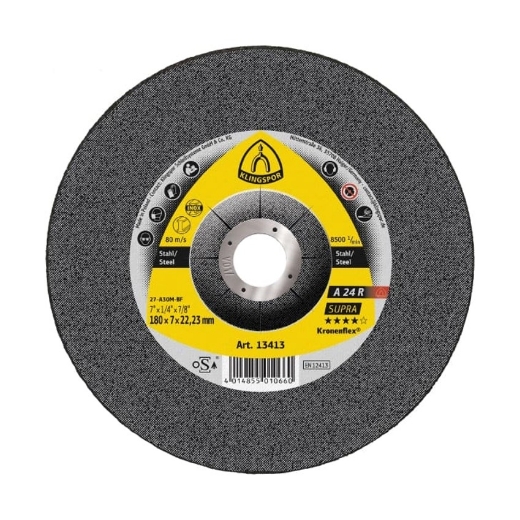
You choose a grinding disc based on three things: the material you're working, the disc thickness, and the grit. Steel and cast iron take an aluminium oxide disc marked "A", stone and concrete need a silicon carbide disc marked "C", and stainless steel demands an iron-free, low-sulphur disc built specifically for inox. Klingspor Kronenflex discs cover diameters from 110mm to 230mm and thicknesses from 4mm to 8mm, all fitted with a standard 22.23mm bore. Get the combination wrong and you either burn through the workpiece too slowly or overheat it and ruin the finish.
Not sure which grinding disc fits your angle grinder? Browse the full range of Klingspor afbraamschijven at DHZ-Proshop and follow the five steps below to pick the right one.
- An "A" disc (aluminium oxide) is for steel, cast iron and aluminium; a "C" disc (silicon carbide) is for stone and concrete.
- Stainless steel needs a dedicated inox disc, free of iron and sulphur, so it doesn't cause corrosion in the weld seam.
- Thicker discs (8mm) remove more material per pass; thinner discs (4mm) are more manoeuvrable for lighter grinding.
- Every Klingspor disc in this range shares a 22.23mm bore, so fit depends on your grinder's flange, not the disc itself.
- Never exceed the rated diameter of your angle grinder's guard, and always check the disc for cracks before mounting.
Which grinding disc fits which job? Full overview
The table below lists the Klingspor Kronenflex discs available at DHZ-Proshop, grouped by the material they're designed for. Use it to match your job to a diameter, thickness and grit before you order.
| Product | Grit / bond | Diameter x thickness | Ideal for |
|---|---|---|---|
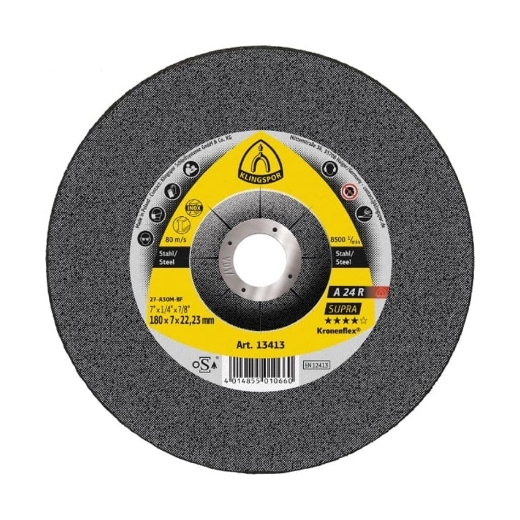
| A 24 R Supra Kronenflex 125x6mm | A24 R (coarse, aluminium oxide) | 125 x 6mm | Steel, stainless steel, cast iron |
| A 24 R Supra Kronenflex 230x8mm | A24 R (coarse, aluminium oxide) | 230 x 8mm | Heavy stock removal on steel |
| A 24 R Supra Kronenflex 230x4mm | A24 R (coarse, aluminium oxide) | 230 x 4mm | Lighter grinding on steel |
| A 30 R Supra Kronenflex cup wheel 110x55mm | A30 R (medium, aluminium oxide) | 110 x 55mm | Weld seam smoothing on steel |
| A 16 R Supra Kronenflex cup wheel 110x55mm | A16 R (very coarse, aluminium oxide) | 110 x 55mm | Fast, aggressive removal on steel |
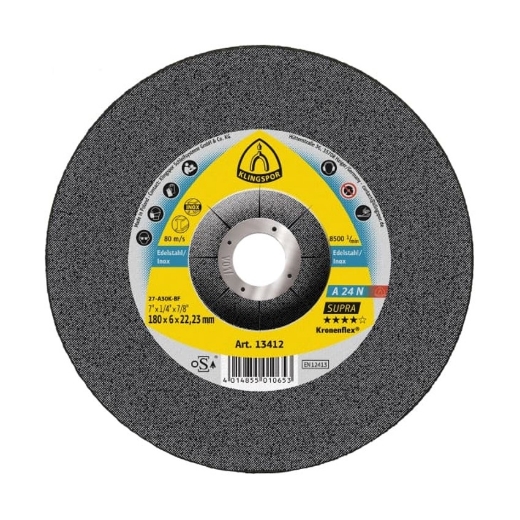
| A 24 N Supra Kronenflex 230x6mm | A24 N (coarse, medium bond) | 230 x 6mm | Stainless steel, aluminium |
| A 624 T Supra Kronenflex 230x6mm | A624 T (dedicated inox bond) | 230 x 6mm | Stainless steel, steel, cast iron |
| A 46 N Supra Kronenflex 125x6mm | A46 N (fine, medium bond) | 125 x 6mm | Aluminium, non-ferrous metals |
| A 46 N Supra Kronenflex 180x8mm | A46 N (fine, medium bond) | 180 x 8mm | Heavier aluminium grinding |
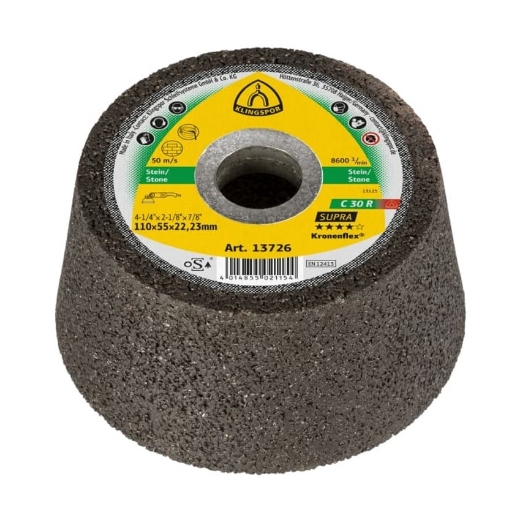
| C 30 R Supra Kronenflex cup wheel 110x55mm | C30 R (medium, silicon carbide) | 110 x 55mm | Stone, concrete, cast iron |
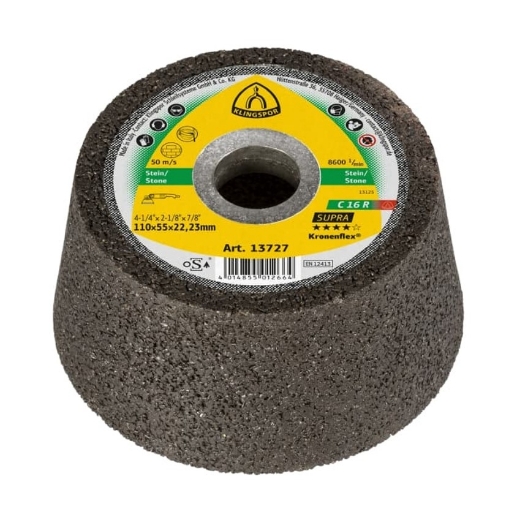
| C 16 R Supra Kronenflex cup wheel 110x55mm | C16 R (very coarse, silicon carbide) | 110 x 55mm | Fast removal on stone, concrete |
| C 24 R Supra Kronenflex 180x6mm | C24 R (coarse, silicon carbide) | 180 x 6mm | Stone, concrete |
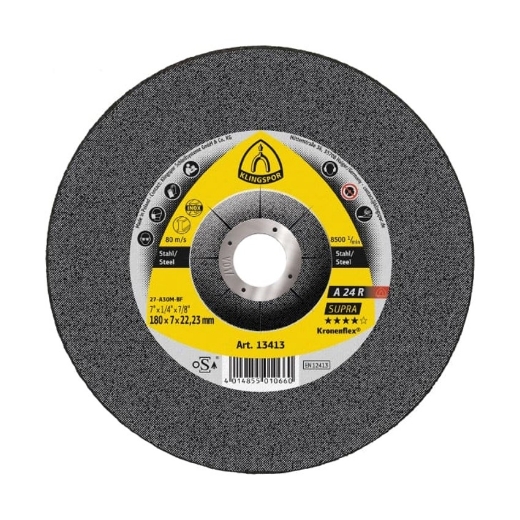
Grinding steel
Welded frames, brackets and mild steel plate call for a coarse A24 disc that removes stock fast. It's one of our most chosen discs for general fabrication work.
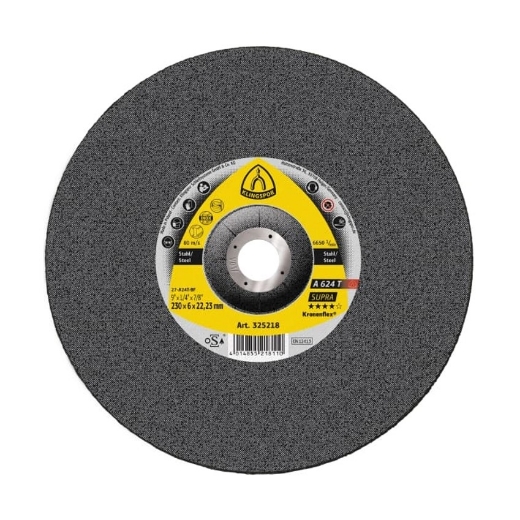
Stainless steel
Inox needs a disc without iron or sulphur contamination, so the weld doesn't corrode later. The A 624 T is built specifically for that job.
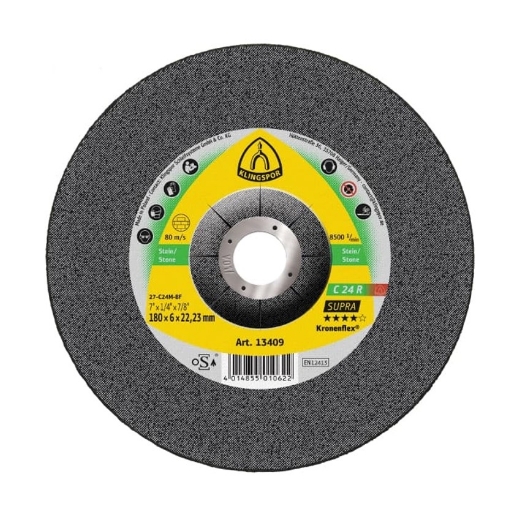
Stone and concrete
Rendering, masonry and concrete edges wear an aluminium oxide disc down in minutes. Switch to a silicon carbide "C" disc instead.

Aluminium
Aluminium clogs a steel-grade disc almost instantly. A finer A46 grit clears the swarf and keeps cutting cool.
Step 1: Match the disc to your material
Start by identifying whether you're grinding steel, stainless steel, aluminium or stone/concrete, since each takes a different abrasive. Klingspor marks this with a letter: "A" stands for aluminium oxide, suited to steel, cast iron and aluminium, while "C" stands for silicon carbide, made for stone, concrete and gypsum-based materials. Grinding steel with a stone disc wastes it in seconds; grinding stone with a steel disc leaves the surface glazed and barely touched.
Stainless steel sits in its own category. A standard "A" disc leaves tiny iron particles embedded in the surface, which later cause rust spots along the weld. For inox work you need a disc formulated to be iron- and sulphur-free, which is covered in Step 4.
Step 2: Pick the right diameter and thickness
Diameter is set by your angle grinder, and thickness is set by the job. Klingspor Kronenflex discs in this range run from 110mm to 230mm and from 4mm to 8mm thick, all with a shared 22.23mm bore. A 125mm grinder takes a 125mm disc, and a 230mm grinder takes anything up to 230mm; never mount a disc larger than your grinder's guard is rated for.
Thickness changes how the disc behaves. A 4mm disc such as the A 24 R 230x4mm is lighter and easier to control for detail grinding, while an 8mm disc such as the A 24 R 230x8mm or the A 46 N 180x8mm removes far more material per pass and holds up longer under sustained pressure. For quick weld dressing on smaller parts, the 110x55mm cup wheels give you a curved face that reaches corners a flat disc can't.
Step 3: Check the grit and bond
The grit number tells you how coarse the disc is: a lower number cuts faster and rougher, a higher number leaves a smoother finish. A16 and A24 are coarse grades built for fast stock removal on steel, A30 sits in the middle for general weld smoothing, and A46 is finer, which matters on aluminium because a coarse grit clogs with soft metal almost immediately.
The letter after the grit (R, N or T) describes the bond hardness that holds the abrasive grains together. R is a harder bond for tougher steel work, N is a softer, more forgiving bond suited to stainless and aluminium, and T marks Klingspor's dedicated inox formulation. Choosing the wrong bond doesn't stop the disc from working, but it wears out faster or grinds less aggressively than the job needs.
Step 4: Choose the correct disc for stainless steel
For stainless steel you need a disc that is free of iron and sulphur, because ordinary aluminium oxide discs contaminate the surface and trigger corrosion around the weld seam over time. The Klingspor A 24 N 230x6mm and the A 624 T 230x6mm are both formulated for this, with the A 624 T also rated for steel and cast iron, making it a flexible choice for mixed metal fabrication.
In our workshop in Beerse, welders working with stainless steel almost always ask for a dedicated inox disc rather than a standard steel disc, precisely because rust stains along a weld seam are so hard to fix afterwards.DHZ-Proshop vakteam, Beerse
Keep a separate stainless disc set apart from your steel discs, and ideally use a dedicated angle grinder for inox. Cross-contamination from a disc that has previously touched carbon steel can undo the benefit of buying the right abrasive in the first place.
Step 5: Mount the disc and grind safely
Mount the disc between the grinder's flanges, tighten the locking nut with the correct spanner, and spin the disc by hand before switching on to check it runs true. Always fit the guard, wear safety glasses and gloves, and hold the grinder so sparks fly away from your body and any flammable material nearby.
Inspect every disc before use. A hairline crack, a chipped edge or a disc that's been dropped can shatter under load, so replace it rather than risk it. Apply steady, moderate pressure and let the grit do the work; forcing the disc overheats both the workpiece and the abrasive, and shortens the disc's working life considerably.
Common mistakes
- Using a steel disc on stainless steel: ordinary "A" discs leave iron particles that cause rust spots along the weld, even weeks later.
- Mounting a disc larger than the grinder's guard: this exposes more of the disc than the guard can contain and removes a key layer of protection.
- Grinding aluminium with a coarse steel-grade disc: the soft metal clogs the grit almost immediately, so the disc stops cutting and starts smearing instead.
- Skipping the pre-use check: a cracked or chipped disc can fail under load; always spin it by hand first and inspect the edge.
Find the complete Klingspor range in our grinding disc category at DHZ-Proshop.
Frequently asked questions about grinding discs
Which grinding disc should I use for metal?
Which grinding disc should I use for stainless steel?
Which grinding disc should I use for stone or concrete?
What is a grinding disc?
What are the different types of grinding disc?
How long does a grinding disc last?
Compiled by the trade team at DHZ-Proshop, your DIY and trade specialist with a shop and collection point in Beerse. What we recommend most often in the shop is matching the disc to the metal first, then the grit, since that single step prevents most complaints we hear about a disc "not cutting properly". Questions about which Klingspor disc suits your job? Contact our team or browse the full Klingspor grinding disc range.