Which Chain Won't Rust Outdoors? (Stainless, Galvanized or Coated)
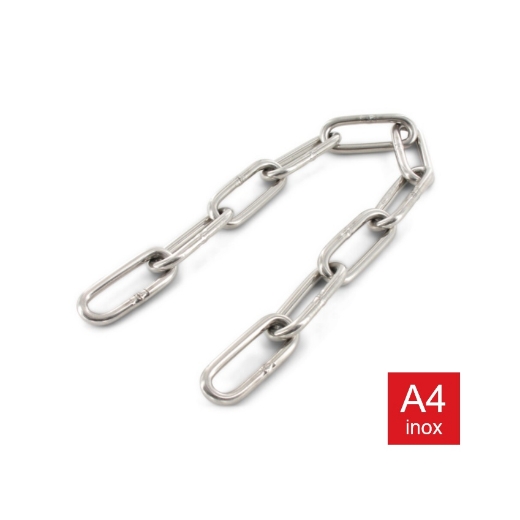
The chain that rusts least outdoors is stainless steel: 316 stainless is the strongest choice in a coastal or salt-heavy environment, and 304 stainless a strong general outdoor option. If you need a lower-cost alternative, galvanized, nickel-plated or coated steel chain can work, but it is not as durable as stainless when moisture exposure is constant. Short version: choose stainless for the best rust resistance, galvanized or coated steel for budget-conscious use, and avoid bare steel outdoors wherever you can.
Which chain won't rust on an outdoor project? A chain does not become "rust-proof" just because it hangs outside. Rust resistance depends on the base material, any coating on top of it, and the conditions it lives in. A chain that is fine for indoor hanging can fail quickly outdoors once moisture, salt or condensation gets into the metal. In this guide you start with the environment and arrive at the right material.
Overview: which chain for which environment?
Browse the full chain and accessories range in our webshop: link chains, turnbuckles, carabiners, D-shackles, steel cable and U-brackets. The table below puts the materials side by side on rust resistance.
| Material | Rust resistance | Best use | Price range |
|---|---|---|---|
| 316 stainless | Highest, also against chlorides | Coast, salt air, pool, industry | High |
| 304 stainless | Very good in normal outdoor air | Rain, humidity, general outdoor use | Medium to high |
| Galvanized steel | Reasonable, while the zinc layer is intact | Budget, functional, lighter outdoor work | Low |
| Nickel-plated / coated | Variable, depends on the coating | Mild, decorative, light use indoors or sheltered | Low to medium |
Coast or salt air
By the sea, near salt water or heavy industry? 316 stainless contains molybdenum and resists chlorides best. This is the closest thing to "won't rust outdoors".
General outdoors
Rain and humidity without salt air? 304 stainless is a strong, practical default for most outdoor applications.
Budget and functional
A functional job where replacement is easy? Galvanized chain protects with a zinc layer at a lower price than stainless. Not the best choice at the coast.
Decorative, light use
Decorative or light work in mild conditions? Nickel-plated or coated chain can work, as long as the coating stays intact. Only for mild exposure.
Always start with the environment
The biggest factor is where the chain will be used. A covered patio, a wet garden gate and a coastal application each create a different corrosion risk. If the chain is only occasionally exposed to moisture, coated steel may be enough in some cases. If the chain stays outdoors, sees rain often or sits in damp air for long periods, stainless steel becomes the safer choice.
If the project is by the sea, gets salt spray or is often washed down, 316 stainless is the strongest recommendation. That is exactly the kind of environment where ordinary galvanized or coated chain can fail surprisingly fast.
Stainless steel: the best rust resistance
Stainless chains are the premium answer for outdoor corrosion resistance, designed to resist rust far better than bare steel or simple coated chains. Within stainless, two grades are relevant.
304 stainless: strong general outdoor choice
304 stainless contains roughly 18% chromium and 8% nickel and is a strong choice for many outdoor jobs. It handles rain, humidity and normal outdoor air well, which makes it a practical default when the environment is not especially aggressive. Note: in constantly damp conditions, 304 can develop light surface rust over time; mount it so rain can reach it and wipe it down occasionally.
316 stainless: best at high corrosion risk
316 stainless contains, besides chromium and nickel, about 2% molybdenum. That addition makes it more resistant to chlorides, pitting and crevice corrosion. Salt air, marine use and harsh wet conditions all push the decision toward 316. If you want the closest thing to "won't rust outdoors", this is it. In mechanical strength 304 and 316 are comparable; the difference is in corrosion resistance.
Galvanized chain: the budget option
Galvanized chain is steel protected with a zinc layer. That coating slows rust and makes the chain suitable for many outdoor jobs at a lower price than stainless, a common budget option for hanging, fencing support and light exterior work. It is especially attractive when the chain is functional rather than decorative and replacement is not too difficult.
The limitation is that galvanizing is still a coating. Once the zinc layer wears, scratches or is consumed over time, rust can begin underneath. So galvanized chain is not the best long-term choice in harsh outdoor exposure, and certainly not at the coast, where salt wears the zinc layer down much faster.
Nickel-plated and coated chains
Nickel-plated and coated chains sit between bare steel and stainless in both cost and performance. They can provide corrosion resistance, but the degree depends heavily on the quality and thickness of the coating. They work in mild outdoor conditions, especially if the chain is not constantly wet and the coating stays intact, and for decorative work they are often more attractive than galvanized chain. The drawback: any coating can be damaged by abrasion, bending or wear at contact points, and once the base steel is exposed, rust begins much faster. If the chain is important or hard to replace, stainless is usually safer.
Accessories matter just as much
A chain is only as rust-resistant as its weakest exposed metal part. If the chain is stainless but the carabiner, D-shackle or connector is bare steel, the assembly can still rust, and one corroding part can stain nearby material and weaken the whole setup.
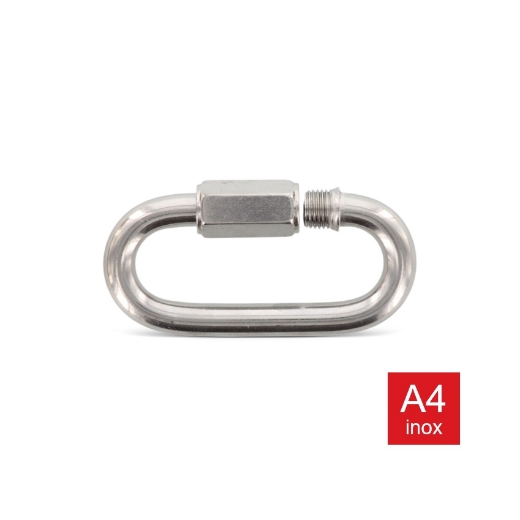
The range also includes chain accessories such as carabiners, D-shackles, turnbuckles, steel cable and U-brackets. For outdoor assemblies, keep the material system consistent: stainless chain with stainless accessories gives the most reliable long-term result. Mixed metals are where many outdoor failures start.
Load, safety and condensation
Rust resistance is not the same as strength. A chain used for hanging, anchoring or carrying loads must also have the right load rating; a corrosion-resistant chain that is too light-duty is still unsafe for the job. Where safety or weight-bearing is involved, choose on rust resistance, load capacity and the quality of the accessories together, because corrosion can reduce that strength over time.
Rust is also not only a rain problem. Condensation, morning dew and humid air can corrode a chain even when it does not get directly wet. That is why a sheltered outdoor spot is still a corrosion risk: a chain under a canopy may see enough moisture to rust over time. If the chain is stationary and stays damp, the risk rises. Stainless wins here too, because it resists corrosion even when the environment is not obviously "wet".
Common mistakes when choosing a chain
- Choosing on appearance: shiny coated steel can look nicer at first but still rust once the coating wears. Check the base material first, not the shine.
- Mixing materials: a stainless chain with ordinary steel connectors ages to its weakest part; if the accessories rust, the whole installation can fail or look bad.
- Wrong material for the environment: galvanized chain for a long-life coastal job wears down much faster; if the chain must last for years, stainless is the better investment. And outdoors, even a budget coated option is usually better than bare steel.
Fast decision logic
- Coastal, marine or salt-heavy outdoors: choose 316 stainless.
- General outdoor air with rain and humidity: choose 304 stainless.
- Budget, functional outdoor use: choose galvanized chain.
- Light or decorative, mild conditions: nickel-plated or coated chain can work, as long as the coating stays intact.
And think about maintenance: even a good chain lasts longer if it is kept clean, dried where possible and inspected for coating damage. Browse the full selection via our chain and accessories category or find all your fasteners and building materials in Belgium at the DHZ-Proshop webshop.
Frequently asked questions about rust-free chain outdoors
Which chain rusts least outdoors?
What is the difference between 304 and 316 stainless?
Can I combine a stainless chain with ordinary steel accessories?
Can a chain rust without rain?
Which chain do I choose for a project by the sea?
Posted by the fastening expert at DHZ-Proshop, your specialist in chains, carabiners, D-shackles, turnbuckles, steel cable and U-brackets in stainless and galvanized. Webshop available 24/7 and pick-up point in Beerse. Questions about the right chain for your outdoor project? Contact our team or browse our complete range of fasteners.