Which Plug for Concrete, Brick or a Hollow Wall? (Selection Guide by Wall Type)
The simplest way to choose a plug is to match it to the wall structure first, not the screw size or the object weight. In practice: nylon or universal expansion plugs are best for solid concrete and solid brick, hollow-wall plugs or anchors are the right choice for hollow walls, and for heavy loads in concrete you choose wedge anchors or bolt anchors. A plug that spreads well in solid masonry can fail in a hollow wall because there is nothing solid for it to grip. That is why the same plug is perfect in one wall and useless in another.
Which plug do you use for concrete, brick or a hollow wall? Concrete behaves differently from solid brick, and both behave very differently from hollow walls or cavity construction. In this guide you start with the wall type and arrive at the right Fischer solution, whether that is a nylon plug, a wedge anchor, a frame screw or a bolt anchor.
Overview: which plug for which wall?
Browse the full Fischer range in our webshop: nylon plugs, universal DuoPower plugs, wedge anchors, frame screws and bolt anchors. The table below links the wall type to the right type of fixing.
| Wall type | Best plug or anchor | Action | Load |
|---|---|---|---|
| Solid concrete | Nylon plug / DuoPower; wedge or bolt anchor when heavy | Spreading | Light to very heavy |
| Solid brick | Nylon expansion plug / DuoPower | Spreading, careful drilling | Light to medium |
| Perforated brick | DuoPower or material-specific plug | Folding behind the webs | Light to medium |
| Hollow wall / plasterboard | Hollow-wall plug or metal cavity anchor | Knotting or spreading behind the panel | Light to medium |
Solid concrete or brick
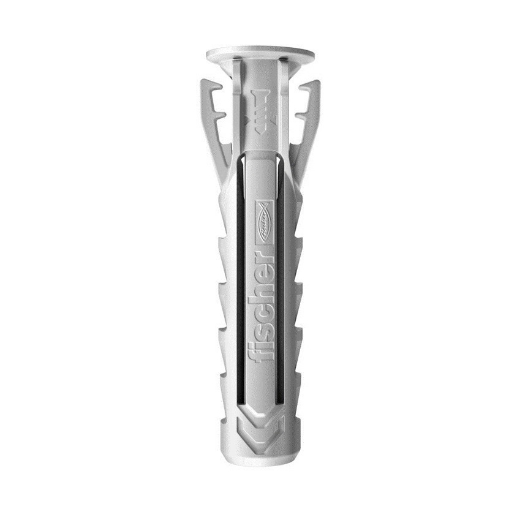
A dense, solid base material? A nylon plug or the universal DuoPower spreads and grips reliably for general mounting work.
Hollow wall or plasterboard
A cavity or panel material behind the surface? A hollow-wall plug or metal cavity anchor spreads or knots behind the panel.
Heavy load in concrete
Heavy brackets, consoles or structural work in solid concrete? Wedge anchors and bolt anchors give the strongest mechanical grip.
Only in solid, uncracked concrete
Frames and profiles
Mounting a wooden frame or profile? Frame screws with the right plug give a controlled, square fixing.
Match the plug to the wall type
Always start with the wall type
The first question is whether the wall is solid, hollow or uncertain. Concrete and solid brick are solid building materials: they can carry the spreading action of an ordinary expansion plug well.
Hollow walls are different, because there is often a cavity behind the surface or a board-like structure with limited material thickness. In those cases, a plug must either fold out behind the wall or spread the load over a much larger area.
If you are not sure what the wall is, assume the weaker condition first. That protects you from overloading the base material and reduces the risk of a failed fixing. A simple check: drill a small hole. If the bit suddenly drops through into a cavity after a thin skin, you have a hollow wall; if it drills through solid material over the full depth, the wall is solid.
Concrete: the most predictable base
Concrete is the easiest and most predictable base material for many plug systems. It is dense, uniform and usually strong enough to handle the radial force created by a nylon expansion plug.
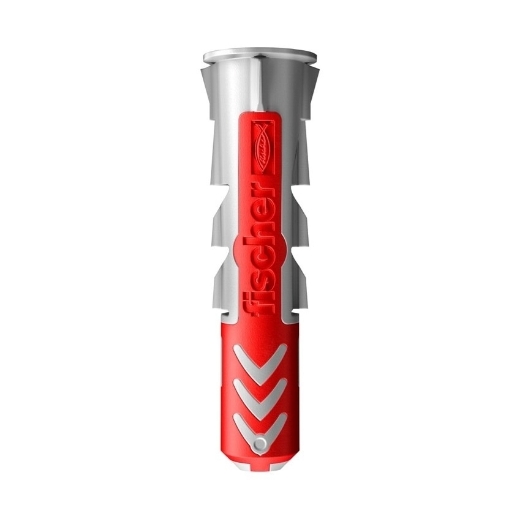
For ordinary mounting in concrete, a standard nylon plug is often the practical choice. The Fischer DuoPower is described as a universal plug that adapts to different building materials, which makes it a flexible option when you are not fully sure whether the base is concrete or masonry.
For heavier loads in concrete, wedge anchors or bolt anchors are often better than small plugs. When the load is serious, choose by load class, not just hole diameter. A bolt anchor such as the Fischer FBN II is a steel anchor for uncracked concrete and reaches a high load capacity there; it does not belong in plasterboard or hollow walls.
Solid brick: strong, but more delicate
Solid brick is a strong material, but more variable than concrete. Brick faces can chip, mortar can be weak and the internal structure is less uniform than poured concrete.
That means a standard nylon plug still works well, but drilling and hole placement matter more. If the brick is brittle or the hole is near an edge, be more cautious than with concrete, and do not place the hole in the mortar joint.
Fischer's broader plug systems, such as the DuoPower, are useful here because they adapt to different base materials and improve grip across a range of masonry conditions. In perforated (hollow) brick that matters extra: there the plug folds behind the webs instead of spreading. For medium-duty work in brick, that flexibility is very helpful.
Hollow walls: a different logic
Hollow walls are the biggest category mistake people make. An ordinary concrete plug in a hollow wall can spin, pull out or crush the thin wall material, because there is not enough mass to carry the spreading force.
Instead, hollow walls need anchors that either spread behind the panel or mechanically lock into a cavity. That is why hollow-wall anchors, hollow-wall plugs and specialized Fischer systems are designed differently from ordinary expansion plugs.
For light to medium-duty hollow-wall applications, the right plug must distribute the load over a larger area. Fischer offers, among others, the metal hollow-wall plug HM for panel material and the DuoTec toggle plug, whose geometry allows very high loads in hollow walls. For heavier loads, a metal hollow-wall anchor or even a structural alternative may be needed.
Fischer DuoPower as a universal option
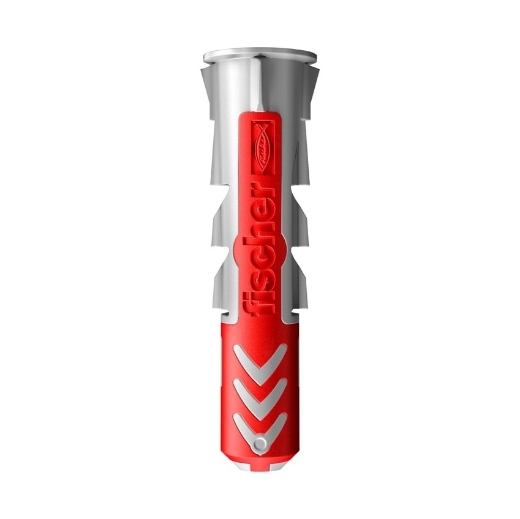
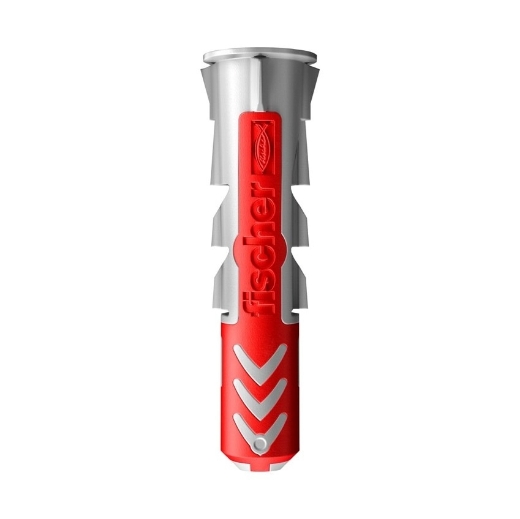
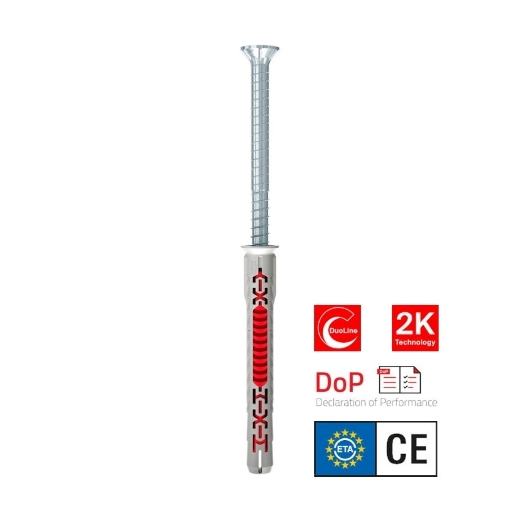
The Fischer DuoPower is one of the most flexible options because it adapts automatically to the base material. That makes it useful when you might be dealing with solid masonry or with mixed substrates.
It is a smart two-component plug with three working principles, and it chooses the best technique for the base itself:
- Spreading in solid material such as concrete and solid brick: the plug expands in the hole.
- Folding in perforated (hollow) brick: the wings fold behind the webs.
- Knotting in panel material such as plasterboard: the plug forms a knot behind the panel.
A thin collar prevents the plug from disappearing into the hole when knotting or folding, while in solid material you simply push it through. This type of plug is valuable because many walls are not exactly known before drilling: renovations, older homes and mixed-build construction often contain concrete in one area and brick or block in another. Universal is convenient and saves time, but it is not a substitute for the right specialized anchor when the load is high or the wall is clearly hollow. Universal is convenient, not magical.
Heavy loads and frames
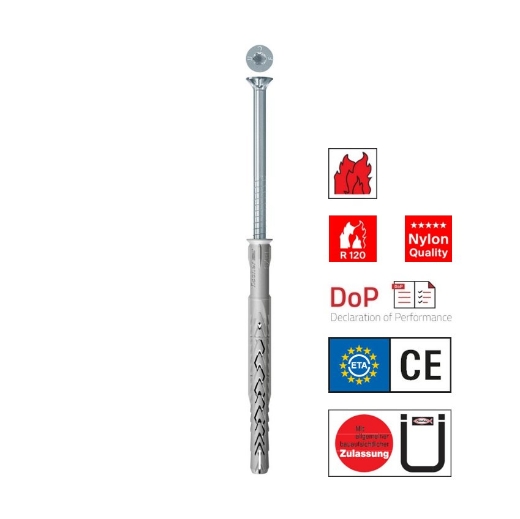
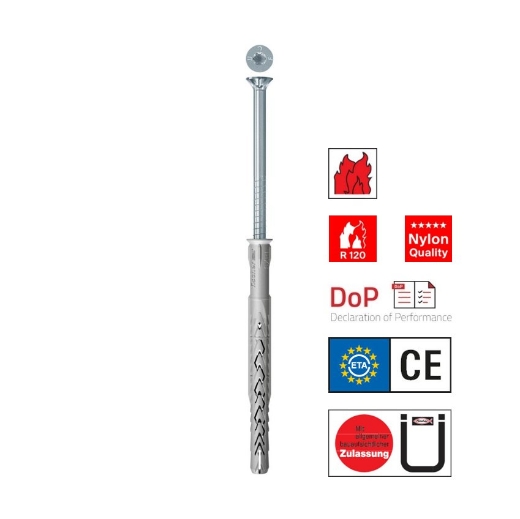
Wedge anchors and bolt anchors for heavy loads
Wedge anchors are heavy-duty expansion anchors, best suited to solid concrete and other dense materials. It is the kind of fixing you use when the load is substantial and the base can safely handle expansion: heavy brackets, structural supports, high-confidence anchoring in concrete. They are not the first choice for weak brick, hollow walls or damaged masonry, because the expansion force can become destructive there.
Bolt anchors such as the Fischer FBN II are steel anchors for efficient fixing in uncracked concrete, with two anchoring depths and suitable for push-through and stand-off mounting. These too belong in solid concrete, not in plasterboard or hollow walls.
Frame screws for frames
Frame screws are meant for mounting frames, especially wooden or profile frames in masonry. They give a controlled, adjustable fixing that is useful for window and door installation, and help keep the frame square and aligned during fitting. In concrete or solid brick you use them with a compatible plug for a strong frame connection. For hollow or uncertain walls, take extra care that the plug system behind the screw suits the wall type: a frame screw is only as good as the anchor holding it.
Hole quality and load
Why hole quality counts
The correct plug can still fail if the hole is poorly drilled. Hole diameter, depth, cleanliness and straightness together determine how well the plug performs. If the hole is too large, the plug can spin or lose grip; if it is too small, the plug deforms or does not seat correctly. Dust in the hole also reduces performance, so blow or brush the hole clean before you set the plug. This matters extra in hollow walls and older masonry, where the margin for error is smaller. Good drilling technique is part of plug selection, not something separate.
Weight and load level
Light decoration, shelves and small fixtures do not need the same anchor strength as wall cabinets or structural supports. The heavier the object, the more critical the plug choice. In concrete, many plugs work well for moderate loads; in brick, the same load sometimes needs a more careful or larger anchor; in hollow walls, even a moderate load may need a specialized anchor or load spread across several fixing points. Always think in terms of load path: if the wall is the weak part, the anchor must compensate for that weakness rather than amplify it.
Common mistakes when choosing a plug
🕳️ Misjudging the wall structure
- A concrete plug in a hollow wall: the plug spreads where there is no solid material to support it, which leads to pull-out or wall damage.
- Assuming all brick behaves like concrete: brick can be much more delicate, especially old or porous brick. A plug that is fine in one wall can split another.
🔩 Choosing by the wrong part
- Choosing by the screw alone and ignoring the plug: the plug interfaces with the wall, so it often determines the success of the installation.
- A bolt anchor or wedge anchor in weak or hollow base material: those belong in solid, uncracked concrete.
📏 Underestimating hole and load
- A too-large or dirty hole: the plug spins or loses grip.
- Underestimating the load: choose by load class and wall type, not just hole diameter.
Fast decision logic
If you want the shortest possible answer, use this logic before you drill:
- Concrete: use a standard nylon plug or a universal plug like the DuoPower for general work.
- Solid brick: use a nylon expansion plug or universal masonry plug, with careful drilling.
- Hollow walls: use a hollow-wall anchor, hollow-wall plug or a system that spreads behind the panel.
- Heavy loads in solid concrete: use wedge anchors or a bolt anchor.
- Frame mounting: use frame screws with the correct plug type.
The rule of thumb: solid walls like spreading, hollow walls like spreading or knotting behind the panel, and heavy loads like stronger anchors. Browse the full selection via our Fischer category or find all your fasteners and building materials in Belgium at the DHZ-Proshop webshop.
Frequently asked questions about choosing plugs
Which plug do I use in concrete?
Which plug do I use in a hollow wall or plasterboard?
What makes the Fischer DuoPower universal?
Can I use a concrete plug in a hollow wall?
Which plug do I choose for heavy loads in concrete?
Is the DuoPower suitable for heavy loads?
Which plug do I use for a wooden frame?
Why is hole quality so important?
How do I know if my wall is solid or hollow?
Posted by the fastening expert at DHZ-Proshop, premium Fischer dealer and your specialist in nylon plugs, DuoPower, wedge anchors, frame screws and bolt anchors. Webshop available 24/7 and pick-up point in Beerse. Questions about the right plug for your wall? Contact our team or browse our complete range of fasteners.