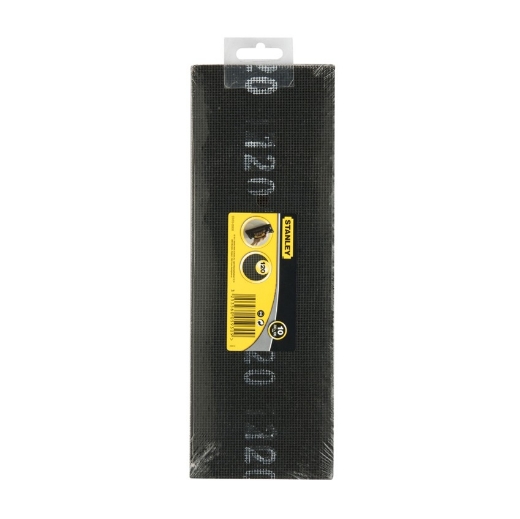
The Stanley® sanding mesh is a net-shaped abrasive used for smoothing plasterboard, joints, filler and plaster. Unlike solid sandpaper, this product consists of an open weave in which the grit sits exposed on all sides. The K120 grit is a fine version, suitable for finishing and removing small imperfections.
What the mesh does and how it works
The sanding mesh has a net structure with openings between the threads. This allows dust to pass straight through the mesh and be carried away to the back, instead of building up between the grit. As a result, the mesh clogs far less quickly, stays sharp longer and lasts longer than ordinary sandpaper on dusty materials such as plaster.
Because the grit is exposed on both sides, you can often use the mesh from both faces, giving an even sanding result. It is intended as a tool for plasterboard and plaster work, where a lot of fine dust is released.
What you use it for
The sanding mesh is especially suited to dusty, plaster-like materials:
- Plasterboard — smoothing the surface and board joints;
- Jointing and finishing plaster — levelling transitions and small bumps;
- Filler — smoothing cured repairs;
- Plaster and render — sanding before painting or wallpapering.
Practical use and how to choose
You can use the mesh by hand or fix it to a sanding block or a long-neck sander with a hook-and-loop pad. Work with calm, even movements and light pressure; let the grit do the work so you don't make the surface uneven. For the best result, combine it with extraction or a dust bag, as plaster releases a lot of fine dust.
A fine grit such as K120 is intended for the finishing stage: removing light imperfections and smoothing the surface before the final treatment. If you still have coarse work or thicker imperfections to remove, start with a coarser grit and then work gradually towards fine.