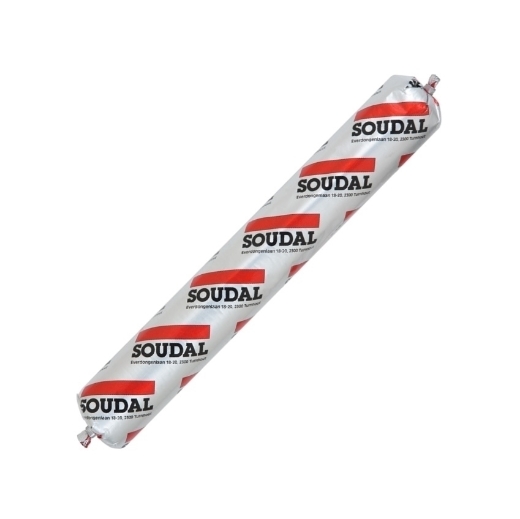
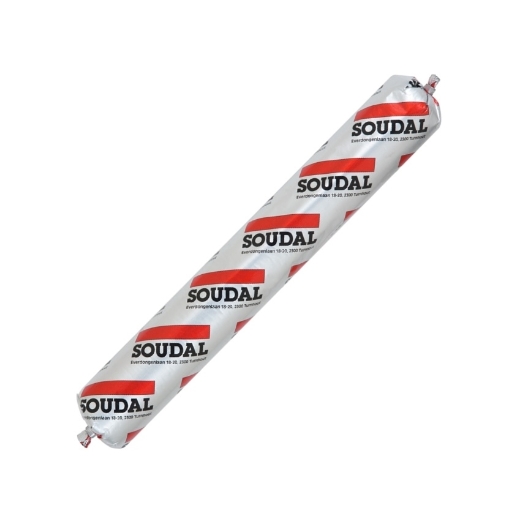
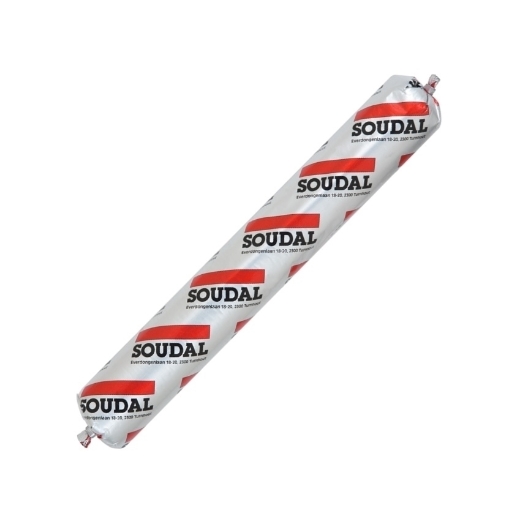
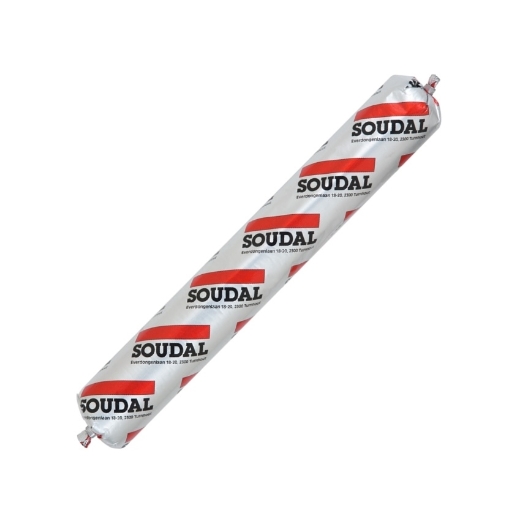
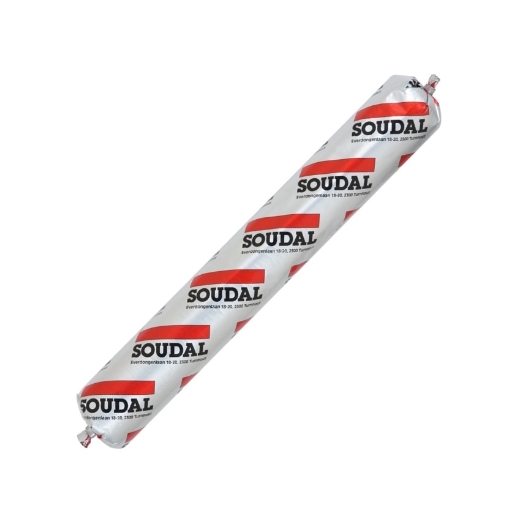
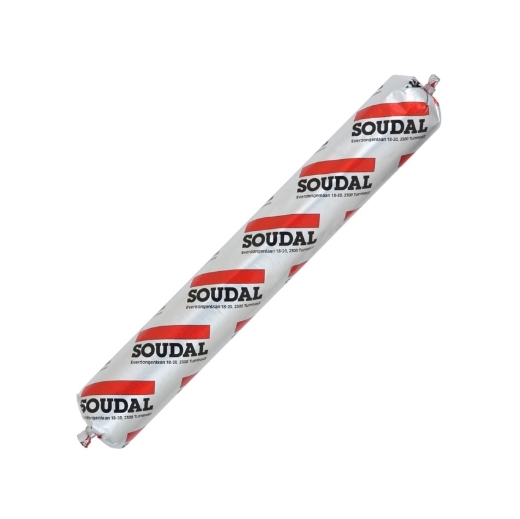
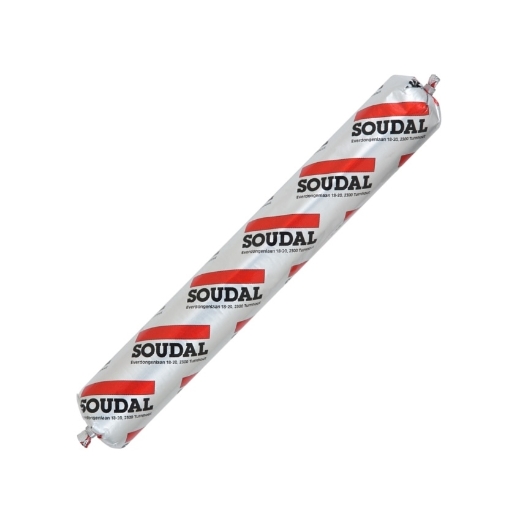
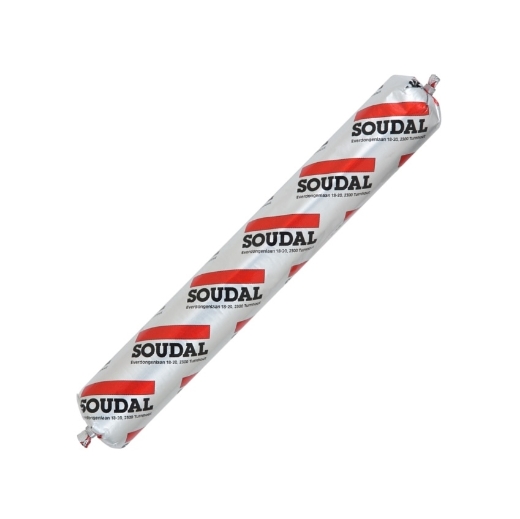
Soudaseal 215LM+ or Soudaseal 222LM? Both are hybrid SMX polymer joint sealants for construction and connection joints with permanent elasticity, but they are not interchangeable. The difference lies in UV resistance, emission class and behaviour on natural stone. Below you can choose quickly, followed by processing tips and everything about PU backer rod for wide joints.
Quick choice: which product for which situation?
Browse the full Soudal hybrid joint sealants range in our webshop. For a broader overview of all joint sealants by application: choosing the right sealant.
Outdoor, façade & natural stone → Soudaseal 215LM+
The choice for outdoor joints and façade joints where UV resistance and weather resistance are decisive. Also the recommended sealant when the joint adjoins natural stone (marble, granite, blue limestone) and staining through plasticiser migration is a risk, 215LM+ causes no edge zone contamination. Overpaintable with water-based paints after curing. Available in 600ml sausages for professional throughput. More about sealing on stone: sealing on natural stone.
General construction joints & emission requirements → Soudaseal 222LM
The most widely used hybrid joint sealant for general construction and connection joints indoors and outdoors. Known for its low emission class EC1 PLUS, relevant for projects with indoor air quality requirements, and stable processing even in changing conditions. Broad adhesion on concrete, masonry, wood, metal and plastic. Sufficiently elastic for standard connection joints and frame connections. Available in 600ml sausages. More about frame applications: sealant for windows and doors.
Wide & deep joints → PU backer rod as filler
In industrial construction, prefab and expansion joints, gaps are often too wide or too deep to fill entirely with sealant. PU backer rod (round backer rod in polyurethane foam) sets the sealant depth in a controlled way, limits sealant consumption and prevents three-sided adhesion, where sealant sticks to three surfaces and tears under movement. Choose a diameter roughly 25% larger than the joint width so the profile sits slightly compressed. More about three-sided adhesion and joint build-up: the right joint width. More backer rod variants: difference in backer rods.
The biggest practical difference: stiffness and workability
On the technical data sheet 215LM+ and 222LM look very similar, but anyone who applies both from a sausage immediately notices the difference in consistency, and that has direct consequences for when you choose which sealant.
- Soudaseal 215LM+ has a more fluid composition: The sealant has a slightly flatter consistency. That makes it easier to apply and smoother to tool off in the joint. An advantage for narrow or precise visible work, and for applications where you want to get the joint smooth quickly.
- Soudaseal 222LM is drier and stiffer: This sealant has a slightly firmer consistency. That gives more control on vertical surfaces and overhead applications, the sealant sags less out of the joint. In warm weather 222LM becomes a little more supple due to the heat, which actually makes processing more pleasant during the summer period.
- Temperature also determines which sealant you reach for: In winter, in cold or frost, every sealant becomes stiffer, but 222LM feels noticeably heavier to apply at low temperatures. The more fluid composition of 215LM+ then gives a clear advantage: less pressure needed, smoother throughput and less fatigue over long runs. Practical rule of thumb: winter or cold conditions → 215LM+. Summer or warmer working conditions → 222LM, which then becomes supple by itself.
Professional processing: joint build-up, tooling and PU backer rod
A good hybrid sealant is only as strong as the preparation and joint build-up. In practice, adhesion, joint geometry and timing are the three factors that determine the result.
- Joint preparation, the 80/20 of sealing work: Eighty percent of adhesion problems with construction joints can be traced back to insufficient preparation: dust layers, cement laitance, loose old sealant residue or release agents on prefab elements. Remove all loose parts, brush away cement laitance and always degrease metal profiles, lacquered surfaces and composite with Soudal Cleaner & Degreaser. If in doubt about a specific substrate combination: always carry out an adhesion test on the real situation, not just based on the technical data sheet.
- Standardising joint geometry for large runs: On prefab and industrial construction it pays to standardise joint width and sealant depth in advance. Consistent joint dimensions ensure less variation in consumption, faster throughput and more predictable drying times. Always cut the nozzle to the size of the joint width, a nozzle cut too wide gives unnecessary edge smearing. More about the correct depth-to-width ratio: the right joint width.
- Tooling window: finishing wet-on-wet: Hybrid sealants form a surface skin relatively quickly, depending on temperature and humidity. Always work wet-on-wet: tool off with a smoothing spatula and, if needed, a smoothing agent within the sealant's working time. Tooling too late results in ragged edges that hold dirt and look out of place in visible work. In warm and dry weather the tooling window shortens, plan larger sections in stages and adjust your working speed.
- Overpaintability, always test on critical systems: Both sealants are overpaintable with water-based paints. With alkyd resin paints, epoxy finishes or other solvent-based systems, drying may be slower or adhesion may vary. Always test on a sample piece for critical paint compatibility before finishing a complete façade or project. This applies to every hybrid sealant, not just Soudal.
- PU backer rod: choosing the diameter and placing it: Choose a PU backer rod profile with a diameter roughly 25% larger than the joint width, so it sits slightly compressed without being damaged during placement. Avoid sharp tools when pressing it in, a damaged profile loses its resilience and does not close the joint bottom correctly. Make sure adjoining pieces close seamlessly without gaps. The sealant layer goes on top of the profile, the depth of the sealant layer is thus controlled exactly. More: difference in backer rods.
- Sausages (600ml) vs. standard cartridges (310ml): Sausages deliver higher output per load and are more efficient than standard cartridges on large runs, fewer changeover interruptions, less packaging waste, a steadier work rhythm. Requirement: a correctly set sausage gun with constant pressure control. Too high an initial pressure at the start of a new sausage gives an uneven first metre.
Frequently asked questions about Soudaseal 215LM+ and 222LM
What is the concrete difference between Soudaseal 215LM+ and 222LM?
Are these sealants suitable for outdoor applications?
Can I overpaint Soudaseal 215LM+ or 222LM?
When is PU backer rod really necessary?
Are these sealants suitable for use on or adjoining natural stone?
Why do professionals so often work with 600ml sausages?
Posted by the Soudal sealant expert at DHZ-Proshop, your specialist in fastening materials, adhesives & silicones. Webshop available 24/7 & collection point in Beerse (province of Antwerp). Questions about the right choice between 215LM+ and 222LM for your project? Contact our team.