Which Router Bit for Which Job? (Quick guide: straight, spiral and profile bits)
You choose a router bit by the operation and the material, not by diameter alone. In short: a straight bit for grooves, rebates and dados, a spiral bit (up-cut, down-cut or compression) for clean edges, plunging and chip removal, a flush trim bit with bearing for trimming and template work, and a profile bit (roundover, chamfer, ogee, cove) for decorative edges. For wood and board, solid carbide (HM) bits stay sharp far longer than HSS, especially in chipboard, MDF and hardwood. Always match the shank size (6, 8 or 12 mm) to your router's collet.
Which router bit do you need for your job? In the router bit range at DHZ-Proshop you will find straight bits, spiral bits, flush trim bits and profile bits, each for a different operation and a different material. This guide sorts them out quickly.
Overview: which router bit for which job?
Browse the full router bit range in our webshop. The table links the operation to the right type of bit.
| Operation | Best bit | Feature |
|---|---|---|
| Grooves, dados, rebates, joints | Straight bit | Straight cutting edges, one or two flutes |
| Clean edges, plunging, mortising | Spiral bit (up/down/compression) | Solid carbide, shears the fibres for a clean cut |
| Trimming, template/copy work | Flush trim bit | Bearing guides along edge or template |
| Decorative edges (roundover, ogee) | Profile bit | Shaped cutter, usually bearing-guided |
Grooves and joints
Dados, rebates, mortises or tongue-and-groove? A straight bit cuts a clean, square-bottomed channel of an exact width.
Clean edges
Tear-out free edges in plywood, MDF or solid wood? A spiral bit shears the fibres and clears chips for a glass-smooth cut.
Trimming and templates
Trimming laminate, veneer or copying a template shape? A flush trim bit with a bearing follows the edge exactly.
Decorative profiles
Roundover, chamfer, ogee or cove edges? A bearing-guided profile bit shapes a clean, repeatable decorative edge.
Start with the job and the material
The first question is not "which diameter", but "which operation and which material". Cutting a groove, plunging a mortise, trimming a template or shaping a decorative edge each call for a different cutter geometry. On top of that the material matters: softwood, hardwood, plywood, MDF and chipboard all behave differently. Abrasive boards such as MDF and laminate blunt a bit far faster, so they reward solid carbide (HM).
Use the wrong bit for the job and you see it immediately: a straight bit that tears out the top veneer of plywood, a single-flute bit that burns hardwood at the wrong feed, or an up-cut spiral that lifts the surface fibres on the show face. Operation, bit type and feed rate belong together. Work in several shallow passes rather than one deep cut, and feed against the rotation for control.
Grooves, dados and joints: the straight bit
For grooves, dados, rebates, mortises and tongue-and-groove joints you use a straight bit. The straight cutting edges remove material along the side and bottom, producing a square-walled channel of an exact width. One-flute bits clear chips aggressively for fast stock removal; two-flute bits leave a finer, smoother finish at the same feed.
Straight bits are the backbone of joinery: housing joints for shelves, rebates for backs and bottoms, and grooves for panels. Choose the cutting diameter to match your joint width, and the cutting length to cover your stock thickness. For deep grooves, step down in passes of a few millimetres at a time so you do not overload the bit or the router. A bearing-guided rebate bit is handy when you want a set rebate depth without a fence.
Spiral and flush trim bits: clean edges and template work
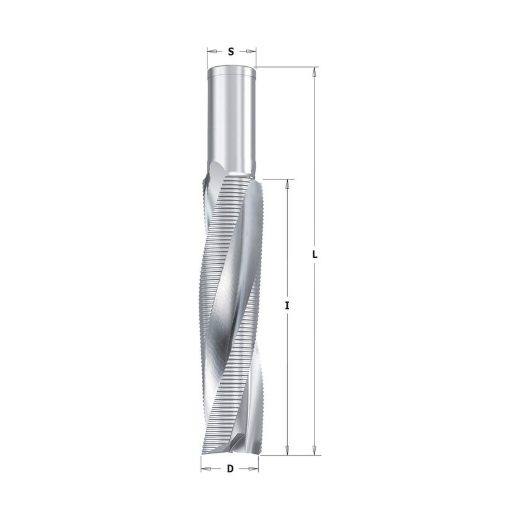
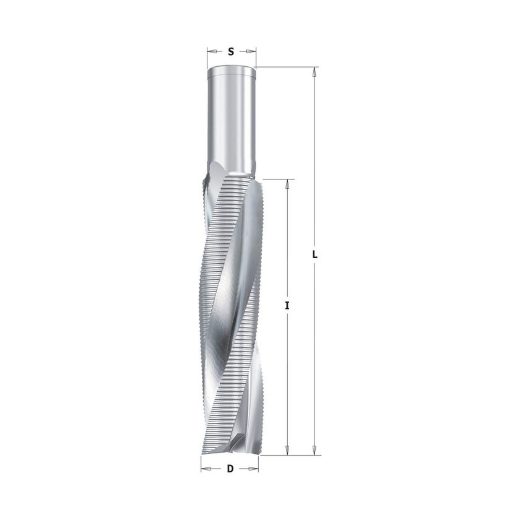
A spiral bit is made of solid carbide and twists like a drill, shearing the fibres for an exceptionally clean cut. An up-cut spiral pulls chips upward and out of the cut, ideal for plunging and mortising. A down-cut spiral presses the top fibres down for a tear-out free top surface, perfect for veneered panels and CNC work. A compression bit combines both, leaving clean faces on both sides of plywood and laminated board.
For trimming and copying you use a flush trim bit with a guide bearing. The bearing rides along an existing edge or a template, so the cutter trims the workpiece exactly to that shape, perfect for laminate overhang, veneered edges or producing identical parts. A pattern bit (bearing on the shank) and a flush trim bit (bearing at the tip) let you rout from either face. Both spiral and trim bits run best at the right speed for the diameter, with steady feed.
Edges and profiles: roundover, chamfer, ogee and cove
For decorative and finished edges you use a profile bit, most of them guided by a bearing so they follow the workpiece edge without a fence. A roundover bit softens a sharp corner into a neat radius, a chamfer bit cuts a clean angled bevel, and shaped cutters such as the ogee and cove create classic moulded profiles on table tops, doors and frames. Door and panel sets even let you build raised panel doors and matching rails and stiles.
Profile bits remove a fair amount of material, so take it in steps: a light first pass to define the shape, then a final pass for a clean, burn-free surface. Keep the bearing clean and free of pitch, and always feed against the bit's rotation. For larger or deeper profiles, drop your router speed to keep the rim speed of the cutter under control and avoid scorching the wood.
HM (carbide) vs HSS: which cutter material?
Most quality router bits today use solid carbide (HM) cutting edges, or carbide tips brazed onto a steel body. Carbide stays sharp far longer than HSS (high speed steel), runs at higher speeds and copes with abrasive materials such as MDF, chipboard and laminate that quickly dull HSS. For production work and panel materials, HM is the clear choice.
HSS bits can still make sense for occasional jobs in soft solid wood, where they take a very keen edge and can be resharpened easily by hand. But for anything frequent or abrasive, a carbide-tipped or solid-carbide bit pays for itself in edge life and cut quality. Spiral bits are almost always solid carbide because the slender helix needs the rigidity and wear resistance. Keep all bits clean and resin-free for the best finish.
Shank size: match the bit to your collet
The shank must match your router's collet, and you cannot mix them. Common sizes are 6 mm, 8 mm and 12 mm (and the imperial 1/4" and 1/2"). A larger shank is stiffer and runs with less vibration, which matters for big profile and panel bits.
| Shank | Typical router | Best for |
|---|---|---|
| 6 mm / 1/4" | Compact / trim routers | Small grooves, edges, light work |
| 8 mm | Mid-size routers | All-round joinery and profiling |
| 12 mm / 1/2" | Heavy / table routers | Large profiles, panel and door bits |
Push the shank fully into the collet, then back it out a few millimetres before tightening, so the bit does not bottom out. Never run a bit in a too-large collet with an adapter sleeve unless the sleeve is intended for it. Browse the right diameter and shank in our router bit range.
Common mistakes
- Taking one deep pass: hogging the full depth in a single cut overloads the bit and the router and burns the wood. Step down in several shallow passes.
- Wrong feed direction: feeding with the rotation lets the bit self-feed and run away. Always feed against the bit's rotation for control.
- Using HSS in abrasive board: MDF, chipboard and laminate dull HSS very fast. Use solid carbide (HM) for clean cuts and long edge life.
- Mismatched shank and collet: the shank must match the collet exactly, and the bit must be seated and tightened properly to avoid vibration and slippage.
See the full selection through our router bit range or find all your tools and building materials in Belgium on the DHZ-Proshop webshop.
Frequently asked questions about router bits
Which router bit for wood grooves and joints?
Which router bit for woodworking edges and trimming?
Which router bit for wood cutting and a clean edge?
Which router bit for wood flooring?
Should I choose HM (carbide) or HSS router bits?
Which shank size do I need: 6, 8 or 12 mm?
Posted by the tool expert at DHZ-Proshop, your specialist in router bits: straight bits, spiral bits, flush trim bits and profile bits, in carbide (HM) and HSS, including CMT. Webshop available 24/7 and a pick-up point in Beerse. Questions about the right bit for your job or material? Contact our team or browse our complete router bit range.