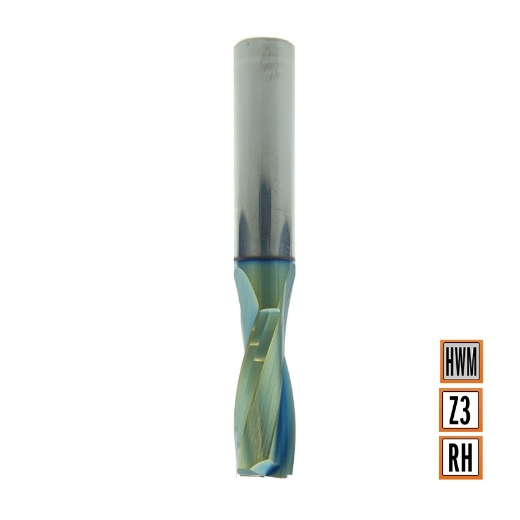
The CMT Tussenleg groeffrees is a grooving cutter of the MAN type, designed for use on a spindle moulder or shaper with a vertical spindle. You slide the cutter onto the spindle and use it to mill straight grooves and rebates in wood. It is a disc-shaped cutter with a bore in the centre, which you mount alone or in combination with other cutters on the spindle.
What the cutter does and how it works
The cutter turns with the spindle and cuts a groove or rebate out of the workpiece as you feed it past. Because this is an "insert" (tussenleg) version, it is designed to be combined with other grooving cutters and spacer rings on the same spindle. This lets you build up a cutter stack to set the desired groove width: the way you stack the cutters and rings determines how wide and how deep the groove becomes.
The rebate height determines the width of the cut a single cutter makes, while the rebate depth indicates how deep the cutter can reach into the material. The bore must match the diameter of your spindle exactly, so that the cutter runs true and without play.
What you use it for
The insert grooving cutter is intended for woodworking that calls for accurate grooves and rebates, for example:
- Grooves for base panels and back panels in cabinets and drawers;
- Rebates for fitting panels or glazing beads;
- Joints where parts interlock;
- Runs where you need to keep the same groove width throughout.
Because you can stack cutters and adjust them with spacer rings, this system is especially handy when you want to produce different groove widths with the same tool.
Practical use and how to choose
First check that the bore of the cutter matches the diameter of your spindle; the cutter must fit without play. Set the desired groove width by combining cutters with the right spacer rings, and clamp the stack securely before you start. Work at a steady feed rate and let the cutter do the work; feeding too fast strains the tool and gives a rougher result.
Choose the version that suits your machine (mind the bore) and the groove width and depth you need. For wider grooves, combine several cutters; for narrower grooves, use a single cutter with the right spacer rings. That way you tailor the cutter stack to each job.