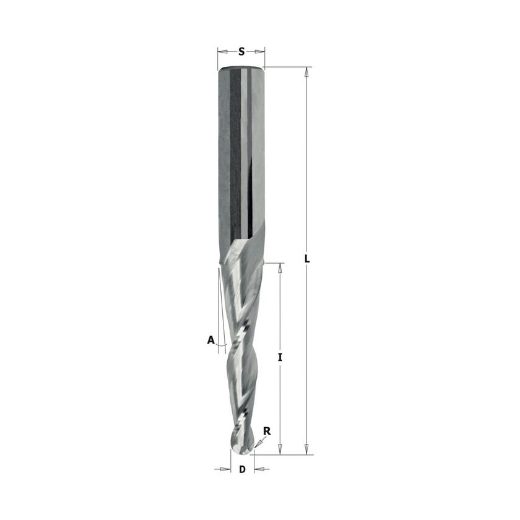
The CMT 2D 3D spiral bit is a tapered ball-nose bit made from solid tungsten carbide (HWM). Its positive, spiralled cutting edges evacuate the chips upwards, while the ball-shaped tip delivers a perfect finish on the underside of the workpiece. This bit is designed for high-precision engraving and milling in plastics, aluminium and wood.
What the bit does and how it works
Thanks to its tapered shape, the bit narrows towards the ball nose, making it ideal for fine detail work and deep cuts without the tip breaking. The spiralled cutting edges (Z2/Z3) turn clockwise and pull the chips up and out of the groove, keeping the cut clean and preventing clogging. The positive cutting angle gives a smooth, slicing action instead of scraping, which limits heat build-up and keeps the surface smooth.
Solid carbide stays sharp for a long time and handles the high spindle speeds involved in engraving and 3D milling. The cylindrical shank lets you fit the bit straight into the collet of your router, engraving machine or CNC.
What you use it for
This bit is versatile for graphic and three-dimensional work:
- milling and modelling 3D reliefs;
- 2D engraving, also well suited to deep cuts;
- signs and nameplates with engraved lettering;
- contour milling, profiling and mould making for furniture, (advertising) signs and jewellery;
- large 3D milling in rigid expanded polystyrene ('foam') and other foam types.
Materials include plastics (ABS, acrylic/PMMA, PVC, Lexan™, polycarbonate), sheet materials such as Dibond® and Corian®, various foams (EPS, XPS, EPP, EVA, HDU), wood, MDF/HDF, composites and glass-fibre-reinforced polyester, and even softer metals like aluminium, brass, copper and bronze.
Practical use and how to choose
Choose the diameter to match your work: a smaller diameter gives finer detail and sharper corners, while a larger diameter removes material faster for coarser 3D work. When milling plastics you want to avoid heat build-up — otherwise the plastic melts and sticks to the bit. Ensure good chip evacuation, use a smaller diameter if needed and adjust your speed and feed rate. Cooling and chip removal with compressed air are strongly recommended.
When clamping, note that the bit is right-hand (RH) and seat it firmly and as deep as possible in the collet for stable, vibration-free running. Work with steady pressure and feed so the chips are evacuated cleanly and you get a crisp finish.