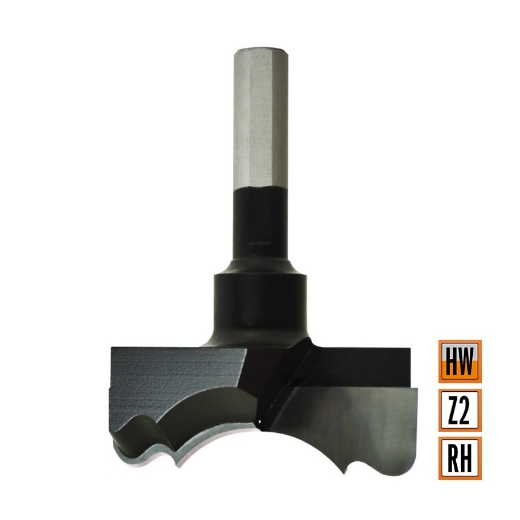
The CMT Positive roughing bit is a solid carbide (HWM) spiral cutter with a screw-shaped cutting geometry and a cylindrical shank. The cutting edges run as a right-hand positive spiral along the body, so the bit removes material gradually rather than all at once. The DLCS Chrome Coating protects the edges and reduces friction while cutting.
What the bit does and how it works
Thanks to the screw shape with a positive spiral, the edges engage progressively as the bit turns. This gives smooth, even chip removal and a quiet run with less vibration. The positive spiral lifts the chips up and out of the cut, so the bit is less likely to clog and you get a clean, tidy wall.
The roughing (screw-shaped) design is built to process a lot of material efficiently. The carbide edges stay sharp for a long time, and the DLCS Chrome Coating extends service life further: it lowers friction and heat build-up, keeping the bit cooler and reducing material sticking. Clamp the cylindrical shank in your machine's collet.
What you use it for
This right-hand bit is intended for efficient stock removal and profiling in woodworking and related applications:
- Solid wood — routing out, edging and heavy material removal;
- Sheet materials such as plywood and chipboard — clean, fast cutting;
- Rough work where you need to remove a lot of volume quickly.
Because it is a roughing bit, the emphasis is on speed and chip evacuation. For the finest finish, pair it if needed with a bit aimed at a smooth final cut.
Practical use and how to choose
Clamp the cylindrical shank firmly in a suitable collet and don't insert the bit deeper than necessary. Work at an appropriate speed with a steady feed; let the bit do the work and don't force it, so you preserve service life and cut quality. Mind the right-hand rotation (RH) when setting up your machine and feed direction.
Choose the diameter and useful cutting length based on your workpiece: the diameter sets the width of the groove or profile, while the useful cutting length determines how deep you can cut in one pass. Don't use a longer cutting length than your job requires — a shorter, stiffer bit runs more smoothly and accurately.