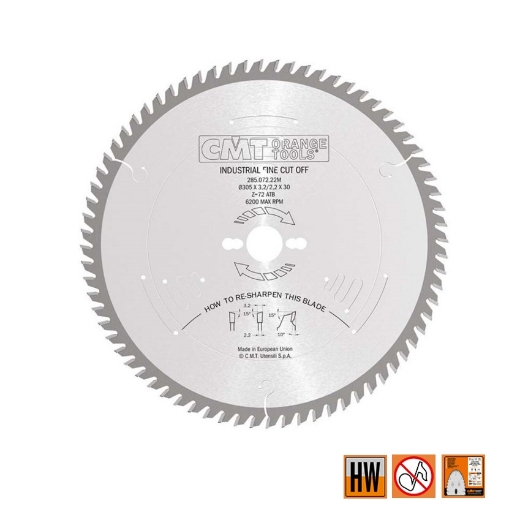
This CMT saw blade is fitted with tungsten carbide (HW) teeth and is specifically designed to give you a fine, clean finish. You can use it on stationary saw machines such as a table saw or mitre saw, or on portable hand-held saws, for crosscutting, dividing and (depending on the version) thin rip cutting of wood and panel material.
What the blade does and how it works
The teeth are made of tungsten carbide (HW), a hard-wearing material that stays sharp much longer than ordinary steel. This means you can keep working longer without losing cutting quality, and the blade is also suitable for cutting panel materials with a harder, more abrasive top layer.
The teeth have an ATB grind (Alternate Top Bevel): they are alternately bevelled, so each tooth slices into the wood or panel like a small knife instead of pushing straight through it. This gives you a cleaner, sharper cut with less tear-out on the top and bottom face — exactly what you're looking for with a fine-finish blade. The blade's rake angle is deliberately kept fairly small, which makes the cut even smoother and cleaner, at the cost of a slightly lower cutting speed compared with coarser blades.
This is also a semi-silent saw blade. Slots in the blade body absorb vibration and allow the blade to expand freely as it heats up, giving you less noise and a more stable, smoother cut.
What you use it for
This type of blade is designed for all types of wood and wood-based panel materials, such as plywood, chipboard, MDF and laminated panels. It's the right choice whenever the visible quality of the cut matters, for example in visible joinery, furniture making, kitchen cabinets or other finishing projects where you don't want splintering or rough edges.
How to use and choose it
Before use, always check that the bore and diameter of the blade match your saw machine, and that the blade's maximum rotation speed matches that of the machine. Mount the blade so that the rotation direction (marked on the blade) matches the rotation direction of the saw arbor.
For the best result, feed the material at a steady, even pace: pushing too fast can still cause tear-out, even with a fine-finish blade. Use this blade specifically for crosscutting and dividing work (and, on some versions, thin ripping too); for heavy, fast rip cutting of thicker boards, you're better off choosing a blade with a coarser tooth grind and a larger rake angle.