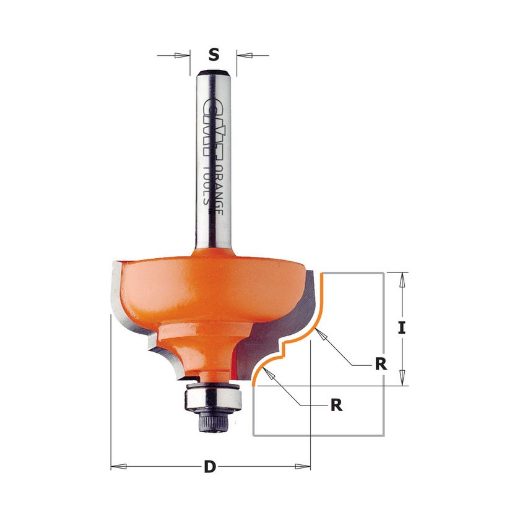
The CMT Profielfrees met kogellager (HW) is a router bit for creating decorative moulded edges in wood. A ball bearing on the underside of the bit runs along the edge of your workpiece. This bearing sets the cutting depth and guides the bit, giving you an even, elegant finish without needing a separate fence or template. The bit has a cylindrical shank and cuts in a right-hand rotation.
What the bit does and how it works
The cutting edges are made of carbide (HW), using fine-grain Micrograin carbide for a sharp cut and a smooth finish. The bit's profile — with one or more radii — is transferred into the edge of the wood as you cut, giving you a rounded, upmarket moulded edge.
The following ball bearing is key here: it rolls against the side of your workpiece and keeps the horizontal cutting depth constant. As long as you follow the edge, you get exactly the same profile everywhere. The size of the bearing also shapes the result: a smaller bearing exposes more of the lower radius, while a larger bearing produces a smoother rounding along the bottom.
What you use it for
This profile bit is intended for decorative finishes in solid wood and panel material, such as:
- Furniture edges — a refined, decorative finish on tables, cabinets and fronts;
- Mouldings and trim — profiles with a 'raised' or upmarket look;
- Panels and doors — finished, rounded edges;
- Repeat work — multiple identical parts with exactly the same profile.
Practical use and how to choose
Clamp the bit firmly in the collet of your router or router table and check that the shank diameter fits. Set the height so the desired profile falls in the right spot on the edge and the bearing runs neatly along the workpiece. Work at an even feed rate and against the direction of rotation; don't force it, but let the cutting edges do the work.
For a deep profile, remove the material in several passes for a cleaner result and less strain. Choose the model based on the profile shape and radius you want: a single or double radius, and a larger or smaller bearing depending on how smooth or pronounced you want the rounding along the bottom. Finally, keep the bearing clean and turning freely so it keeps following the edge.