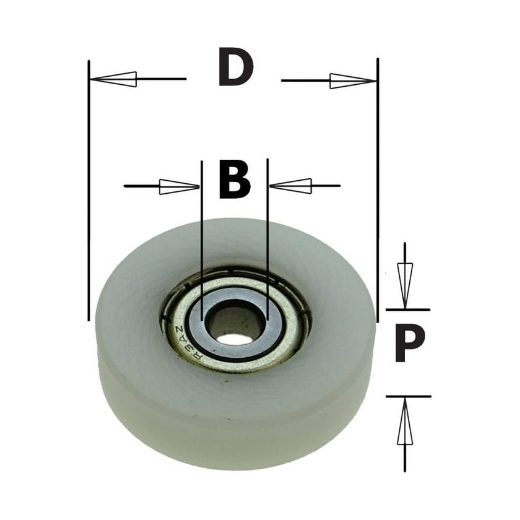
The CMT Delrin® straight ball bearing is a guide bearing that mounts onto the shaft of a router bit. It runs along an edge, template or the workpiece itself and thereby controls how deep the bit cuts into the material. What makes this type special is its running surface made of Delrin®, a strong and wear-resistant plastic from CMT Orange Tools®.
What the bearing does and how it works
A guide bearing turns with the router bit and rolls along a guiding surface. The cutting diameter of the bit together with the diameter of the bearing determines how much material is removed. By choosing a different bearing, you change the cutting depth without replacing the bit itself.
Here the running surface is made of Delrin® instead of steel. This plastic is soft enough not to damage or mark your workpiece, yet firm and wear-resistant. That is especially useful on sensitive or finished surfaces and on materials where a metal bearing can leave marks or burns. Inside sits a real ball bearing, so the running surface turns smoothly and without friction.
What you use it for
You use this bearing for edge trimming, pattern routing and profiling, whenever you want to guide the bit along an edge or template. The Delrin® running surface comes in handy on:
- Veneer, lacquered and finished surfaces where you want no scratches or pressure marks;
- Soft woods that mark quickly under a metal bearing;
- Plastic and delicate sheet materials;
- Work where the guiding surface itself stays visible and must remain flawless.
How to choose and fit it
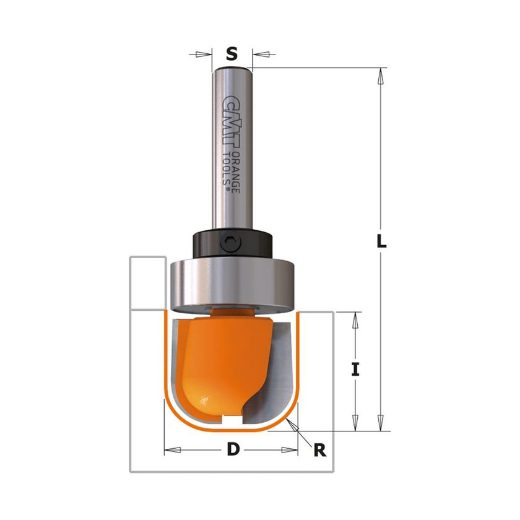
First check the bore (B) of the bearing: it must fit onto the shaft of your router bit. Also look at the outside diameter (D), as this together with the bit determines the final cutting depth. Choose a bearing with the same diameter as the cutting head when you want to copy exactly, or a different diameter when you want to leave an edge or remove more material.
Slide the bearing onto the shaft and secure it with the corresponding bolt or retaining ring. Tighten everything so the bearing stays in place, but make sure the outer running surface can still turn freely. Test on a scrap piece before starting your final work, so you can be sure the cutting depth is correct.