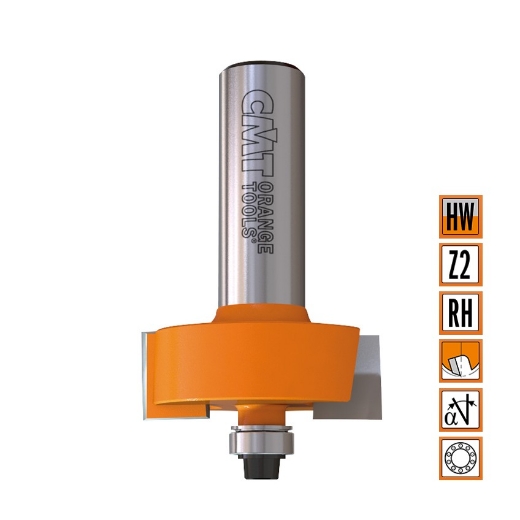
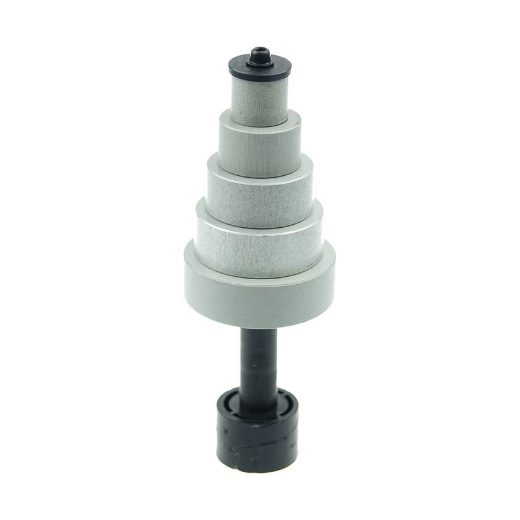
The CMT Aanloopringen are a set of ball bearings you fit onto a compatible CMT router bit. Such a guide bearing rotates with the bit and runs along the edge of your workpiece or along a template. The bearing determines how deep the bit cuts into the material: the larger the ring diameter, the less the bit removes, and vice versa.
What the rings do and how they work
A guide bearing turns with the rotation of the bit but spins freely on its own ball bearing. As a result it rolls smoothly along the guiding edge without damaging or burning it. Because the bearing and the cutting part of the bit share the same axis, the bit follows exactly the shape the ring traces.
By fitting a ring with a different outer diameter, you shift the relationship between the guiding edge and the cutting edge. This lets you set different profile depths or routing lines with the same bit, simply by changing the ring. This set contains several sizes, so you can adapt flexibly to your job.
What you use them for
You use guide bearings when routing with a guiding edge, for example:
- setting the cutting depth on profile and groove bits;
- accurately tracing a jig or template;
- following the contour of a workpiece for an even result.
The rings are intended as a replacement or extension for the matching CMT bit. Always check that the set fits the bit number it is designed for.
Practical use and how to choose
Choose the ring size based on the cutting depth you want: a larger ring makes the bit work shallower, a smaller ring deeper. Fit the ring onto the bit's shaft and secure it well according to the bit's instructions. Turn the spindle by hand first to check that the bearing spins freely and nothing binds.
Then work with a steady feed and let the ring run calmly along the edge or template. This gives you a clean, repeatable profile over the full length of your workpiece.