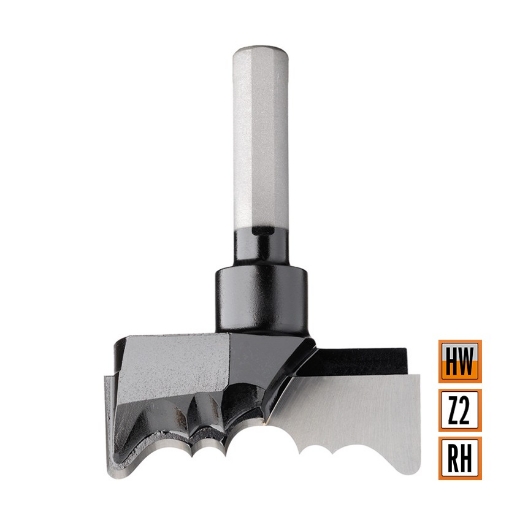
The CMT Dovetail router bit with ball bearing, HWM is a carbide-tipped router bit with characteristic angled flanks, designed specifically for making dovetail joints. The ball bearing on the shank follows a template or guide, allowing you to rout accurately and repeatably. This bit is part of a range of no fewer than 25 different dovetail router bits, letting you create a wide variety of joint shapes.
What it does and how it works
The angled cutting edges give the bit its characteristic dovetail shape: a joint that widens toward the base, so the two parts interlock mechanically and can't be pulled apart. This makes the dovetail joint one of the strongest and most durable wood joints there is.
The bit is made in HWM (tungsten carbide): the cutting edges consist of carbide tips fixed to a steel body. Carbide is significantly more wear-resistant than standard tool steel, stays sharp longer, and better withstands the heat generated when routing wood and panel materials.
The ball bearing on the shank is the key to accurate work: it runs freely against a template, jig or guide while the cutter beneath removes material. This means the template determines the exact shape and depth of the joint, without you needing to steer the bit yourself. The bit rotates clockwise (RH), matching the standard rotation direction of routers and router tables.
What you use it for
Dovetail router bits with ball bearing are used for making strong wood joints in, for example:
- Small boxes and cases;
- Drawers and drawer fronts;
- Cabinets and furniture pieces that need a sturdy corner joint.
Thanks to the bit's fixed cutting angle, the same dovetail shape is produced every time, so joints are repeatable and interchangeable.
Practical use and tips
To make dovetail joints you work with a template or jig that the bearing on the bit follows. If you're using a template, it's advisable to make two passes: first a light pre-pass, then rout through to full depth. Before removing the template, check that the bit has passed cleanly and without splintering through the workpiece.
For an optimal result, it's a good idea to first do a pre-cut with a groove bit, so the dovetail bit has to remove less material in one go, giving a cleaner finish.
Want an easy way to make various types of dovetail and finger joints? The CMT universal joint system type CMT300 is a handy tool for this: it lets you set up the template quickly and accurately, so you can get straight to work with this bit.