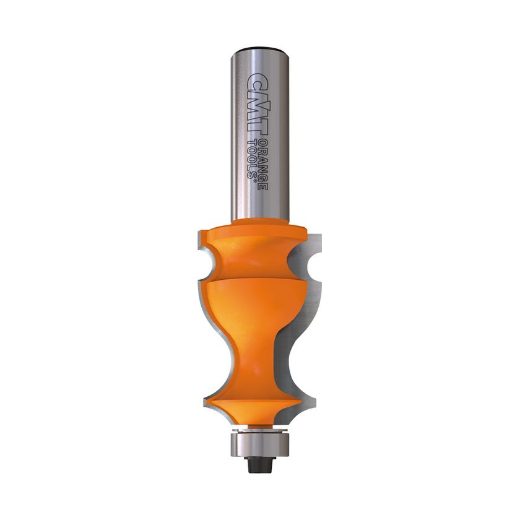
The CMT rabbeting and edge cutter with bevelled cutting heads is a straight groove bit with a cylindrical shank and a guide bearing at the bottom. It is fitted with thick micrograin carbide (HW) cutters, positioned in a slightly negative, shearing angle. Thanks to these bevelled cutting heads the bit slices through the wood fibres cleanly instead of tearing them out, giving a splinter-free, smooth result in both solid and glued wood.
What the bit does and how it works
The bit relies on the right-hand rotation of your router or routing machine. The ball-bearing guide follows the edge of your workpiece or a template exactly, so you can cut at a fixed depth and width without the bit pushing into the material. That makes it ideal for template and jig work.
The bevelled (slightly negative, shearing) cutting heads keep the fibres on the top surface from breaking out. This is especially noticeable on glued timbers and panel materials, where a plain straight cut is more likely to cause splintering. The special construction also promotes good chip evacuation, keeping the bit cooler and clearing chips easily from the groove.
What you use it for
This bit is intended for precision work on edges and surfaces:
- Cutting rabbets along the edge of a workpiece;
- Making shallow grooves;
- Recessing hinges — cutting a flat pocket in which a hinge sits flush;
- Template routing: running against a jig thanks to the guide bearing.
Use it on solid wood and on glued or composite timbers, where the splinter-free result comes into its own.
Practical use and how to choose
Clamp the bit firmly in your router collet and set the cutting depth to the required rabbet or groove depth. Work with a steady feed and let the bearing run along the template or the edge of the workpiece. Don't force it; let the bit do the work at speed for the cleanest result.
Because the bit makes a round cutting motion, the corners of a routed pocket stay slightly rounded. For hinge work, square up those corners afterwards with a hand chisel. Choose the version based on the required diameter and cutting length: these determine the width and the maximum depth of the rabbet or groove you can cut in one pass.