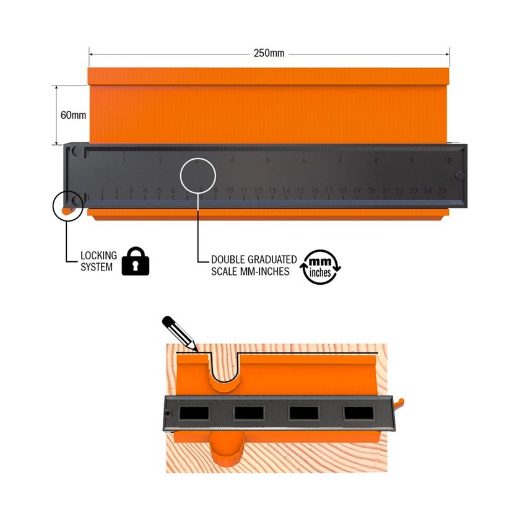
The CMT Profile Gauge (CDG) is a contour tool that lets you capture shapes and profiles exactly, so you can trace them onto your workpiece. It consists of a row of thin, sliding pins held in a housing. When you press the gauge against a surface or profile, each pin slides in individually and follows the contour precisely. This gives you a faithful copy of the shape, which you can then use as a template.
What the gauge does and how it works
The strength of this tool lies in its loose, individually moving pins. Each pin slides independently of the others, so the whole set adapts fully to the shape — whether that's a right angle, a curve or an irregular line. The captured shape stays in place once you remove the gauge, so you can lay it on your material and trace the contour at your ease. You then saw, cut or rout exactly along that line.
The result: no guesswork, no endless fitting and patching, and therefore less waste. You measure once and transfer the shape in a single motion.
What you use it for
The profile gauge is designed to trace irregular shapes and obstacles so your materials fit tightly. Think of situations like:
- Pipes, columns and other round obstacles that a panel or tile has to go around;
- Skirting boards, cornices and moulded trims you want to adjust to the right shape;
- Door and window frames where floors or wall coverings meet;
- Regular and irregular walls and corners that aren't perfectly straight.
You can use it on a wide range of materials such as tiles, wood and wood derivatives, composite, porcelain, ceramic, vinyl and flooring.
Practical use and how to choose
Press the gauge with its pins against the shape you want to copy, so each pin takes on the contour. Remove the tool straight so the shape doesn't shift, place it on your workpiece and trace the line with a pencil or marker. Then saw or cut along the marked line and fit the piece into place. For long or complex contours you can work in sections, shifting the gauge to transfer the shape bit by bit. If you often work with wide surfaces, keep the length of the gauge in mind relative to the contour you want to capture.