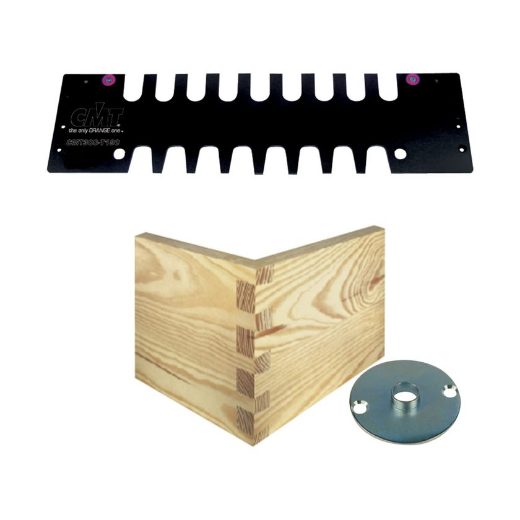
The CMT Open zwaluwstaart zwaluwstaartmal is a routing jig that lets you cut dovetail joints in an accurate, repeatable way. You use the template together with a router and a dovetail bit to cut the characteristic wedge-shaped pins and sockets that lock together into a strong, form-fitting corner joint.
What the jig does and how it works
A dovetail joint owes its strength to the trapezoidal shape of the pins: they mechanically interlock, so the joint can hardly be pulled apart even without glue. To cut that shape cleanly and consistently, the jig guides your router along fixed guides. The bit follows the pattern of the template and transfers it exactly onto your workpiece.
With the open type the dovetails are open at the edge, so you can determine the pattern and width of the joint yourself. This lets you make joints tailored to your workpiece instead of a fixed, predetermined layout. You cut the parts so that pin and socket fit together precisely.
What you use it for
This jig is intended for woodworking where you want to make strong and neat corner joints, for example:
- Drawers — the classic application for dovetails;
- Chests, cabinets and boxes — for durable and decorative corners;
- Furniture parts — where both strength and a refined look matter;
- Fine woodwork and craft projects — where a handmade look is desired.
You work with solid wood; the material thickness and the joint size help determine which parts you can join (see the specifications for the exact dimensions).
Practical use and how to choose
Clamp the workpiece firmly in the jig and make sure the parts are well aligned; accurate clamping is decisive for a clean end result. Use a dovetail bit and guide bushing that match the joint size of the jig, and set the routing depth to the thickness of your wood. Work with calm, even movements along the guides.
Always make a test joint in a scrap piece before tackling the real work. This lets you check that pin and socket fit together nicely and adjust the settings without wasting your final workpiece. When choosing, pay attention to the joint size and maximum width, and to the wood thickness the jig can handle.