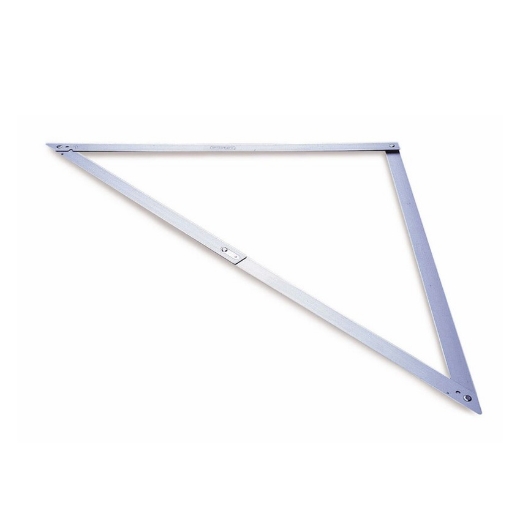
The Stanley® Folding Aluminium Construction Square is a large aluminium square for setting out and checking right angles and lines. What makes this square special is its folding design: a hinge lets you fold the two arms together, so the square becomes compact and fits easily in your toolbox or bag. Unfolded, you have a solid, square reference for marking and measuring.
What the square does and how it works
A construction square consists of two arms joined at a fixed 90° angle. Place one arm along an edge and the other runs exactly square to it. In a single move you set out a perpendicular line or right angle, or you check whether an existing corner really is 90°.
The hinged design lets you fold the square away when you're not using it. When unfolded, it locks into the working position so the angle stays reliably square while you mark out. The arms often carry a measuring scale, so besides setting out right angles you can read off and transfer measurements directly.
The body is aluminium: light in the hand yet strong and rust-resistant. That makes the square comfortable to handle at larger sizes and long-lasting, even when used outdoors on site.
What you use it for
A folding construction square is especially handy where you work with larger workpieces and long lines:
- Construction and renovation — setting out right angles for wall and floor work;
- Woodworking and carpentry — marking straight cutting and crosscut lines on boards and beams;
- Tiling and sheet work — marking square cutting lines on large panels;
- Checking — verifying that installed corners and frames are truly square.
Practical use and how to choose
Unfold the square until it locks into the working position and lay one arm flush against the edge of your workpiece. Mark your line along the other arm, keeping the square firmly pressed so it doesn't shift. To check a corner, place both arms along the two sides and see whether they fit all the way along. After use, fold the square back up so it stores compactly and the arms stay protected.
Choose the length that suits your work: a longer square is great for large panels and long marking lines, while a shorter version is handier for finer work and smaller spaces. Keep the hinge clean and free of sawdust so the square keeps opening and closing smoothly and stays reliably square.