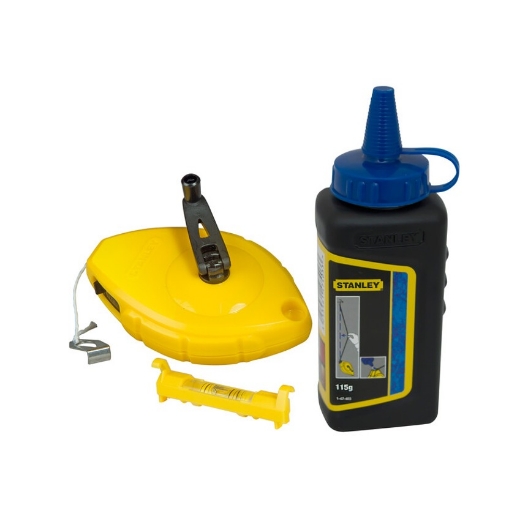
The Stanley® Slaglijnmolenkit ABS is a tool that lets you apply a perfectly straight guide line onto a surface in a single motion. The kit consists of a chalk line reel with a sturdy ABS housing and a wound line that you fill with chalk powder. Pull the line taut and let it snap back against the surface, and you're left with a sharp, straight chalk line — ideal as a marking before sawing, drilling, tiling or bricklaying.
What the chalk line does and how it works
Inside the housing, a thin line is wound around a reel. You fill the housing with loose chalk powder so the line picks up chalk along the way. Hook the end onto your starting point, unwind the line to your end point and pull it taut. Then lift the tensioned line slightly in the middle and let it snap back against the surface. The impact transfers the chalk and leaves a perfectly straight line, even over longer distances.
The ABS housing is light yet impact-resistant, so the reel can take a knock on the job site. Using the winding knob, you neatly and quickly rewind the line after use, preventing tangles and keeping the tool ready for the next task.
What you use it for
A chalk line is versatile and is used wherever you quickly need a long, straight reference line:
- Wood and sheet material — marking cutting lines on boards, panels and sheets;
- Brickwork and concrete — marking layout and level lines;
- Tiling and flooring — setting start lines for straight alignment;
- Walls and ceilings — marking lines for installing profiles, battens or boards;
- Roofing — straight lines for tiles, slates or roof decking.
Practical use and how to choose
Fill the housing with chalk powder in a clearly visible colour and make sure the line picks up enough chalk before you start. Hook the end in place or have a helper hold the starting point, unwind the line to your end point and stretch it taut above the surface. Lift the line straight up in the middle and let it snap back in one go — not sideways, otherwise you get a faint or double line. Then rewind the line using the winding knob.
If you mostly work indoors on a flat surface, a finer line may be enough; for rough outdoor work and longer distances, a robust housing and a sturdy line are more convenient. With the supplied length you work comfortably over larger distances, so you can snap one continuous line without repositioning each time.