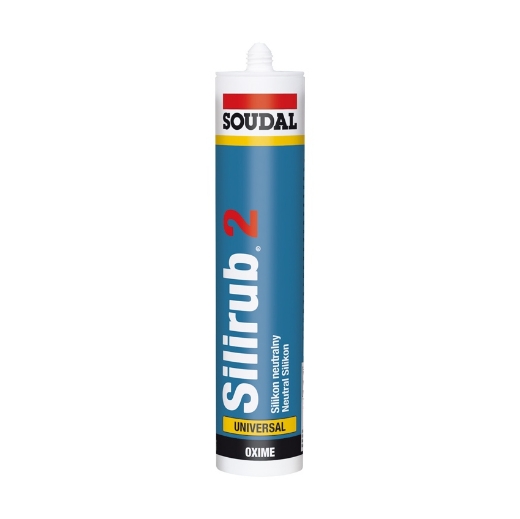
Silirub 2 is Soudal's neutral silicone sealant for joints that move:
connection joints, expansion joints and glazing. Neutral curing means it releases no acetic acid, so it is
not corrosive to metal or concrete. Low-modulus means it gives instead of tearing loose — it absorbs
± 25 % movement and then recovers more than 80 % of its shape.
We receive daily deliveries from Soudal; with sufficient stock, orders placed before 4 p.m. leave the same working day.
What is Silirub 2 for?
- Ordinary construction and connection joints that move with temperature or settlement
- Expansion joints between different building materials
- Glazing work and seals between glass and uPVC, coated timber or metal profiles
- Facade joints exposed to weather and UV — the sealant is highly ageing- and UV-resistant
What not to use it for
This is where things most often go wrong, and Soudal's technical data sheet says so in as many words:
- Natural stone such as marble, granite or blue limestone — it causes staining.
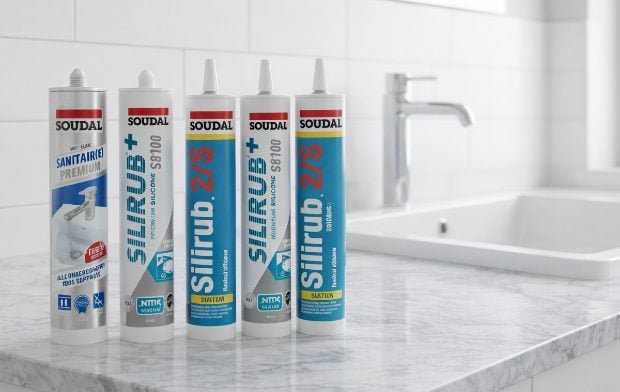
Use Silirub MA instead, or
Silirub+ S8800 for natural stone in a bathroom or
kitchen, because that one is also mould-resistant.
- Sanitary areas with heavy mould pressure (bath, shower, kitchen, without natural stone)
— Silirub+ S8100 is made for that.
- Polycarbonate, bituminous substrates, PE, PP and PTFE: insufficient adhesion.
- Structural glazing and aquariums: this sealant is not approved for those.
- Joints under permanent water immersion.
- Contact with bitumen, tar, EPDM, neoprene or butyl causes discolouration or loss of adhesion.
Which Silirub do you need?
The full comparison of every Silirub variant is on the Silirub overview page.
Adheres well to
All common building materials: glass, concrete, ceramic tiles, metal, anodised aluminium, stainless steel,
PVC and coated timber. Prime porous substrates with Soudal Primer 150; clean and degrease non-porous ones with
Surface Cleaner. For critical joints — severe weather, water load — always carry out an adhesion
test first.
Sizing the joint correctly
Soudal's rule of thumb: joint width = 2 × joint depth. Filled too deep, the sealant
cannot move and tears loose at the edges.
- Minimum joint width 5 mm, maximum joint width 30 mm
- Minimum joint depth 5 mm
- Fill deeper joints first with a PE foam backing rod
How many cartridges do you need?
One 300 ml cartridge fills roughly 300 cm³ of joint. Rough guide:
| Joint | Metres per 300 ml cartridge |
|---|
| 5 × 5 mm | ca. 12 m |
| 10 × 5 mm | ca. 6 m |
| 10 × 10 mm | ca. 3 m |
| 20 × 10 mm | ca. 1,5 m |
Always allow some margin; an opened cartridge has a limited shelf life.
How to apply
- Make the substrate sound, clean, dry and free of dust and grease.
- Mask the edges so you get no sealant on the visible surface.
- Apply with a manual or pneumatic caulking gun, between +5 °C and +35 °C.
- Tool the joint with soapy water or Soudal finishing agent within 9 minutes — after that a skin forms.
Do not do this in full sun.
- Remove the tape immediately. Clean fresh sealant and tools straight away with Soudal Surface Cleaner or Soudal Swipex cleaning wipes. Cured sealant can only be removed mechanically.
The sealant cures at about 2 mm per 24 hours, from the outside in. A joint 10 mm deep is therefore only
fully cured after several days.
All technical values on this page were taken by us from Soudal's technical data sheet and checked against the current edition on soudal.com. The full data sheet and the declaration of performance are under the Downloads tab, in Dutch, French and English.