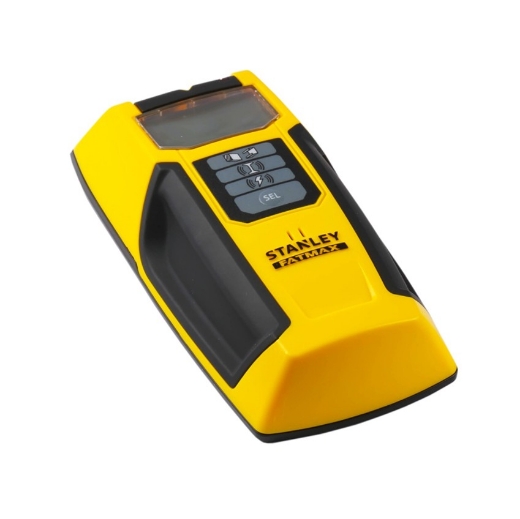
The Stanley® FatMax Material Detector is a digital measuring tool that helps you find what is hidden behind a wall, floor or ceiling. You hold the device against the surface and it measures on the spot whether something lies beneath the finish: wood, metal or a live cable. That way you know where you can safely work before you start drilling, sawing or nailing.
What it does and how it works
The detector measures changes in the material below the surface. For wooden studs and joists it responds to the difference in density between the timber and the hollow space next to it. Metal objects such as pipes, tubes and screws are picked up because they influence the measurement in a recognisable way. To find electrical cables, the device detects the alternating field that surrounds a live wire.
You move the device slowly across the surface; as soon as it finds something, it shows this on the display and usually with an audible signal. This lets you outline the edges of an object and pinpoint its centre, so you know exactly where you should and shouldn't drill.
What you use it for
The detector is handy for all kinds of jobs around the house where you work in a wall or floor:
- Wood — locating studs and joists in plasterboard walls and timber frames, for example to fix a cabinet or shelf securely;
- Metal — finding water pipes, heating pipes, nails and screws behind the finish;
- Electrical cables — tracing live wires so you can avoid them when drilling or sawing.
Practical use and how to choose
Place the detector flat against the surface and follow the calibration procedure: the device adjusts to the wall before you start measuring. Then move slowly and evenly, as sliding too fast can miss an object. Mark with a pencil wherever the device indicates something, and measure from several directions to be sure of the position.
Pay attention to the different measuring modes: choose the mode that matches what you are looking for (wood, metal or power) and keep the maximum detection depth in mind, which varies per material and per model. Always treat a detector as an aid that reduces risk, not as an absolute guarantee — work carefully if in doubt and, for electrics, call in a professional if needed.