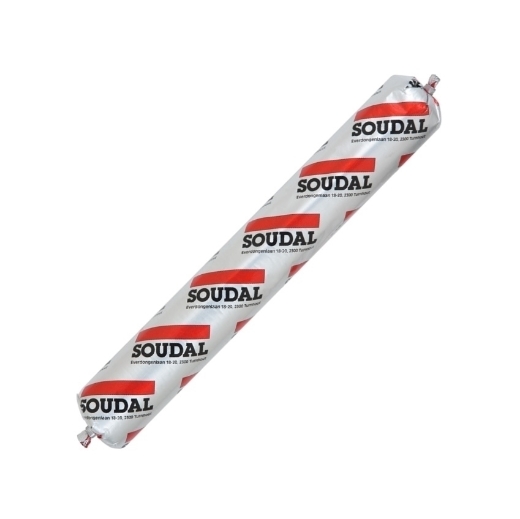
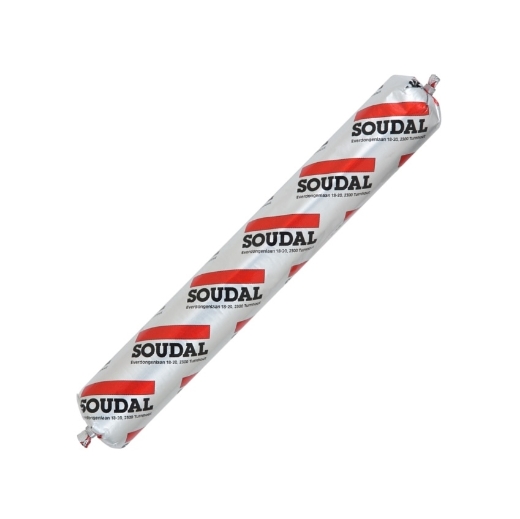
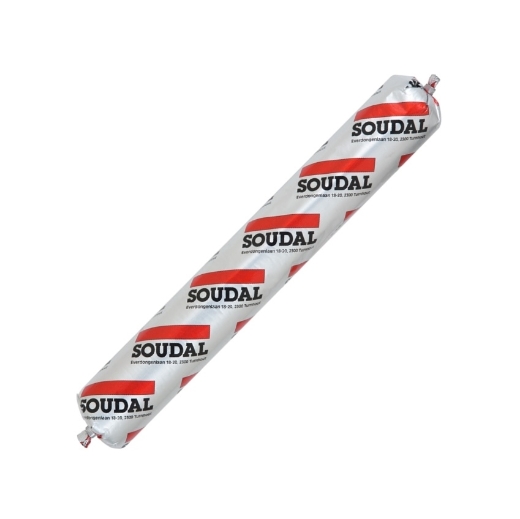
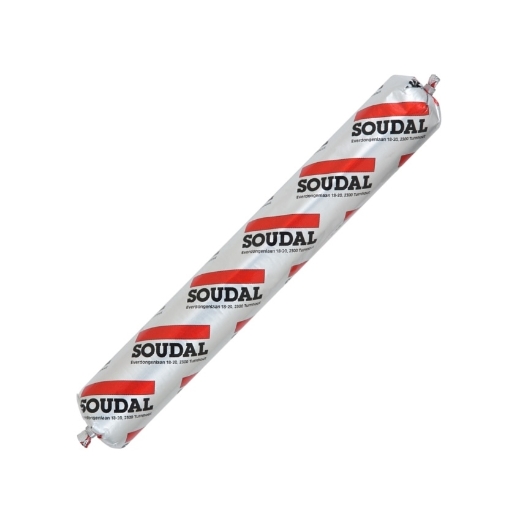
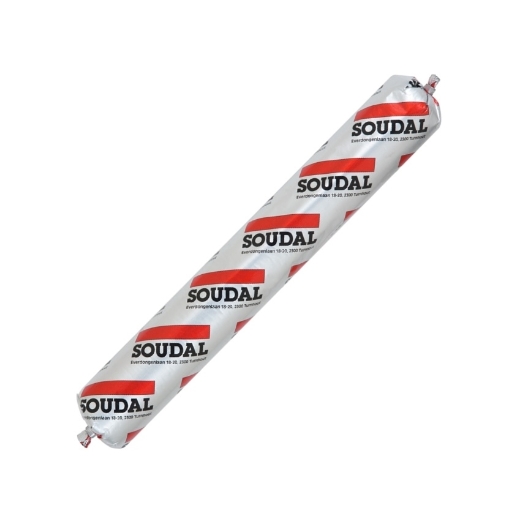
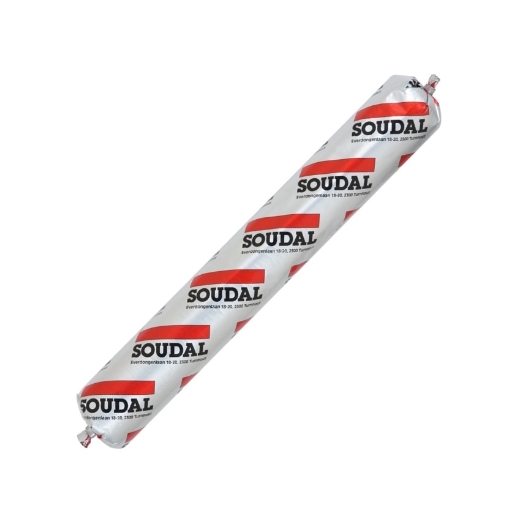
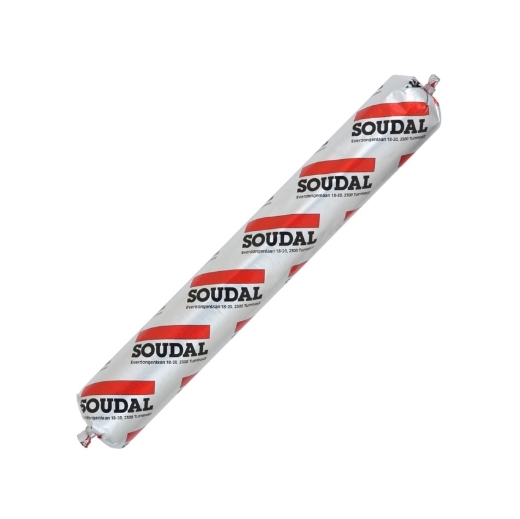
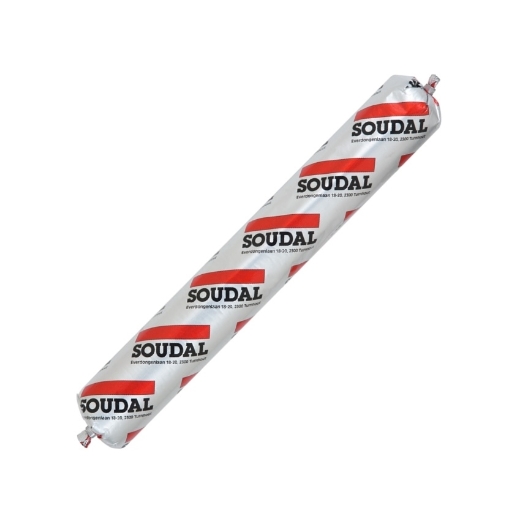
Soudaflex 20LM for floor joints and expansion joints in concrete. Floor joints in warehouses, car parks and industrial halls face three forces at once: moving traffic, thermal expansion and structural settlement. An ordinary sealant fails there, silicone sealants break under mechanical loading, sealants that are too rigid crack with movement. Soudaflex 20LM is a low-modulus PU joint sealant that combines movement, loading and outdoor conditions in a single product. Below you quickly select the right application and read how to build up the joint correctly for maximum service life.
Soudaflex 20LM, for which floor joint is it the right choice?
View the complete Soudaflex range: Soudal joint sealants range. For an overview of low vs. high modulus PU sealant and when to choose which: PU joint sealants comparison.
Expansion joints in industrial floors & warehouses
The most demanding application: expansion joints in concrete floors of warehouses, logistics halls and production facilities. These joints undergo daily traffic from forklifts and pallet trucks as well as thermal movement from temperature fluctuations in large unheated halls. Soudaflex 20LM is specially developed for this combination: elastic enough to absorb the thermal movement of concrete slabs, and mechanically strong enough to withstand point loads when traffic crosses the joint edge without edge crumbling. Joint width in industrial floors: typically 10–25mm. PE backer rod compulsory at joint depths above 10mm. Point to note: for heavy continuous traffic (more than 5 tonnes axle load) it is best to also consider a specialised floor sealant with a higher modulus such as Soudaflex 40FC.
Car parks, parking garages & outdoor floors
Car park floors combine traffic loading with outdoor conditions: frost, de-icing salts, rain and UV radiation. A joint sealant that fails here lets water infiltrate beneath the concrete slab, which causes reinforcement corrosion and frost damage. Soudaflex 20LM is weather and frost resistant and resistant to the chemical attack of de-icing salts. For outdoor car parks and parking garages with an open façade, UV resistance is extra relevant, check the technical data sheet for the specific UV behaviour under prolonged direct sun exposure. More on joint build-up and backer rod for outdoor floors: difference in joint fillers.
Connection joints concrete–wall & concrete–column
Connection joints between concrete floor and wall, or between floor slab and column, are a separate category: they must absorb movement in two directions, the floor expands and shrinks horizontally, the wall or column moves vertically with settlement. A standard joint sealant without movement reserve systematically cracks here. Soudaflex 20LM provides sufficient elasticity for this combined movement. Joint width at floor-wall connections: typically 10–20mm. Always use PE backer rod to avoid three-sided adhesion. More on three-sided adhesion and the consequences: the right joint width.
Correct joint build-up, PE backer rod & joint geometry
With floor joints the joint build-up is technically stricter than with façade joints: the joint geometry directly determines how long the sealant lasts under cyclic loading. Rules of thumb for floor joints: joint width at least equal to joint depth (ideal width: depth = 2:1), PE backer rod compulsory at joint depths above 10mm, choose a closed-cell PE profile that is moisture resistant and dimensionally stable. PE does not bond to the sealant, which mechanically rules out three-sided adhesion. Always clean the joint of cement laitance, dust and release agents before applying. With new concrete: wait at least 28 days for full carbonation before applying sealant. More: difference in joint fillers.
Joint build-up and application, how Soudaflex 20LM achieves its maximum service life
A low-modulus PU sealant only performs as well as the joint build-up beneath it. These are the steps and points of attention that make the difference between a joint that lasts 10 years and one that starts to fail after two winters.
- Concrete must be fully carbonated, wait 28 days: Fresh concrete contains alkaline moisture that is still migrating to the surface. Sealant applied to concrete younger than 28 days has a high chance of adhesion loss because the alkaline moisture attacks the sealant-concrete interface. The golden rule: wait at least 28 days after pouring the concrete floor before sealing the joints. If in doubt about the condition of the concrete surface: carry out an adhesion test on a small section before tackling the entire joint.
- Remove cement laitance and release agents completely: After formwork, concrete floors often have a cement laitance (thin layer of calcium hydroxide) that undermines adhesion. Remove this mechanically (grinding, blasting) or chemically. Release agents from the formwork phase are equally harmful, they make the concrete surface greasy and prevent any adhesion. Always degrease with Soudal Cleaner & Degreaser after mechanical cleaning. For porous or highly absorbent concrete: consider a primer that closes the porosity for better adhesion depth.
- PE backer rod: diameter, placement and depth check: Always use a closed-cell PE backer rod profile, this type does not absorb moisture and remains dimensionally stable. Choose a diameter about 25% larger than the joint width so the profile sits slightly compressed and does not shift during application. Check the depth of the backer rod over the entire joint length before you start applying: an uneven backer rod gives variable sealant depth, which becomes visible as convex-concave variations in the finished joint and creates stress at the thinnest points. More: difference in joint fillers.
- Joint geometry: width–depth ratio for floors: For floor joints the ideal ratio is width: depth = 2:1, so a joint 20mm wide gets a sealant layer 10mm deep. This is stricter than for façade joints (max ½×width) because floor joints also undergo vertical point loading. A sealant layer that is too thick cannot deform properly under traffic and builds up stress at the adhesion edges. A sealant layer that is too thin wears away faster at the surface. More background: the right joint width.
- Curing: minimum waiting time before loading: Soudaflex 20LM cures through air humidity (one-component). In a standard situation (20°C, 50% RH) the surface skin forms after 30–60 min and full cure is reached after 24–48 hours. At low temperature (<10°C) or dry air the cure slows significantly, then allow 48–72 hours for full cure. Wait at least 48 hours before loading the floor with traffic, even if the joint already appears cured at the surface. The core of deep joints is still active. For urgent return to service: two-component PU offers controlled accelerated curing, ask about availability.
- Tooling and the connection at the joint edge: Tool the joint immediately after application with a tooling spatula and a suitable tooling agent. With floor joints the joint edge, the corner between sealant surface and concrete floor, is a critical point: a sharp or concave joint edge concentrates wear under traffic. A slightly convex joint shape gives the best resistance to wear at the joint edge. Use HPX masking tape for crisp edges and remove the tape immediately after tooling. Do not leave tape in place until after curing, then it pulls the joint edge loose with it.
Frequently asked questions about Soudaflex 20LM and floor joints
Why not use silicone sealant in floor joints?
How long must Soudaflex 20LM cure before the floor can be loaded?
Do I always have to use PE backer rod, even with narrow floor joints?
Is Soudaflex 20LM suitable for outdoor car parks and parking garages?
When do I use Soudaflex 20LM and when Soudaflex 40FC?
How long do I wait after a fresh concrete floor before sealing the joints?
Posted by the Soudal sealant expert of DHZ-Proshop, your specialist in fastening materials, adhesives & silicones. Webshop available 24/7 & collection point in Beerse (province of Antwerp). Questions about the right floor joint sealant for your hall, car park or industrial floor? Contact our team.