What is changing in the AREI/RGIE for your home? The General Regulations on Electrical Installations (AREI/RGIE) received two important updates: new rules for bathrooms and damp spaces since 1 March 2025, and for the first time rules for direct current (solar panels, home batteries and charging stations) from 1 April 2026. Below you can read what this means in practice and when an inspection is mandatory.
Bathrooms and shower rooms: new rules since 1 March 2025
A royal decree, published on 28 October 2024, amended the chapter on rooms containing a bath or shower. The rules have applied since 1 March 2025 and revolve around safety volumes: zones around the bath and shower where stricter requirements apply the closer you get to the water.
- Fewer volumes: a bathroom now only has volume 0, 1 and 2. A separate shower room only has volume 0 and 1. The former volume 3 disappears from the AREI/RGIE.
- Volume 1bis falls under volume 1: the space beneath the bath or shower tray now belongs to volume 1, where stricter requirements apply.
- Finger-safe sockets: sockets must be at least finger-safe (protection rating IPXX-B, no access with a finger). Sockets up to 16 A and 250 V must achieve a rating of IPXX-D (no access with a 1 mm wire).
- Waterproofing matters: the closer to the water, the higher the required IP protection of appliances and lighting. Always have the correct zone classification determined by a professional.
Direct current: new from 1 April 2026
With the royal decree of 6 October 2025, the AREI/RGIE (Book 1) regulates direct current (DC) installations on low voltage and extra-low voltage for the first time from 1 April 2026. The reason is clear: solar panels, home batteries and charging stations work with direct current and were barely covered by the regulations until now.
- For whom? Anyone who has or installs a photovoltaic installation, a home battery or a charging station now falls under specific direct current rules.
- Earthing systems for DC: the regulations describe the earthing systems (TN, TT and IT) for direct current as well, so that installations are carried out uniformly and safely.
- Protection against electric shock: rules are being introduced for protection with direct current. Where smooth direct current can occur, a type B residual current device is recommended, because a standard residual current device does not reliably detect that fault current.
- Inspection follows suit: solar panels, batteries and charging stations also receive attention during the inspection of your installation.
When is an inspection mandatory?
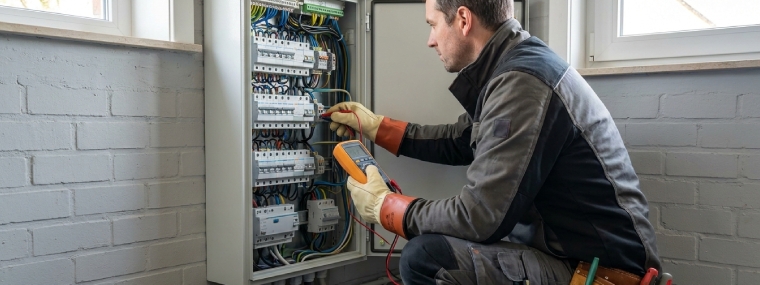
An electrical inspection checks whether your installation complies with the AREI/RGIE. It is carried out by an accredited inspection body.
- Periodic: a domestic installation is inspected every 25 years. For businesses and non-domestic installations this is every 5 years.
- On sale: when selling a residential unit, the seller must present a valid inspection certificate to the notary, even if the installation is rejected.
- After work or extension: a new installation or a significant modification must be inspected before it is put into use.
- Remedial period on rejection: for domestic installations dating from after 1981, a period of 12 months applies to remedy defects. For never-inspected installations dating from before 1981, on sale this is 18 months from the deed.
Frequently asked questions about the AREI/RGIE
What exactly is the AREI/RGIE?
What is changing in the bathroom since 1 March 2025?
What does the direct current change of 1 April 2026 involve?
Do I need a type B residual current device for my solar panels or charging station?
How often must my home be inspected?
May I work on my electrical installation myself?
Posted by the expert team at DHZ-Proshop, your specialist in fastening, tools and installation materials. Webshop available 24/7 and collection point in Beerse (province of Antwerp). This guide is informative: always have your installation checked by an accredited inspection body or professional electrician. Contact our team.