Which Bolt Will Not Rust on Your Outdoor Project? (A2 stainless, A4 stainless and hot-dip galvanized steel)
The only bolt guaranteed not to rust outdoors is one made from the right corrosion-resistant alloy for your environment. For general outdoor work, A2 stainless is the standard. Near the coast or around chlorine, A4 stainless is the one to use. For heavy steel structures, hot-dip galvanizing lasts longest. The trick is matching the material to the moisture, salt load and substrate.
Which bolt will not rust on your outdoor project? This guide walks through corrosion, the main bolt materials, and the hidden risk of galvanic reactions, so you can pick the right fastener for your deck, facade or structure. Browse our bolts for outdoor constructions at DHZ-Proshop.
The basics of corrosion and rust formation
Rust is the biggest enemy of any outdoor project. So what is it, exactly? Rust is an electrochemical reaction between iron, oxygen and water, and salt, acids and pollution all speed it up. Outdoors, bolts take constant punishment from rain, UV, temperature swings and dirty air. Without proper protection, any steel bolt will eventually oxidise, swell and damage everything around it.
That makes the right bolt a necessity, not a nicety. A rusting bolt loses its tensile strength, and the swelling rust can split timber, crack concrete and bleed ugly brown streaks down a facade or deck. There's no single bolt that suits every outdoor job: the environment, the substrate and the load all decide which alloy you need. The sections below take each material and use case in turn.
The most important bolt materials for outdoors
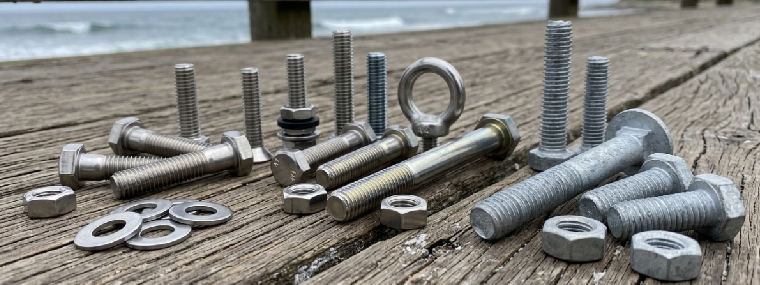
To work out which bolt won't rust, you need to know the materials and how each one protects itself. Every option has its own strengths and weak spots outdoors.
1. Bright steel (unprotected)
Bright steel bolts have no corrosion protection at all. They belong in dry, covered indoor spaces, or in jobs where the bolt ends up fully encased in concrete or another sealing mass. Never use bright steel outdoors unless the whole thing will be coated or maintained later. Leave it in the rain and it starts rusting within hours.
2. Electroplated zinc
Electroplating lays a very thin coat of zinc onto the bolt electrically. These bolts are cheap and shrug off light moisture, which makes them fine for dry interiors or temporary outdoor work. For anything permanent outdoors, though, the coating is far too thin: once it wears through or gets nicked, the steel underneath starts to rust. Keep it away from load-bearing structures and visible facades.
3. Hot-dip galvanized (HDG)
Hot-dip galvanizing is the heavy-duty option: the bolts are dunked in molten zinc at around 450°C, which forms a thick metallurgical bond between zinc and steel, 50 to 100 micrometres deep. These bolts take real weather and are the default for heavy steelwork, fencing, bridge railings and masts. The thick zinc slowly sacrifices itself to protect the steel, and even a scratch or knock leaves the surrounding zinc giving cathodic protection. The trade-offs are the rough, crystalline finish and a coating thick enough to clog the thread, which is why threads are often re-cut after galvanizing to keep the fit right.
4. Stainless steel A2 (AISI 304)
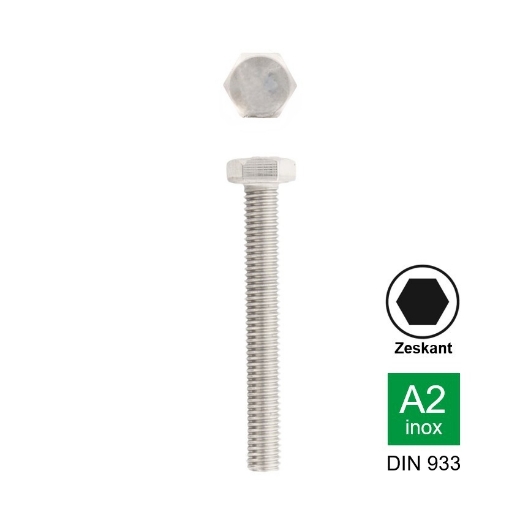
A2 stainless is the go-to for general outdoor work. The alloy runs at least 18% chromium and 8% nickel, and the chromium reacts with oxygen to grow an invisible, self-healing oxide layer; as long as there's oxygen around, that layer holds and the metal beneath stays protected. A2 is ideal for garden projects, wooden gates, facade cladding and everyday joinery, strong, good-looking and happy in normal rain and damp. What it won't handle is aggressive chemicals or heavy chloride exposure.
5. Stainless steel A4 (AISI 316)
Once conditions get harsher, A2 runs out of road. A4 stainless adds molybdenum to the chromium and nickel, usually around 2 to 3%, and that one element is what makes it stand up to chloride attack and pitting. A4 is the call for coastal projects, roadsides treated with de-icing salt, chemical settings, and poolsides full of chlorine vapour. If the job sits in salty sea air, A4 is the only safe bet for staying rust-free long term. For the right spec for your project, see the complete assortment of bolts and threaded rods in the webshop.
The influence of wood species on bolts
One factor people often overlook when choosing bolts is the wood itself. Wood holds moisture and contains natural chemicals that speed up corrosion, so any wood-and-metal connection needs a closer look before you pick a fastener.
Some species, oak, chestnut and afrormosia among them, are high in tannic acid. Once the wood gets wet, that acid leaches out, and inside a tight space like a screw hole it creates an acidic pocket that attacks the passive layer on stainless steel. The result is black staining around the fixing and a corroding bolt. For oak in particular, use A4 stainless, or better still a coated bolt sealed in a chemically resistant layer. Wood also moves: it swells in the wet and shrinks as it dries, and that constant movement slowly wears at a bolt's protective layer. On top of that, a bolt set into damp timber stays in a wet environment year-round, even when the surface feels bone dry, so the corrosion grade matters more than the weather suggests.
- European oak and chestnut: very high in tannic acid. Stick to A4 stainless or a coated bolt. A2 will stain the wood black and corrode over time.
- Western red cedar: acidic too, but gentler than oak. A2 usually holds up, though A4 buys you a safer margin.
- Pine and spruce: low in acid but soak up plenty of moisture. A2 is the standard pick here.
- Hardwood such as bangkirai: can hold iron deposits or stay damp for long spells. Use A2 or A4 to avoid staining and corrosion.
Galvanic corrosion: the invisible danger
Galvanic corrosion is one of the sneakiest ways a joint fails. It kicks in when two different metals touch in the presence of an electrolyte, water, rain or damp wood, and it can wreck even good stainless or aluminium. Put a stainless bolt through an aluminium plate, let water run across the joint, and you've built a tiny battery: the two metals sit at different points on the electrochemical series, and the less noble one, the aluminium here, starts dissolving. The bolt stays intact while the aluminium around it is eaten away. It can move surprisingly fast and end in a failed connection.
The first rule is to avoid pairing metals that sit far apart on the series. If you can't, isolate them properly, with plastic washers, EPDM washers, Teflon tape or a dedicated isolation paste to break the metal-to-metal contact. Keep water from pooling on the joint too, or design it so water drains away fast. A good seal, with quality sealant or a rubber ring, can be the difference between a joint that lasts decades and one that's gone after a single winter.
Frequently asked questions about bolts and corrosion
Can I use a galvanized bolt for my wooden deck?
What is the exact difference between stainless steel A2 and A4?
Why does my stainless steel bolt still turn brown?
How do I prevent my bolts from turning black in oak wood?
Can I use a stainless steel bolt in an aluminum profile?
Which bolt should I choose for a steel structure outdoors?
Posted by the fastening expert at DHZ-Proshop, your partner for bolts, nuts, threaded rods, and specialized fasteners for every environment. Webshop available 24/7 and pickup point in Beerse. Questions about corrosion resistance or the right bolt for your project? Contact our team or view our full range of bolts and fasteners for your next project.