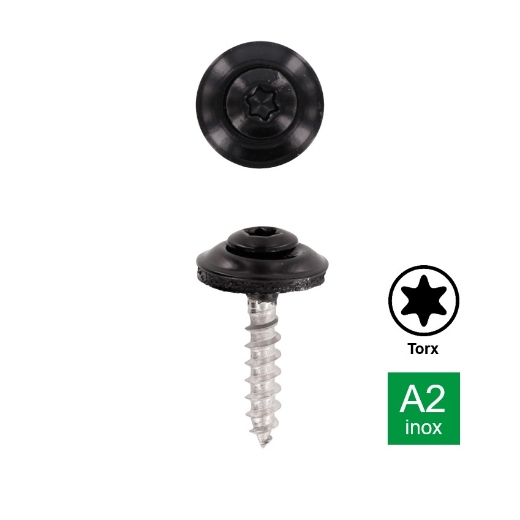
Choose your spengler screw in three checks: material, sealing ring and length. For roofing and zinc work you always fit a stainless steel A2 screw, because ordinary carbon steel starts streaking rust down a roof within one season. Every spengler screw in our range carries an EPDM sealing ring of Ø15mm under the head, which closes the fixing hole against driving rain. Length follows your roof build-up: add the sheet thickness, any insulation layer, and at least 20mm of thread engagement into solid timber. Get the length wrong and the head either sits proud of the sheet or barely reaches the batten, and both faults break the seal.
Which spengler screw fits your roof? Browse the full range in the spengler screws category at DHZ-Proshop, then work through the five fitting steps below.
- All spengler screws in our range are stainless steel A2 with a Torx TX20 drive, so corrosion from weather exposure is not a factor.
- The EPDM sealing ring under the countersunk head measures Ø15mm and closes the pilot hole; over-tightening flattens it and breaks the seal.
- Lengths run from 25mm up to 300mm; match the screw to sheet thickness plus insulation plus at least 20mm of thread engagement.
- Colour-matched heads (RAL 9005 black, RAL 7016 anthracite grey) keep visible fixings unobtrusive on coloured roof sheeting.
- None of these screws carry a pre-cut point, so pre-drilling with a multi-material bit is not optional, it is a required step.
Which Spengler Screw Length Matches Your Roof Build-up?
Match the screw length to what it has to pass through: sheet, insulation, and enough timber underneath to hold. The table below lists the lengths available in our range, all with the same Ø15mm EPDM sealing ring and Torx TX20 drive, so you only need to pick the right one for your job.
| Screw | Thickness / length range | Ideal for |
|---|---|---|
| 4.5x25mm Inox A2 | 4.1-5mm / 21-30mm | Sheet fixed straight into a thin batten, no insulation |
| 4.5x30mm Inox A2 | 4.1-5mm / 21-30mm | Slightly thicker battens or double-lapped sheet |
| 4.5x50mm Inox A2 | 4.1-5mm / 41-60mm | Sheet plus a thin counter-lath or first insulation layer |
| 4.5x60mm Inox A2 | 4.1-5mm / 41-60mm | Thicker timber substructure without insulation board |
| 4.5x70mm Inox A2 | 4.1-5mm / 61-80mm | Sheet fixed through a moderate insulation layer |
| 4.5x90mm Inox A2 | 4.1-5mm / 81-100mm | Thicker insulation boards on outbuildings or sheds |
| 4.5x100mm Inox A2 | 4.1-5mm / 81-100mm | Sandwich panels and thicker roof build-ups |
| 4.5x120mm Inox A2 | 4.1-5mm / 101-150mm | Thick insulation layers on industrial roofing |
| 5x300mm Inox A2 | 4.1-5mm / 201-300mm | Deep fixings through very thick insulation into structural timber |
| 4.5x25mm RAL 9005 Black | 4.1-5mm / 21-30mm | Visible fixings on black roofing or zinc work |
| 4.5x120mm RAL 7016 Anthracite | 4.1-5mm / 101-150mm | Visible fixings on anthracite grey roof sheeting with insulation |

Short: 25-30mm
Sheet fixed directly onto a batten with no insulation in between. One of our most chosen sizes for straightforward corrugated roofing.
Medium: 50-70mm
Sheet plus a counter-lath or a thin insulation board. This range covers most sheds, carports and lean-to roofs.
Long: 90-300mm
Thick insulation layers on industrial or agricultural roofs, right through to deep structural fixings at 300mm.
Colour-matched heads
RAL 9005 black or RAL 7016 anthracite grey heads blend into the sheet, so visible fixings do not stand out.
Step 1: Map Your Roof Build-up
Before picking any screw, list what it has to pass through, in order, from the top down. Note the sheet thickness, whether there is an insulation board, a counter-lath, and the material of the structure underneath: timber batten, purlin or steel frame. This list is what every later choice in this guide is built on.
Write the total down in millimetres. A corrugated steel sheet on a bare timber batten might add up to 20mm total, while a sandwich panel over 80mm of insulation on a purlin quickly reaches 100mm or more. Skipping this step is the single biggest reason spengler screws end up too short or too long.
Step 2: Choose Stainless Steel A2
For any roofing or zinc work exposed to weather, fit a stainless steel A2 spengler screw and nothing else. Zinc coatings on carbon steel wear through within a few seasons of rain and UV exposure, and once that happens rust streaks appear on the sheet below every screw head. Every spengler screw in our range is A2 by default, so this decision is already made for you.
A2 stainless also pairs correctly with a Torx TX20 drive head, which resists cam-out under an impact driver far better than a Phillips or slotted head. That matters more than it sounds: a stripped screw head on a roof means drilling it out from above, which is awkward and slow.
Step 3: Check the EPDM Sealing Ring
Every screw in this range carries an EPDM sealing ring of Ø15mm under a countersunk head, and that ring is what actually keeps water out of the fixing hole. EPDM rubber stays flexible in cold weather and resists UV ageing far longer than the cheaper washers found on generic screws, so it keeps sealing years after installation.
The ring only works if it is compressed evenly, not crushed. Drive the screw until the ring just flattens against the sheet and the head stops turning easily; stop there. Keep driving past that point and the ring splits at the edge, and a split ring lets water straight through the hole it was meant to close.
Step 4: Pick the Correct Screw Length
Add up the sheet thickness, any insulation layer, and at least 20mm of thread engagement into solid timber; that total is your minimum screw length. Round up to the next available length in the overview table above rather than down, since a screw that is a few millimetres short loses holding power fast in timber that flexes under wind load.
For steel purlins or thin metal substructures instead of timber, a shorter length with full thread contact through the metal usually holds better than a long screw with only a few threads engaged. When in doubt between two lengths, the longer one is the safer choice, because a screw sitting a little deep still seals; one sitting a little proud does not.
In our Beerse shop, roofers reach for the 4.5x25mm and 4.5x50mm EPDM-ringed screws for straightforward sheet fixing, and step up to the 90mm to 120mm lengths the moment an insulation layer gets added to the build-up.DHZ-Proshop vakteam, Beerse
Step 5: Pre-drill and Drive with Torx TX20
None of these screws carry a pre-cut point, so pre-drilling a pilot hole is a required step, not an optional one. Use a multi-material bit sized close to the screw's core diameter: the Irwin 5.5x95mm handles most sheet-and-batten combinations, while the longer Irwin 6x160mm reaches through thicker insulation and sandwich panels in one pass.
Drive the screw with a Torx TX20 bit at a moderate, steady speed, keeping the driver square to the sheet so the EPDM ring compresses evenly all the way around. Forcing the screw at an angle crushes one side of the ring before the other side has even sealed, and that uneven seal is where leaks start first.
Common Mistakes
- Fitting standard steel screws outdoors: the zinc coating wears through fast, and rust stains appear below every screw within a season.
- Over-tightening past the seal point: this flattens the EPDM ring past its working thickness and cracks it at the edge, letting water straight through.
- Skipping the pilot hole: these screws have no pre-cut point, so forcing them straight into sheet steel tears the sealing ring on the way through.
- Choosing a screw too short: less than 20mm of thread engagement in timber loosens under wind load and vibration over time.
Frequently Asked Questions
What screw do I need for a metal roof or zinc work?
Why do spengler screws have a rubber sealing ring?
What length spengler screw do I need for insulation panels?
Can I use spengler screws on wood or timber battens?
Why choose stainless steel A2 for roofing screws?
Do I need to pre-drill before fitting spengler screws?
Compiled by the trade team of DHZ-Proshop, your DIY and trade shop with a store and pickup point in Beerse. What we advise most often in the shop is to bring the sheet thickness and insulation depth with you, so we can hand you the right length off the shelf straight away. Questions about your roof build-up? Contact our team or browse the full spengler screws range.