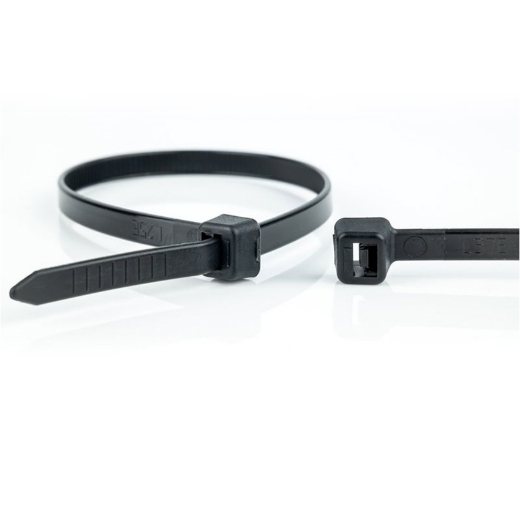
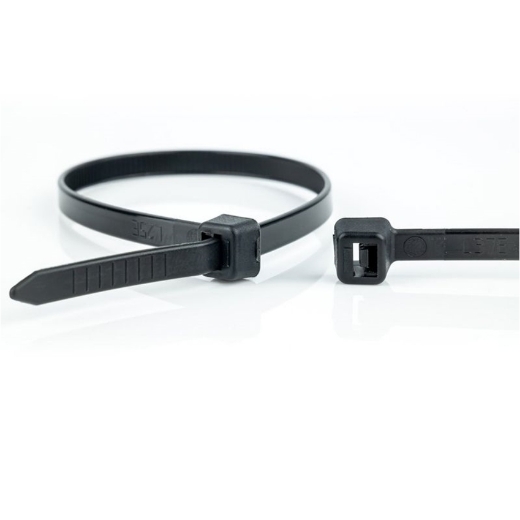
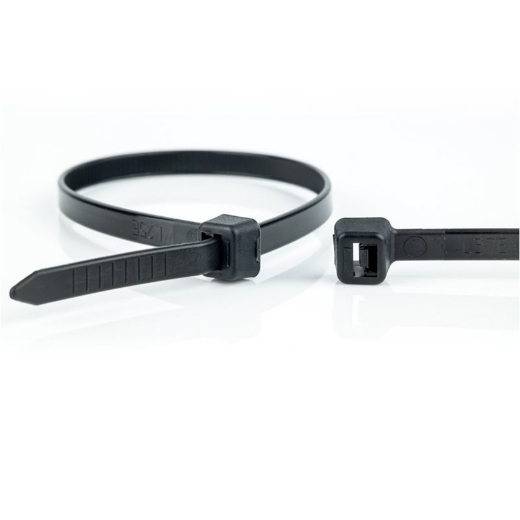
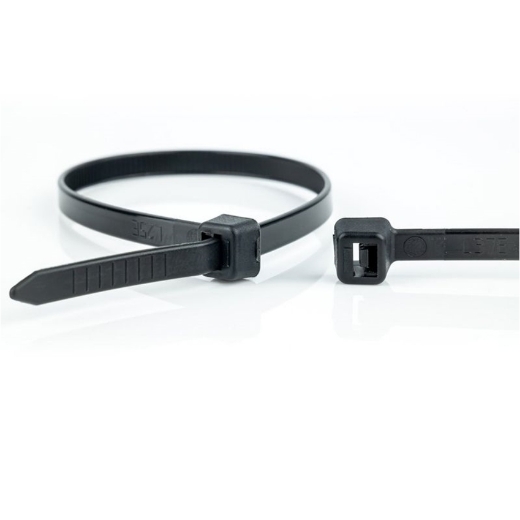
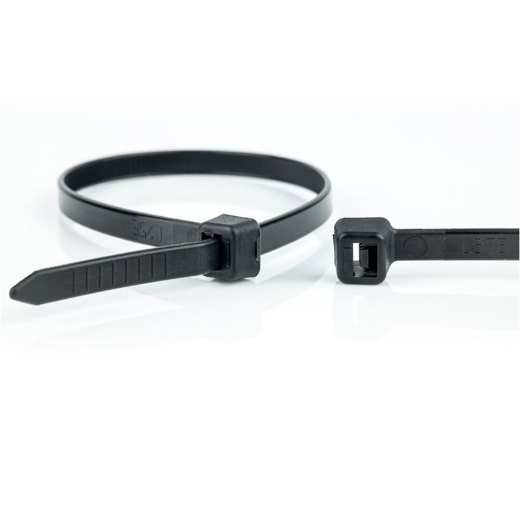
Choose your cable tie by width first, then match the length to whatever you are bundling. Thin wiring and light indoor cabling call for a narrow 2.4mm tie, while pipes, conduit and facade cable runs need a wide, heavy-duty tie such as the 13mm x 580mm nylon cable tie. Nearly every tie in this range is made from polyamide 6.6 (nylon), the standard material for everyday cable management. Our 4.8mm x 200mm nylon cable tie is one of our most chosen widths, strong enough for general-purpose bundling yet still easy to tension by hand. Width sets the tensile load a tie can hold; length sets the maximum bundle it can close around. Get either wrong and the tie either snaps under load or sits loose around the bundle.
Which cable tie is right for your job? Browse the full cable tie range (Stripbandjes) at DHZ-Proshop. This guide breaks our best-selling sizes down by width, length and intended use.
In het kort:
- Width sets the load: from 2.4mm for light wiring up to 13mm for heavy-duty pipe or facade bundling.
- Length sets the bundle size: match the tie length to roughly the outer circumference of what you're closing, not the diameter.
- Polyamide 6.6 (nylon) is the standard material across this range, chosen for its flexibility under tension.
- The 4.8mm x 200mm tie is one of our most chosen sizes for general-purpose bundling.
- For fixing cables to a wall or facade, pair a tie with a screw mount, adhesive mount or dedicated wall plug rather than driving a fastener through the tie itself.
Which cable tie width and length do I need?
The table below lists our core range of nylon cable ties by width, length and colour, together with what each size suits best. Use it to match a tie to cables, network wiring, pipe clusters or facade cable runs before you order.
| Cable tie | Width | Length | Colour | Ideal for |
|---|---|---|---|---|
| Standard cable tie 2.4 x 80mm | 2.4mm | 80mm | Black | Thin wiring, small electronics bundles |
| Standard cable tie 2.5 x 100mm | 2.5mm | 100mm | Black | Light household and office cabling |
| Standard cable tie 2.5 x 140mm | 2.5mm | 140mm | Black | Several thin cables bundled together |
| Standard cable tie 3.6 x 140mm | 3.6mm | 140mm | Black | Network cabling, medium bundles |
| Standard cable tie 3.6 x 200mm | 3.6mm | 200mm | Black | Larger cable bundles, garden hose tie-down |
| Standard cable tie 4.8 x 200mm | 4.8mm | 200mm | Black | General-purpose bundling, one of our most chosen sizes |
| Standard cable tie 7.6 x 300mm | 7.6mm | 300mm | Black | Heavy cable bundles, small conduit |
| Standard cable tie 9 x 430mm | 9mm | 430mm | Natural (transparent) | Large bundles, pipe clusters, conduit runs |
| Standard cable tie 13 x 580mm | 13mm | 580mm | Black | Heavy-duty bundling, large pipe runs, facade cable runs |

Thin wiring & electronics
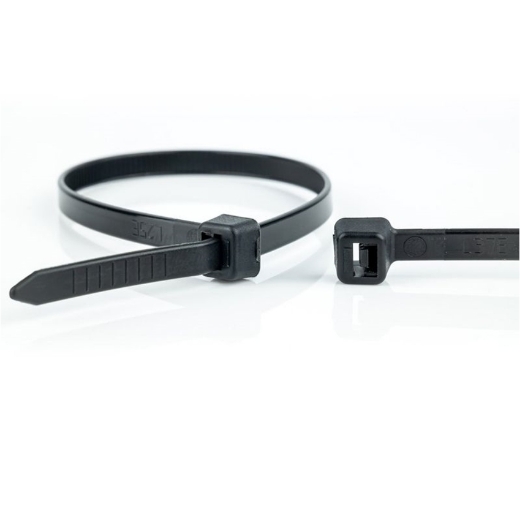
Bundling thin signal or low-voltage wiring? The 2.4mm x 80mm nylon cable tie is narrow enough to tension by hand without crushing delicate cores.
General-purpose bundling
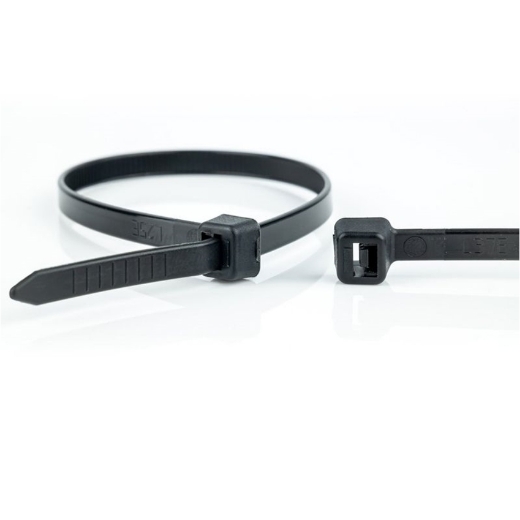
Not sure which width to pick? The 4.8mm x 200mm nylon cable tie is one of our most chosen sizes, wide enough for everyday cable runs and mixed bundles.
Heavy-duty & facade runs
For thick conduit, pipe clusters or a long facade cable run, the 13mm x 580mm nylon cable tie has the width and length for a proper hold.

Fixing to a wall or facade
Need to anchor a bundle to masonry rather than just close it? A screw mount for cable ties gives you a permanent fixing point on a wall or facade.
What material are these cable ties made from?
Every standard cable tie in this range is made from polyamide 6.6 (nylon), the standard material for indoor and general-purpose cable management. Nylon flexes as you pull it tight, then locks off once tensioned, holding the bundle without cutting into the cable jacket. Most sizes come in black; the 9mm x 430mm tie is supplied in a natural, transparent finish, useful where you want the tie itself to stay unobtrusive against light-coloured cabling or trunking.
Nylon's flexibility is also its limit. It is not steel, so it will stretch slightly under sustained heavy load and it is not designed to be re-tightened once the ratchet has locked. Pick the width for the job upfront rather than relying on over-tightening a thin tie to compensate.
How does width affect the load a cable tie can hold?
A wider cable tie holds a heavier load. Our range runs from a slim 2.4mm up to a heavy-duty 13mm, and that width is the main thing to check before you order, not the length. Thin cores need a thin tie so they don't get crushed; heavy conduit or a cluster of pipes needs the widest tie in the range to avoid the tie itself failing under tension.
As a rough guide: pick 2.4mm to 2.5mm for signal wiring and light household cabling, 3.6mm for network cabling and medium bundles, 4.8mm to 7.6mm for general-purpose and heavier indoor bundling, and 9mm to 13mm for pipe clusters, conduit or facade cable runs that carry real weight.
How do I pick the right cable tie length?
Match the tie length to the circumference of the bundle, not its diameter. Wrap a scrap piece of string or an old tie loosely around the cables or pipe first, measure that loop, then add a bit of slack for tensioning and for the tail that gets trimmed off. Lengths in this range span from 80mm for a handful of thin cables up to 580mm for a wide pipe cluster or a thick facade bundle.
Going too short leaves you unable to close the tie at all. Going too long is not a problem functionally, since the excess tail simply gets cut off, but it does waste material and leaves more to trim on every single tie. For repeat jobs of the same bundle size, it pays to settle on the closest length rather than always sizing up.
How do I fix a cable tie to a wall or facade?
A cable tie alone only closes a bundle; it does not anchor it to a surface. To fix cables or pipes against a wall or facade you pair the tie with a mounting base: an adhesive mount (plakzadel) for light indoor use on a smooth, clean surface, a screw mount (schroefzadel) where you need a permanent fixing through masonry or timber, or a dedicated wall plug for cable ties that anchors directly into a drilled hole for ties up to 9mm wide.
The adhesive mount is the fastest option but relies entirely on the surface and the bond holding; it is not the right choice for anything exposed to real weather load or vibration outdoors. For facade cable runs or anything permanent, drill and use the screw mount or the wall plug instead, then run the cable tie through the base rather than through a hole drilled in the tie itself.
In our Beerse store, customers fixing cables to a facade almost always leave with a screw mount or wall plug alongside their cable ties, not just the ties on their own. DHZ-Proshop vakteam, Beerse
Common mistakes
- Picking width by what's in the drawer, not by load: a 2.4mm tie on a heavy conduit bundle will snap; check the width against the job before ordering.
- Sizing length to diameter instead of circumference: a tie that looks "about right" against the bundle's width often comes up short once wrapped around it.
- Relying on adhesive mounts outdoors: a plakzadel is fine indoors on a clean surface, but weather and vibration will pull it loose on an exposed facade.
- Re-tensioning a locked tie: once the ratchet has set, forcing it tighter stresses the strap and is a common cause of ties failing later under load.
Browse the full cable tie range (Stripbandjes) to compare every width and length side by side.
Frequently asked questions about cable ties
Which cable tie width do I need for cables versus pipes?
How do I know what length cable tie I need?
Can I use a standard nylon cable tie outdoors on a facade?
What's the best way to fix a cable tie to a wall without damaging the cable?
What load can a cable tie hold?
What accessories do I need to mount a cable tie to a wall or facade?
Compiled by the DHZ-Proshop trade team, your DIY and trade supplier with a shop and collection point in Beerse. What we advise most often in-store is to check the width against the load before the length, since an undersized tie is the most common reason a bundle fails. Questions about picking the right cable tie for your job? Contact our team or browse the full cable tie range (Stripbandjes).